


Compliance Teams: AI+HUMAN Cookie Consent Translation for Audits

Valid cookie consent requires comprehensive translation of every visible consent string, linked cookie and privacy policies, automatic visitor language detection, and a human-reviewed translation workflow that maintains an audit trail. Skip any one of those elements and the consent you collect may not hold up as informed consent under GDPR, regardless of how polished the banner looks.
Table of Contents
What Should You Translate for Cookie Consent Compliance?
A cookie consent banner is only as valid as the weakest untranslated link behind it. Auditors don’t stop at the pop-up. They check whether the preference center, the policy pages, and the contact channels all match the language the visitor was shown.
Here’s the checklist to run before launch and again during every compliance audit:
Translate every visible banner string including the headline, body copy, and every button label such as “Accept,” “Reject,” and “Manage Preferences” to ensure consistency.
Translate the preference center comprehensively, including category names, descriptions, and individual cookie rows to maintain full language coverage.
Localize the linked cookie policy and privacy policy pages. Translating only the visible banner while leaving the linked policy in English breaks the informed-consent chain, and it’s one of the most common findings auditors flag.
Localize the “contact for privacy” or data-request link to ensure visitors can access data protection contact information in their preferred language.
Test each language live in private browsing sessions and clear consent cookies between tests to prevent masking of translation issues.
Map the consent model to the visitor’s actual region separately from language translation to ensure legal compliance of consent mechanics.
Treat this as a recurring QA pass, not a one-time launch task. Cookie vendors change, new tracking scripts get added, and each addition creates a fresh translation gap if nobody’s watching.
How Do You Detect Visitor Language for a Consent Banner?
Getting the right language in front of the right visitor is a sequencing problem before it’s a translation problem. Most consent platforms follow a predictable detection order, and getting that order wrong is why banners show the wrong language even when the translations themselves are correct.
Check the HTML lang attribute first. If the page has already declared its language for SEO or accessibility reasons, respect it. This is usually the most reliable signal because it reflects a deliberate publishing decision, not a guess.
Fall back to navigator.language. Browser language detection reads the visitor’s operating system or browser locale setting. Consent platforms including CookieFirst use this as a standard signal when no page-level language is declared.
Use URL path segments as a tiebreaker. A path like /fr/ or /de-de/ is a strong, unambiguous signal and should generally outrank browser locale when both are present.
Respect a saved user preference last. If a visitor already selected a language on a prior visit, that choice should override automatic detection on return visits.
Build in explicit overrides. A global JavaScript variable or a data-lang attribute on the script tag lets developers force a specific language regardless of detection, which matters for staging environments, embedded widgets, or region-locked microsites.
Store the actual translated strings in externalized JSON or i18n message files rather than hard-coding them into templates. Platforms such as c15t and Cookiepal structure translations this way specifically so category labels, cookie-table rows, and vendor lists all live in one editable, versioned object instead of scattered across template files.
Decide early whether detection happens server-side or client-side. Server-side rendering lets you serve the correct localized policy link before the page paints, which avoids a flash of the wrong language. Client-side detection is simpler to implement but can cause a visible language swap after page load, which looks unpolished and can complicate consent logging if the swap happens after a cookie is already set.
Plan for partial-language coverage. If your Portuguese translation exists for the banner but not yet for every cookie-table row, define a fallback (usually English or the site’s default language) rather than showing a blank string. Test placeholder rendering carefully. A string like {{cookieCount}} cookies stored needs to render correctly in every language, including ones with different word order or pluralization rules.
What Translation Workflow Keeps Consent Text Audit-Ready?
Machine translation can produce a usable first draft of consent text quickly, but legal-facing language carries real risk if it’s shipped without review. A single word swapped in translation, “reject” rendered as something closer to “decline temporarily,” for instance, changes what the visitor actually agreed to. That’s why native-speaker proofreading and subject-matter review matter more here than in ordinary marketing copy.
A specialized AI+HUMAN hybrid workflow is recommended for consent-critical, regulated text. The sequence runs in a fixed order:
Asset integration. Client Translation Memories ™ and Term Bases (TB) are ingested first, so “consent,” “opt-out,” and category names translate the same way every time they appear, across the banner, the preference center, and the linked policy.
LLM generation. A proprietary LLM-based system generates the target-language draft, constrained by that terminology and style guidance rather than translating each string in isolation.
Certified subject-matter expert review. A linguist with relevant domain background checks technical accuracy, regulatory phrasing, and contextual nuance, catching the kind of meaning-shifting error a purely automated pass would miss.
Quality assurance. QA aligned to ISO 17100 and ISO 18587 closes the loop, with sector-specific requirements layered in where relevant (MDR for medical device sites, for example).
That structure also produces the audit artifacts a compliance review will ask for: TM exports showing terminology consistency, reviewer sign-offs tied to specific document versions, version history across banner updates, and formal QA reports. Without those artifacts, a translated banner is just a claim. With them, it’s evidence.
Pro Tip: When drafting the LLM prompt for consent text, explicitly instruct the model to preserve all placeholders (like {{cookieName}}) and to avoid softening legal terms such as “reject” or “withdraw consent” into vaguer synonyms. A constrained prompt catches most drift before a human reviewer ever sees the draft.
Run a native legal check specifically on consent-critical phrases before publishing. “Consent,” “reject,” and “opt-out” carry precise legal weight, and a fluent but legally imprecise translation of any of the three can undermine the validity of consent collected through that banner.
Does Translated Text Alone Satisfy US and EU Consent Laws?
Translating the banner is necessary but not sufficient. Consent under GDPR is only valid if the visitor genuinely understands what they’re agreeing to, and understanding requires both the visible text and the linked policy to be in the visitor’s language. That’s the legal definition of informed consent in practice: comprehension, not just translation.
The United States complicates this further because there’s no single federal cookie-consent law equivalent to GDPR. Instead, state laws like California’s CCPA/CPRA impose disclosure and opt-out requirements that differ meaningfully from the EU’s opt-in model. A banner that says “We use cookies” and lets tracking scripts fire before any click is often acceptable under a US opt-out framework. The same banner would violate GDPR if shown to an EU visitor, regardless of how well it’s translated.
That split creates a rule compliance teams often miss: translating the text and adapting the consent model are two separate jobs, and both have to be correct. A French-language banner that still runs scripts before consent is not GDPR-compliant just because the words are in French. Conversely, a technically correct opt-in flow shown in English to a Spanish-speaking visitor may fail the “informed” test even if the underlying consent mechanism is sound.
Practical rules for compliance teams building this out:
Translate all visible and linked consent text into every language your visitor base actually uses.
Set the consent model by visitor region, not by site language. Language and jurisdiction are not the same variable.
Apply opt-in defaults (no tracking before affirmative consent) for GDPR-covered visitors.
Apply opt-out/disclosure models where US state law permits it, while still providing the required notice and opt-out mechanism.
Route final consent-related phrasing, especially anything describing data processing purposes or legal basis, through legal review before it ships, not after a complaint arrives.
None of this is a substitute for jurisdiction-specific legal advice, but the operational pattern holds across most regulated markets: match language to the visitor, match consent mechanics to the region, and don’t assume one fixes the other.
Real-World Patterns for Multilingual Consent Banners
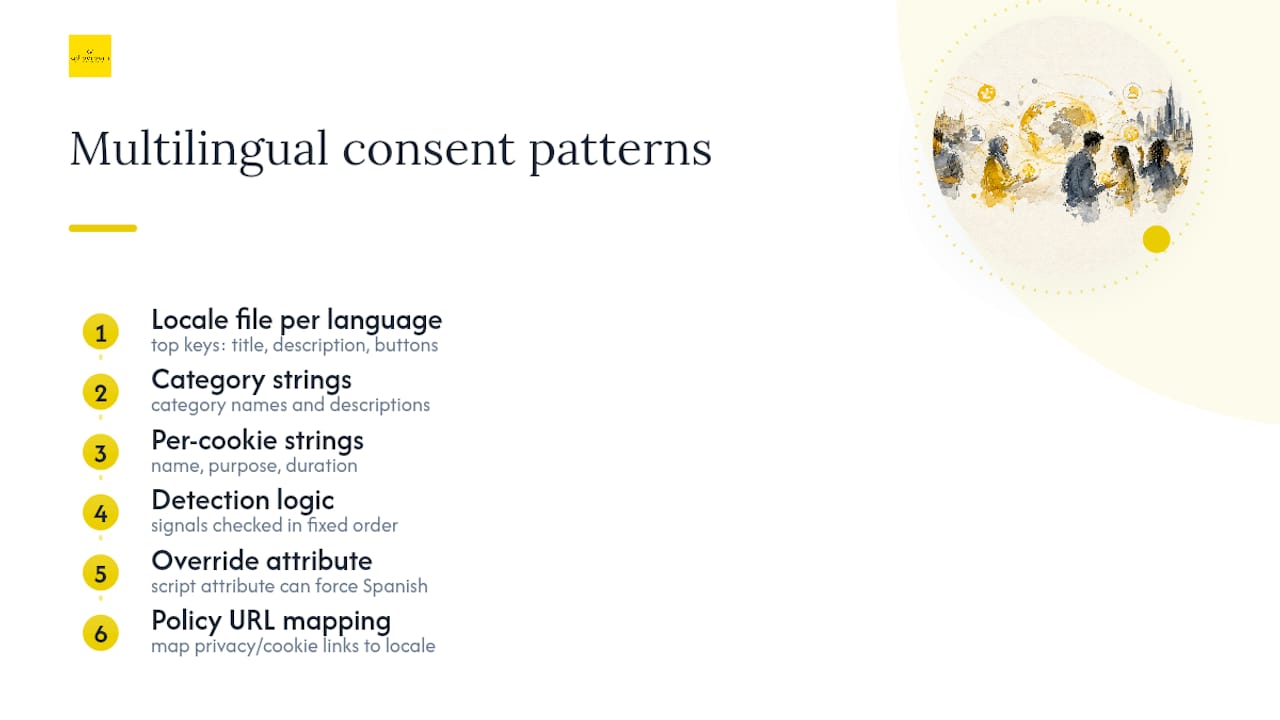
A working i18n structure keeps banner text, preference labels, and cookie-table rows in one file per locale rather than scattered across templates. A typical shape includes top-level keys for banner (title, description, buttons), preferences (category names and descriptions), and cookieTable (per-cookie name, purpose, and duration strings), mirrored identically across every supported locale file so nothing gets orphaned in one language and missed in another.
Detection logic generally checks signals in a fixed order and allows an explicit override for edge cases like staging environments or embedded widgets on partner sites. A data-lang="es" attribute on the consent script, for instance, forces Spanish regardless of what the browser or URL path suggests, which is useful when a subdomain serves a specific regional audience by design.
Localized policy URLs need their own mapping so the “Privacy Policy” and “Cookie Policy” links inside the preference center point to the correct language version rather than defaulting to the English original. The table below shows a simplified mapping pattern many implementations follow.
Notice that the consent model column doesn’t just mirror the language column. That’s deliberate. A Spanish-language banner served to a visitor in Texas would still use a disclosure/opt-out model, while the same Spanish banner served to a visitor in Madrid uses opt-in. The locale code drives translation; the visitor’s actual region drives the legal mechanics.
Why Do Cookie Consent Translations Fail Audits?
Three failure patterns show up repeatedly in compliance reviews, and all three are preventable with the right checks built into the release process.
Partial translation. Some strings get translated, others don’t, usually because a new cookie vendor or tracking category got added after the last translation pass. Fix it by running TM coverage reports before every release and flagging any key that exists in the default locale but not in the target locale.
Wrong consent model for the region. The banner is in the right language but applies opt-out logic to GDPR-covered visitors, or blocks nothing before consent is captured. Fix it with geotargeting rules tied to IP or account region, and verify that tracking scripts are actually blocked pre-consent, not just visually hidden.
Hardcoded strings. A developer bypasses the i18n file to ship a quick fix, and that string never makes it into any translation cycle. Fix it with a code search for hardcoded consent-related text as a standing item in dev QA checklists, and route every new string through the same TM pipeline as the rest.
Pro Tip: Run a raw machine-translation output through SME review even when it looks fluent. Fluency and legal accuracy are different qualities, and a mistranslated “reject” button is invisible to anyone who doesn’t read the target language closely.
Key Takeaways: A 30 to 90 Day Action Plan
Three priorities matter more than the rest: translate everything, including linked policies and hidden preference-center strings; align the consent model to visitor region, not site language; and enforce human-reviewed QA on any text that touches legal meaning.
Quick wins to implement in the next 30 days:
Enable automatic language detection using HTML lang, browser locale, and URL path, in that priority order.
Add translated policy links inside the preference center for every supported locale.
Test each language in a private browsing window and clear consent cookies between tests.
If your site handles regulated content (health data, financial disclosures, legal terms) or faces a compliance audit within the next two quarters, that’s the point to bring in a specialist rather than manage the translation pipeline internally.
Where a Managed Translation Provider Fits In
Hiring a managed provider makes sense once the text touches regulated content, needs a documented audit trail, or carries terminology that a general translator won’t get right on the first pass. Internal teams can usually handle a simple two-language banner. Complex, multi-jurisdiction consent flows with dozens of cookie categories are a different problem.
Consent-related translation work can run through an AI+HUMAN hybrid workflow with aligned QA, certified infrastructure, and use of Translation Memories and Term Bases to maintain consistency across assets. For a consent-translation engagement specifically, the ask to bring to a provider should include: a localized banner and preference center, localized linked policies, a TM/TB handoff for future updates, and a defined QA sign-off scope.
AD VERBUM Editorial Perspective on Consent Translation
Most guidance on this topic treats translation as a checkbox: get the banner into the right languages and move on. That’s backwards. The translation is the easy half of the problem. The harder half, matching consent mechanics to region while keeping terminology consistent across a banner, a preference center, and a linked policy that might run to fifteen pages, is where most implementations quietly fail.
The uncomfortable truth is that a lot of “compliant” multilingual banners are compliant in exactly one language and decorative in every other. Nobody audits the German version until a German regulator asks. That’s not a technical failure. It’s a process failure, because nobody built terminology governance or coverage reporting into the release cycle.
The fix isn’t more automation. Raw machine translation actually makes this worse at scale, because it can produce fluent, confident-sounding text that quietly changes what “reject” or “necessary cookies” means in the target language. The fix is treating consent text with the same rigor a contract gets: version control, terminology consistency, named reviewers, and a QA sign-off that someone can point to when a regulator asks how a translation was produced.
— Eric Brown
Get Audit-Ready Consent Translations From AD VERBUM
A general translation vendor can hand you fluent text. It’s a different thing to get a translated consent banner and policy pair with a documented review trail behind it, terminology enforced through a shared glossary, and infrastructure that keeps client data off public cloud tooling. That’s the gap AD VERBUM’s AI+HUMAN hybrid workflow was built to close for regulated, high-stakes content.
AD VERBUM’s translation and localization services run consent text and linked policies through the same pipeline: Translation Memory and Term Base integration for terminology consistency, LLM-generated drafts constrained by that terminology, certified subject-matter expert review, and QA aligned to ISO 17100 and ISO 18587. The whole system runs on EU-hosted infrastructure under ISO 27001, so consent data and translation assets stay off public cloud tooling.
If you’re preparing a multilingual consent rollout or an audit response, the concrete deliverable to request is a localized banner and preference center, localized cookie and privacy policies, a TM/TB handoff for future maintenance, and QA sign-off documentation. Start that conversation on the AD VERBUM translation services page.
Sources
FAQ
What Does Cookie Consent Mean?
Cookie consent is the process of getting a visitor’s explicit or informed permission before storing or accessing cookies on their device. That consent is only valid if the visitor actually understands what they’re agreeing to, which is exactly why the banner and its linked policy both need to be in the visitor’s own language.
Does the US Require Cookie Consent?
There’s no single federal cookie-consent law in the United States. Several state laws, including California’s CCPA/CPRA, require disclosure and an opt-out mechanism, which is a lighter operational bar than the EU’s opt-in model but still requires translated, accurate consent text for non-English speaking visitors.
What Does It Mean to Consent to the Use of Cookies?
Consenting to cookies means agreeing to let a site store data on your device or access data already stored there, typically for purposes like analytics, advertising, or site functionality. Valid consent requires that the visitor understood the categories of cookies and their purpose before agreeing, which is why translating only the banner and not the underlying cookie policy breaks that chain.
How Do I Know if My Cookie Consent Translation Is Audit-Ready?
Check for three things: full translation coverage across the banner, preference center, and linked policies with no untranslated keys; a consent model matched to visitor region rather than just site language; and documented review artifacts such as TM exports and QA sign-offs. Providers using an AI+HUMAN hybrid workflow with ISO-aligned QA, such as AD VERBUM, typically produce these artifacts as a standard part of the engagement.
Should I Use Machine Translation for Cookie Consent Text?
Machine translation can produce a usable first draft quickly, but it shouldn’t ship without review on consent-critical text. A native-speaker proofread and subject-matter review catches meaning-shifting errors in words like “consent” or “reject” that a purely automated pass often misses.
Recommended

