IRB Ready in 30 Days: Informed Consent Translation Workflow
- 15 hours ago
- 13 min read

U.S. federal regulations require that consent information be presented in a language understandable to the subject, but neither the Common Rule nor FDA regulations mandate a specific certification method for translation. In practice, this means providing an IRB-approved translated long-form consent when non-English speakers are anticipated, reserving the short-form oral process for unanticipated cases only, and documenting the translation method, translator qualifications, and any interpreter or witness involved.
TL;DR:
Translating the full long-form consent before enrollment is essential when non-English speakers are anticipated or when the study involves higher risks or invasive procedures.
The translation process must be documented with a certificate of translation, reviewer qualifications, and QA logs to satisfy IRB and regulatory standards.
Using untrained interpreters or translating before locking the English version are common failure modes that compromise compliance and subject understanding.
Back-translation alone does not prove comprehension; cognitive interviews and pilot testing are best practices for higher-risk or low-literacy populations.
Technology tools should assist only in drafting, with qualified human review and strict version control being critical to meeting “understandable” standards.
Table of Contents
What Informed Consent Translation Requirements Actually Cover
“Translation requirements” for human subjects research spans a specific set of documents and two distinct language services that IRBs treat differently.
The long-form Informed Consent Form (ICF) is the primary document at issue, but it is not the only one. Several other materials often need the same scrutiny:
The full long-form ICF, including all appendices and signature pages
The short-form written consent document used alongside an oral summary
HIPAA authorization language, when bundled with or separate from the ICF
Participant safety instructions, such as drug administration guides or device handling cards
Recruitment materials, when they contain risk or eligibility language subject to IRB review
Written translation converts fixed text into another language for reading and signature; interpretation is the real-time spoken rendering of a conversation, typically used during the actual consent discussion. A study may need both. Materials that describe general study logistics, such as parking instructions or facility maps, usually fall outside the translation requirements for research policy that governs safety critical and consent documents.
The Regulatory Basis: Common Rule, FDA, and the “Understandable” Standard
The operative legal standard sits in two places: 45 CFR §46.116/117 under the Common Rule, and 21 CFR §50.20/50.27 under FDA regulations. Both require that informed consent be provided in language “understandable to the subject.” Neither regulation names a certified translator, a specific credential, or a required QA methodology.
That gap is intentional. OHRP guidance interprets the standard functionally: what matters is whether the subject actually understood the information, not which vendor stamped the document. The OHRP guidance on non-English speakers makes this explicit.
FDA guidance goes a step further operationally. The agency’s informed consent guidance for IRBs, clinical investigators, and sponsors recommends that investigators submit translated consent documents to the IRB before enrollment begins whenever non-English speaking participants are anticipated, and recommends that IRBs evaluate the process used to produce the translation, not just the finished text.
The certificate is a proxy, not the law. A certificate of translation or a forward-and-back translation report is how most IRBs demonstrate that the “understandable” standard was met. It is a practical compliance tool an IRB relies on for its own file, not a separate statutory obligation created by 45 CFR or 21 CFR. Advarra’s review of why IRBs ask for certified translations makes the same point: reviewers care about the reliability of the process behind the translation, not the certificate as a document in isolation.
When to Translate the Full Consent vs. Use the Short Form
The default method is a full translated long-form ICF. The short form is an exception, not a routine alternative, and using it as a substitute for planning invites IRB scrutiny.
Translate the full long-form consent when enrollment is anticipated. If your protocol expects even one or two participants who speak a particular language, translate the long form for that language before the study opens. This is the preferred method under OHRP’s non-English speaker guidance.
Translate the full long-form consent when the study exceeds minimal risk. Higher-risk protocols, drug trials, and invasive procedures raise the bar; IRBs are far less tolerant of an oral summary standing in for a written document a subject can review afterward.
Reserve the short-form oral process for unanticipated, one-off enrollments. Some institutions cap how often you can rely on it. UCSF’s policy limits short form use to two enrollments per language before requiring a full translation.
Translate promptly after a short-form encounter. Institutional practice generally expects the long form to be translated afterward, often within 30 days, so future enrollments in that language use the proper document.
The Translation Workflow and IRB Submission Package
A clean translation workflow maps directly onto what an IRB expects to see in the submission file. Skipping a step in production usually means scrambling to produce a document later.
Start by locking the English source. The consent form should be in its final, IRB-approved state before translation begins. Translating against a draft that later changes forces a second round of translation, a second certificate, and a second IRB amendment. This is the single most common source of avoidable rework in multi-language studies.
Once the English is locked, the workflow runs through four stages that also happen to be the four things an IRB will ask to see:
Forward translation by a qualified linguist with subject-matter familiarity in clinical or regulatory language, mapped to a translator qualification record the IRB can review.
Independent quality check, typically forward-and-back translation or an equivalent second-linguist review, required by many IRBs for greater-than-minimal-risk studies, as reflected in Northwestern’s consent translation guidance.
SME review for technical accuracy in dosing, device use, or risk disclosure language, especially for documents flagged as affecting participant safety under policies like Duke’s translation requirements for research.
Certificate or attestation of translation, naming the translator, the method used, and the date, submitted alongside the translated document itself.
Pro Tip: Build the certificate template before you need it. A standing template with fields for translator credentials, method (forward-only vs. forward-and-back), and reviewer sign-off turns a multi-day scramble into a same-day submission every time a new language is added.
Feed prior approved translations into a Translation Memory and Term Base rather than starting from scratch each time. Consistent terminology across amendments and future studies reduces both translation cost and the odds an IRB flags inconsistent phrasing between related documents.
Signatures, Witnesses, and Interpreter Documentation
Who signs what depends on which consent method was used, and IRBs check this closely during audit.
For a translated long-form consent, the subject signs the translated document directly, and the person obtaining consent signs as well. No witness is required by regulation, though some IRBs require one for higher-risk studies as a local policy matter.
For a short-form process, the signature matrix changes:
The subject signs the short-form document in their own language.
A witness to the oral presentation signs, attesting the summary was accurately conveyed.
The person obtaining consent signs the English long-form summary that was read aloud.
Interpreters need documented qualifications, and this is where audits most often find gaps. OHRP guidance cautions against using family members or untrained bilingual staff as interpreters, since they may lack medical terminology and can introduce coercion or bias into a process meant to be neutral. An interpreter can serve as the witness in many institutional policies, provided their qualifications are on file. Keep a record for every interpreter and witness: full name, institutional affiliation, language pair, qualification or certification, and the date of service. Electronic consent platforms that handle e-signature workflows, like the guidance covered in BeeSign’s overview of consent e-signature steps, can help structure this recordkeeping consistently across sites.
Common Failure Modes and How to Fix Them
Three failure patterns account for most of the translation problems IRBs flag during review.
Untrained interpreters. Using a family member or a bilingual staffer with no interpreter training is a recurring citation. Fix: require a documented interpreter qualification or professional attestation on file before the consent conversation happens, not after.
Translating before the English is final. Locking translation to a draft that later changes creates duplicate work and duplicate certificates. Fix: freeze the English version, then use tracked addenda for minor post-approval edits instead of retranslating the whole document.
Missing certificate or inconsistent QA. Submissions without a certificate of translation, or with no record of who reviewed the translation, slow down IRB approval. Fix: use a standard certificate template and a submission checklist every time, regardless of study size.
Pro Tip: Treat the translation certificate the same way you treat a signed protocol amendment: no submission goes to the IRB without it attached, full stop.
How AD VERBUM’s Workflow Maps to IRB Expectations
AD VERBUM structures its AI+HUMAN hybrid translation process around the same evidence trail IRBs already ask for. Client Translation Memories and Term Bases are integrated first, so terminology stays consistent across a consent form and its amendments. A proprietary LLM-based system then generates draft output constrained by that terminology, followed by review from a certified subject-matter expert linguist for technical accuracy and regulatory nuance. Quality assurance aligns to ISO 17100 and ISO 18587.
This structure fits studies where the stakes for getting it wrong are highest: greater-than-minimal-risk protocols, multi-site trials with several target languages, or sponsors facing an IRB that requires a documented forward-and-back translation process rather than a single-pass rendering.
Documentation that supports an IRB submission package includes:
A certificate of translation naming the method used and the linguist’s qualifications
Records tying each translation to a subject-matter expert reviewer
QA logs aligned to ISO 17100/18587 standards
Version-controlled TM/TB integration that keeps terminology consistent across amendments
Teams managing multilingual clinical trial translation risks across EU sites face this exact documentation burden multiplied across languages and locations simultaneously.
Action Checklist Before Your Next Submission
Finalize the English consent form before any translation work begins.
Identify every anticipated non-English language now, not at enrollment.
Confirm your QA method (forward-only or forward-and-back) matches the study’s risk level.
Assemble the IRB package: translated document, certificate, translator qualifications, interpreter records.
Set a 30-day translation deadline if a short form gets used unexpectedly.
Cultural and Linguistic Adaptation Beyond Word-for-Word Translation
A grammatically correct translation can still fail the “understandable” standard. Concepts like randomization, placebo, or the right to withdraw without penalty do not always have a direct equivalent in another language or culture, and a literal rendering can leave a subject with a technically accurate but practically meaningless sentence.
Readability matters as much as accuracy. Consent forms written at a college reading level in English do not automatically simplify when translated; a skilled translator adjusts sentence structure and vocabulary for the target population’s typical literacy level, not just the target language. Regional dialect matters too: Spanish spoken in Mexico differs from Spanish spoken in Spain in ways that affect medical terminology, and a translation calibrated for the wrong regional variant can confuse rather than clarify.
Northwestern’s guidance on IRB review of international research notes that cultural and readability testing needs to sit alongside linguistic accuracy checks, because literal translation alone can fail to convey complex risk concepts or autonomy language like the right to withdraw.
Cultural context also shapes how risk and consent are perceived. In some cultures, family or community involvement in medical decisions is the norm, and a consent process built entirely around individual autonomy can create friction that has nothing to do with translation quality and everything to do with how the interaction is framed. IRBs reviewing international or diverse-population studies increasingly expect protocols to address this directly, not just hand a translated form to the subject and call it done.
Validating Translations Beyond Back-Translation
Forward-and-back translation catches a meaningful share of errors, but it is a linguistic check, not a comprehension check. A back-translation can render perfectly in English while the target-language version still confuses the actual reader.
Cognitive interviewing closes that gap. A small number of target-population participants read the translated consent form and then explain, in their own words, what specific sections mean. This surfaces comprehension failures that a linguist reviewing text on a page would never catch, particularly around abstract concepts like statistical risk or data confidentiality.

Pilot testing with a handful of representative subjects before full rollout serves a similar function at a slightly larger scale, and it can reveal formatting issues too, such as translated text that runs too long for a layout designed around English sentence length.
Neither method is required by regulation. Both are increasingly treated as best practice for higher-risk studies or for populations with historically low health literacy, where a technically accurate translation that nobody actually understands defeats the purpose of the consent process entirely. IRBs reviewing studies in these populations are more likely to ask what validation, if any, went beyond a certificate and a back-translation report.
Legal Liability When Translations Go Wrong
An inadequate translation is not a paperwork problem. It goes to the legal validity of the consent itself. If a subject did not actually understand what they agreed to, the consent obtained may not hold up as valid, which exposes the sponsor and the institution to liability that has nothing to do with the underlying medical intervention.
Adverse event litigation frequently probes exactly this: whether the subject understood the risks disclosed, in a language they could genuinely follow. A poorly translated consent form becomes a liability exhibit rather than a protective one, and it can undermine an otherwise defensible study.
Regulatory exposure runs alongside legal exposure. An FDA inspection or an OHRP compliance review that finds translated consent documents were never submitted for IRB review, or that an interpreter’s qualifications were never documented, can result in findings that delay a trial or jeopardize data integrity determinations for the affected sites. The fix is not complicated, but it does need to happen before enrollment starts: document the translation method, the translator’s qualifications, and the interpreter or witness identity for every non-English encounter, every time.
Managing Amendments to Consent Forms and Their Translations
Every amendment to an English consent form creates a translation obligation in every language that form already exists in. This is where version control either saves a study real time or costs it real time.
Treat each translated version as tied to a specific English version number, not as a standalone document. When the English form changes, even for a minor edit like an updated contact number, the IRB and the translation record should show exactly which translated versions are now out of date and need updating.
Minor administrative changes, such as a study coordinator’s phone number, often do not require a full retranslation and re-certification cycle; an addendum in the affected language can suffice if institutional policy allows it. Substantive changes, such as a new risk disclosure or a modified procedure, do require full retranslation and a fresh certificate, because the “understandable” standard applies to the amended content just as it applied to the original.
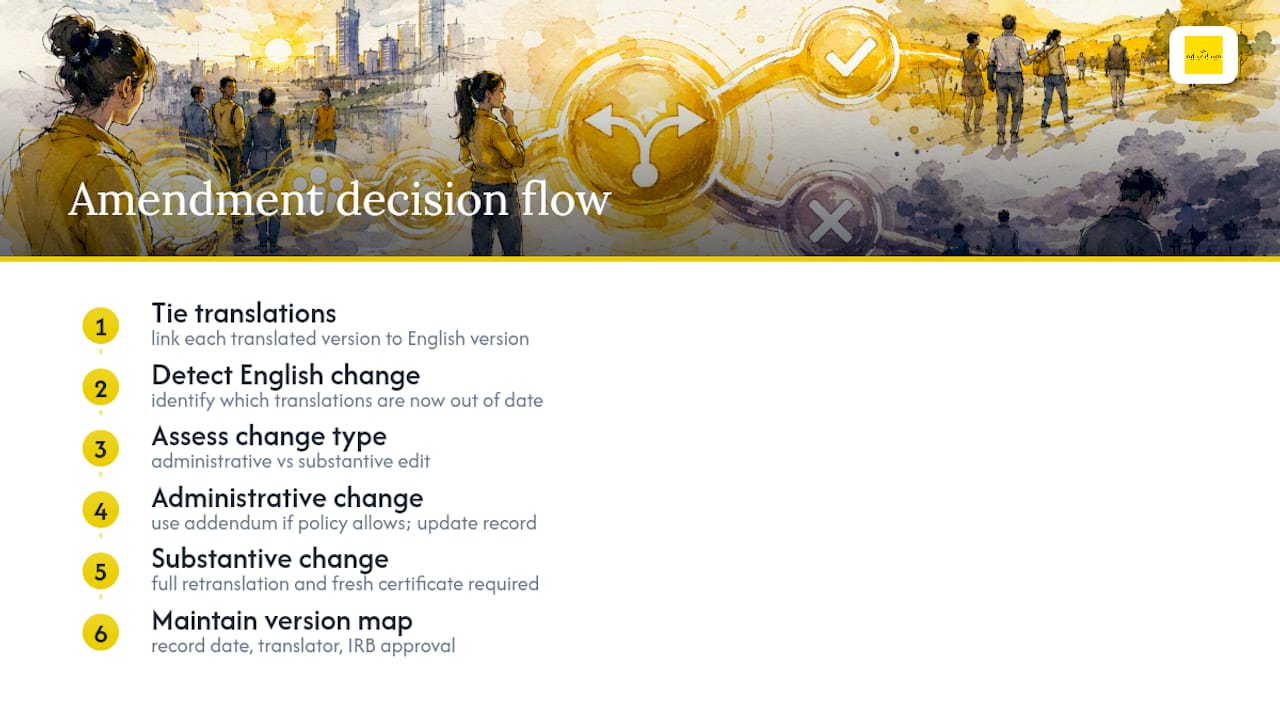
Keep a version map for every language a study operates in: English version number, translation date, translator of record, and IRB approval date for that specific translated version. Studies running in five or more languages without this map tend to lose track of which translated version is actually current at a given site, which is precisely the kind of finding an audit surfaces.
Technology-Assisted Translation Tools: What They Can and Cannot Do
Machine translation tools, including consumer-grade neural machine translation engines, are not appropriate as the sole method for producing a consent document that will be submitted to an IRB. These tools handle general text reasonably well but struggle with regulatory nuance, negation, and the kind of precise risk language a consent form depends on. Using one without qualified human review is a documented failure mode, not a shortcut.
AI-assisted translation systems built specifically for regulated content are a different category entirely. The distinction matters: a general-purpose engine has no terminology governance and no audit trail suited to an IRB submission, while a system built around client-specific Translation Memories and Term Bases, paired with mandatory subject-matter expert review, produces both a faster draft and a defensible record of how that draft was produced.
The appropriate role for any technology in this workflow is acceleration of the first draft, never replacement of qualified human review, forward-and-back checking, or certification. An IRB reviewing a submission cares about the reliability of the process end to end. A tool that speeds up drafting while still routing every document through certified linguists and documented QA fits that expectation. A tool that skips human review to save time does not, regardless of how fluent its output reads.
Why Most Teams Get the Certificate Backwards
Most compliance guidance treats the certificate of translation as the goal. It isn’t. The certificate is paperwork evidence of a process; the process is what actually determines whether a subject understood what they signed. Teams that chase the certificate and skip validating actual comprehension end up with a clean IRB file and a consent that might not survive a deposition.
The conventional advice, translate accurately and get it certified, undersells two things this research makes clear. First, “understandable” is a comprehension standard, not a linguistic one, which means cognitive interviewing or pilot testing with real target-population readers matters more than a second linguist checking grammar. Second, timing discipline, locking the English before translating, prevents more IRB rework than any QA step downstream of it.
If there’s one place to start, it’s not the translation vendor. It’s the version-control discipline: freeze the English, map every translated version to it, and only then invest in the linguistic and cultural validation that actually protects the subject and the sponsor. Vendor selection matters, but it solves the second problem, not the first.
— Eric Brown
Where AD VERBUM Fits for Regulated Consent Translation
Once your English consent is locked and your translation matrix is mapped, the remaining question is execution: who translates it, how fast, and with what audit trail. AD VERBUM runs professional translation through an AI+HUMAN hybrid translation workflow built for exactly this kind of regulated documentation, integrating your existing Translation Memories and Term Bases so terminology stays locked across every amendment cycle instead of drifting version to version.
Subject-matter expert linguists review outputs, and quality assurance can align to ISO 17100 and ISO 18587, with infrastructure hosted on EU servers designed for compliance with data protection standards suitable for teams facing GDPR or HIPAA data constraints. That combination fits sponsors and IRBs that need a documented, repeatable process behind the certificate, not just the certificate itself. For studies running across multiple sites and languages, localization support extends the same terminology governance to every related document a site needs. If your next submission needs a translated consent package with a defensible audit trail, request a quote through AD VERBUM’s contact page before your enrollment window opens.
Sources
Recommended