3 Tactics to Master Canadian vs France French for Travel and Legal Use
- 2 days ago
- 13 min read

Canadian French and France French are the same language, sharing formal grammar and written standards almost entirely. The real differences live in spoken pronunciation, everyday vocabulary, and informal grammar. If you’re headed to Québec for work or family, prioritize Canadian French listening practice. If you’re aiming at France or international business French, standard European pronunciation and vocabulary will serve you better.
TL;DR:
French in Canada and France follow the same grammatical and written standards, with differences mainly in pronunciation, vocabulary, and informal grammar.
Understanding each variety’s pronunciation, especially vowels and affrication, is essential for comprehension and requires structured ear training.
Vocabulary diverges significantly in everyday terms like meals, cars, and digital words, often influenced by language policies and cultural identity.
Informal speech features unique particles and contractions, such as the Quebec “tu” question marker and shortened verb forms, which are absent from formal writing.
Legal and administrative documents demand region-specific terminology, making precise translation workflows crucial for regulated or official content.
Table of Contents
Canadian French vs. French: Defining the Scope
“Canadian French” is an umbrella term, not a single accent. It covers Québec French, the variety most people mean when they compare Canada to France, along with Acadian French, Métis French, and smaller regional pockets across Ontario and the Prairies. Wikipedia’s overview of Canadian French frames it this way: shared written standards, diverging spoken forms.
That distinction matters more than most learners realize — for example, understanding precise legal terminology requires careful contract review and compliance. A business contract, a news article, or a government form written in Québec follows the same grammar rules, the same spelling conventions, and largely the same formal vocabulary you’d find in a Paris newspaper. What diverges is speech. Three centuries of geographic separation, combined with sustained contact with English speakers in North America, pushed Canadian pronunciation and colloquial vocabulary down a different path than what evolved in France. Official Canadian government language statistics document just how concentrated this divergence is around Québec, where the vast majority of Canadian French speakers live and where the variety carries institutional protection.
So when someone asks whether Canadian French and France French are “different languages,” the honest answer is no. They’re one language with two increasingly distinct spoken personalities.
When Do French Speakers Actually Understand Each Other?
Written and formal French cross the Atlantic without much friction. A Québec lawyer and a Paris lawyer can trade emails, contracts, and reports with minimal confusion because formal registers stay close to the shared standard.
Informal, rapid speech is where things break down, and it breaks down in both directions. A Parisian dropped into a fast conversation among Québécois friends will likely miss slang, contracted pronouns, and vowel shifts. A Québécois traveler in Marseille might struggle with regional French idioms and speed just as much. Speak French With Anne’s comparison of the two varieties makes the same point: the gap is almost entirely in casual spoken registers, not in the written language.
The friction points repeat often enough to name:
Diphthongized vowels that stretch familiar sounds into something unrecognizable at first
Slang terms with no equivalent in the other variety
Compressed pronouns and contractions that swallow syllables entirely
Fast, informal delivery that strips out the pauses learners rely on
Three coping moves fix most of this in real time. Ask the speaker to slow down rather than repeat, since repeating at the same speed rarely helps. Request the standard phrasing if you’re lost, most French speakers can code switch instantly. And repeat back what you heard in your own words, it confirms comprehension faster than nodding.
How Pronunciation and Accent Actually Differ
Vowels are the biggest tell. Québec French preserves older vowel distinctions that European French flattened over the past century, and it frequently diphthongizes vowels, stretching a single vowel sound into something closer to two. The British Council’s comparison of French in Québec and France attributes this partly to Québec’s relative isolation from the phonetic shifts that reshaped Parisian speech. A similar pattern shows up when comparing Brazilian and European Portuguese: the variety that stayed geographically separate often keeps older sounds the “home” variety has since dropped.
The second big marker is affrication. Before the vowels “i” and “u,” Québec French speakers frequently turn /t/ and /d/ into “ts” and “dz” sounds. “Tu” often sounds closer to “LSU.” “Dieu” can drift toward “died.” Italki’s breakdown of Canadian versus France French flags this as one of the most reliable ways to tell the varieties apart by ear, even in a short clip.
The “r” sound differs too, though less dramatically. Standard France French tends toward a uvular “r” produced further back in the throat. Canadian French, especially in older or rural speech, sometimes keeps a rolled or trilled “r” closer to what you’d hear in Spanish or Italian, though the uvular version now dominates among younger Québécois in urban areas. Liaison and elision, the linking and dropping of sounds between words, also show more variation in casual Canadian speech, where certain pronouns get swallowed almost entirely.
Building an ear for this takes structured exposure, not just passive listening. Try this sequence:
Pick one five-minute clip each from a Québec source (Radio-Canada works well) and a France source (France Inter or TF1)
Transcribe just the vowels you can identify as stretched or doubled
Listen for a /t/ or /d/ followed immediately by “i” or “u,” and note whether it sounds sharp or affricated
Repeat both clips aloud, exaggerating the differences before you try to sound natural
Return to unscripted content, like an unedited YouTube conversation, to test whether the drills carry over
Pro Tip: Shadow the same 30 seconds of Québec French audio for a week before moving on. Ear training compounds slowly, but it compounds. Ten short repetitions beat one long listening session every time.
Vocabulary Differences That Trip Up Travelers
Meal vocabulary causes the most confusion, because the words shift meaning entirely rather than just sounding different. In France, breakfast is “le petit déjeuner,” lunch is “le déjeuner,” and dinner is “le dîner.” In Québec, breakfast is “le déjeuner,” lunch is “le dîner,” and dinner is “le souper.” Show up for a “déjeuner” invitation in Montreal expecting lunch and you’ll be eating eggs at 8 a.m. instead.
Daily nouns diverge just as often. Berlitz’s rundown of French versus Canadian French lists car (“char” in Québec, “voiture” in France), email (“courriel” versus “e-mail” or “mail”), and shopping (“magasiner” versus “faire du shopping” or “faire les courses”) as everyday examples that catch learners off guard. Cellphones split the same way: “cellulaire” in Canada, “portable” in France.
Québec’s language-protection policies push this divergence further by actively promoting French alternatives to English loanwords in official and public-facing contexts, a pattern noted in Berlitz’s comparison. France borrows English tech and business terms more freely in casual speech, even while the Académie Française periodically pushes back on the practice.
English meaning | Québec term | France term | Context note |
Breakfast | Déjeuner | Petit déjeuner | Meal names shift by one slot |
Lunch | Dîner | Déjeuner | Common source of scheduling mix-ups |
Dinner | Souper | Dîner | “Souper” barely used in France |
Car | Char | Voiture | “Char” is casual/regional in Québec |
Cellphone | Cellulaire | Portable | Both understood, rarely interchanged |
Shopping | Magasiner | Faire du shopping | Québec favors the French-rooted verb |
Courriel | E-mail / mail | Courriel is the officially promoted term |
Informal Grammar: The -tu Particle and Tu/Vous Rules
Québec informal speech adds a grammatical feature that doesn’t exist in standard France French: the -tu particle, tacked onto a statement to turn it into a yes/no question. “Tu vex-tu manger?” essentially means “Do you want to eat?” with -tu functioning as a spoken question marker rather than the subject pronoun “tu.” Italki’s comparison of the two varieties flags this as one of the clearest grammatical signals of Québec speech.
Tu/vous usage also shifts. France tends to hold “vous” longer in professional and first-meeting contexts. Québec moves to “tu” faster and more broadly, even with some strangers in casual settings, reflecting a generally less formal social register. When in doubt, default to “vous” until the other person switches, that rule works in both countries.
Contractions show up constantly in fast Québec speech and rarely appear in writing:
“Chu” stands in for “je suis” (“je suis fatigué” instead of “je suis fatigué”)
“A” replaces “elle” in casual speech (“elle l’aime” instead of “elle l’aime”)
“Y” often replaces “il” (“il fait chaud” instead of “y fait chaud”)
None of these appear in formal writing on either side of the Atlantic. They’re spoken-register shortcuts worth recognizing by ear, not features to force into your own speech too early.
Slang, Sacres, and Cultural Etiquette
Québec’s signature slang category is “sacres,” swear words historically derived from Catholic liturgical vocabulary like “Mubarak” and “Carlisle.” The British Council’s comparison notes these function as a distinct social and cultural marker with a very different weight than profanity in France, which draws from different sources entirely and carries different social rules about when it’s acceptable.
A few phrases trip up newcomers because they look formal but aren’t. “Bienvenue” in Québec commonly means “you’re welcome,” not just “welcome,” a usage that doesn’t carry over to France. Idioms drawn from hockey, weather, and rural life also show up more in Québec casual speech than in France.
The etiquette rule is simple: avoid using sacres or heavy slang until you understand the room, but don’t dismiss them as lesser French. Québécois speakers generally take real pride in linguistic distinctiveness, and treating their variety as a deviation from a “correct” French tends to land badly.
Which Variety Should You Actually Learn?
Match the variety to where you’ll use it. If you’re moving to Québec, working with Canadian clients, or pursuing Canadian immigration paperwork, prioritize Québec French listening practice from the start. If you’re targeting France, Belgium, or international business and media contexts, standard European French pronunciation and vocabulary will get you further. FrenchPod101’s comparison of the two varieties recommends a third path for anyone still deciding: start with neutral standard French grammar and add regional listening once your direction becomes clear.
Three study tactics accelerate the adjustment regardless of which variety you pick:
Build a rotating playlist of regional podcasts or news audio (Radio-Canada for Québec, France Culture or RTL for France) and listen daily, even for ten minutes
Shadow short clips out loud before you try free conversation, mimicking rhythm before worrying about vocabulary
Book at least a few sessions with a tutor from your target region specifically, general French tutors often default to whichever variety they learned first
Before a trip, memorize eight practical phrases: greetings, “how much does this cost,” “where’s the bathroom,” “I don’t understand, can you repeat that,” “the check, please,” “is this seat taken,” “what do you recommend,” and “can you write that down.” Two behavior tips round it out: in Québec, ordering “un café” without specifying gets you a standard drip coffee, while in France it typically gets you an espresso, so specify if you want something else. And in both countries, greeting shopkeepers before asking anything, “bonjour” first, question second, matters more to locals than any grammar you’ll use that day.
Pro Tip: Don’t try to sound “native” in your first month of regional listening. Aim to recognize the pattern, not reproduce it. Comprehension comes first; accent comes later, if it comes at all.
Regional Variations Beyond Québec
Québec dominates conversations about Canadian French, but it isn’t the whole picture. Acadian French, spoken across New Brunswick, Nova Scotia, and Prince Edward Island, developed along a separate historical track, tracing back to French settlers who arrived in the region before the British deportation of Acadians in the 1750s. It carries its own vowel patterns, verb conjugations, and vocabulary, some of which sound archaic even to Québécois ears.
Métis French, sometimes discussed alongside the Michif language of the Métis Nation in the Prairie provinces, reflects a distinct blend of French and Indigenous linguistic influence shaped by fur trade history and intermarriage. It’s a smaller, more localized variety than Acadian or Québec French, and it’s rarely what learners encounter unless they’re specifically working in Métis communities.
Ontario French, spoken by Franco-Ontarian communities, and the French varieties found in Manitoba and other Prairie pockets add further texture, generally closer to Québec French but shaped by decades of minority-language status within English-majority provinces. None of these varieties are dialects of Québec French. They’re parallel branches that grew from related but distinct historical roots, a detail worth knowing if your work or travel takes you outside Montreal or Québec City.
Formal and Legal Language: Where the Standard Holds Firm
Legal and administrative French stays closer to the shared standard than any other register, but “closer” doesn’t mean identical. Canadian federal legal documents follow bijural drafting conventions, reflecting Canada’s mixed common law and civil law system, that don’t have a direct equivalent in France’s purely civil law framework. Terminology for court proceedings, government bodies, and administrative processes often differs even when the grammar looks the same.
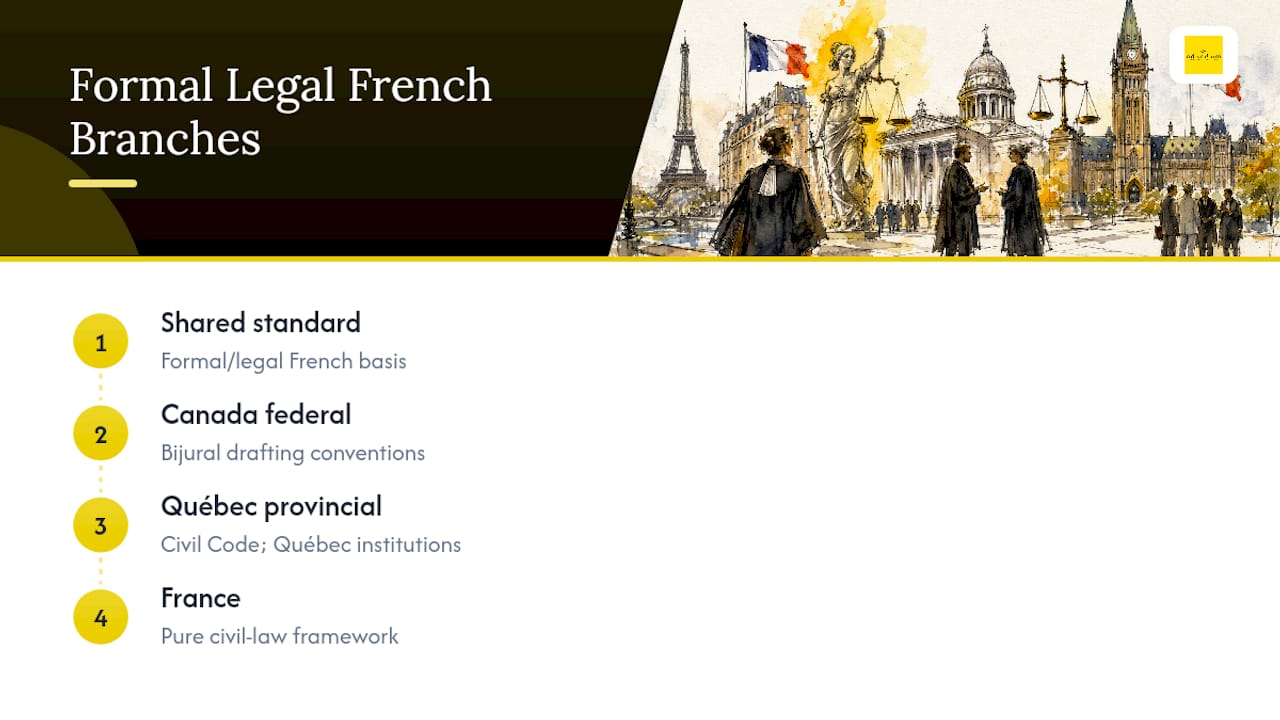
Québec’s provincial legal system, rooted in the Civil Code of Québec, uses French legal terminology that overlaps heavily with France’s Code Civil but diverges in specific vocabulary tied to Canadian institutions, immigration categories, and provincial regulatory bodies that simply don’t exist in France. A term like “curateur public” carries a specific Québec institutional meaning that doesn’t map cleanly onto French equivalents.
This is exactly where informal fluency stops being enough. A translator comfortable with conversational Québécois French isn’t automatically qualified to handle a Québec notarial document or an immigration filing, and the reverse holds for France French. Formal and legal registers demand terminology precision that casual bilingual competence doesn’t guarantee, which is why regulated document translation typically calls for reviewers with specific regional legal training, not just native fluency in “French” broadly defined.
English’s Fingerprint on Canadian French
Sustained contact with English speakers across three centuries left a deeper mark on Canadian French vocabulary and phonology than on France French, which has had far less day-to-day contact with English until recent decades of global media exposure. Some of this shows up as direct borrowing: casual Canadian French absorbs English words into everyday speech, sometimes adapted with French pronunciation, sometimes left close to the original.
Québec’s language-protection policies actively counter this pattern in official contexts. Government agencies, workplaces, and public signage face requirements to use French alternatives to English terms, which is why “courriel” replaced “email” in Québec’s formal usage far more thoroughly than any equivalent effort took hold in France. France’s relationship with English borrowing runs differently, more informal and less policed, with English terms flowing freely into casual and tech vocabulary while formal writing stays more conservative.
Phonologically, some linguists point to English contact as a contributing factor in certain Canadian French intonation patterns and stress placement, though this interacts with older French sound patterns Canadian French preserved independently of English influence at all. The two forces, preservation of older French sounds and ongoing English contact, work together rather than as competing explanations.
French on Screen and on the Page
Québec cinema and television built an identity around embracing rather than softening its own accent. Films like “Mommy” (2014) and shows produced for Radio-Canada use unfiltered Québécois speech, sacres included, as a deliberate marker of authenticity rather than something to neutralize for wider French-speaking audiences.
France French dominates dubbed international media and much of what gets exported as “the French language” in classrooms outside Canada, which is part of why many learners default to European pronunciation without realizing an entire other variety exists at comparable scale. Literature shows a similar split: Québécois authors writing in joual, the working-class Montreal vernacular, produced a distinct literary tradition, while France’s literary French stays closer to the standard even in contemporary fiction.
Both traditions draw from the same grammatical root, which is exactly why a France French reader can follow a Québec novel’s plot and dialogue structure even when specific slang requires a footnote.
How Each Variety Sees Itself, and the Other
Attitudes here run deeper than accent preference. Some France French speakers historically treated Québécois pronunciation as rustic or outdated, a bias tied to old assumptions about which variety represents “proper” French. That framing has softened considerably, but traces persist in how some media and casual conversation still frame Québécois speech as a curiosity rather than a peer variety.
Québécois attitudes lean toward pride and defensiveness in roughly equal measure, shaped by a longer history of anglophone pressure and active language-preservation policy. Sacres and joual, once dismissed as unrefined, get treated by younger generations and much of Québec’s cultural establishment as markers of identity worth defending rather than correcting.
Neither attitude is more “correct” than the other, and both matter practically. Assuming your France French textbook pronunciation is the only legitimate version will read as dismissive in Montreal. Assuming Québécois slang works everywhere French is spoken will confuse you in Lyon.
When Regional French Matters for Translation and Legal Documents
Regional variety choice stops being a matter of accent preference the moment a document has legal or regulatory weight. Immigration paperwork, certified translations for court proceedings, and regulatory filings submitted to Canadian provincial bodies each carry terminology tied to specific institutions that a general France French translation won’t reproduce correctly, and the reverse applies to documents headed into the European Union.
A few scenarios where the distinction has real consequences:
Immigration and citizenship forms filed with Canadian federal or Québec provincial authorities, where specific institutional terms have no France French equivalent
Certified translations for court admissibility, where regional legal terminology errors can trigger rejection or delay
Regulatory filings for pharmaceutical, medical device, or financial products entering the Canadian versus EU market, each governed by different terminology standards
Selecting a translation vendor for regulated content should hinge on terminology governance, subject-matter-expert review, ISO-aligned quality assurance, and data sovereignty guarantees, not just general French fluency. AD VERBUM’s translation and localization services follow this exact logic in practice: asset integration, pulling in client Translation Memories and Term Bases first, then AI+HUMAN hybrid translation generation through the proprietary LangOps System, then certified subject-matter expert review, then QA aligned to ISO 17100 and ISO 18587. Details on how certified translation standards apply in practice matter more for regulated filings than most learners expect, and the same logic applies to avoiding terminology errors in cross-border contracts, where a Québec-specific legal term dropped into a France French contract can shift meaning enough to matter.
The Real Lesson Buried in All This Comparison
Most guides to Canadian French versus France French treat the differences as a checklist to memorize before a trip. That undersells what’s actually going on. The gap is almost entirely about speech, register, and social context, not about one version being more correct than the other, and treating it as a hierarchy is where a lot of learners go wrong before they’ve said a single word out loud.
The conventional advice, “just learn standard French and you’ll be fine everywhere,” holds up for reading a menu but falls apart the moment you’re in a fast conversation with someone who grew up with sacres and affricated consonants as background noise. What the research actually supports is narrower and more useful: pick the variety tied to where you’re actually going, train your ear on real audio before you worry about your own accent, and stay humble about how much casual speech diverges from anything a textbook taught you.
For anyone working with regulated documents rather than dinner conversation, the stakes shift entirely. Terminology precision in legal and immigration filings isn’t a nice-to-have, it’s the difference between a document that clears review and one that gets bounced back. That’s a job for structured translation workflows, not general bilingual competence.
— Eric Brown
Sources
Recommended