


How MiCA Affects Translation for Crypto-Asset Issuers

Compliance officers and legal counsel at EU crypto-asset service providers are discovering that how MiCA affects translation for crypto-asset issuers goes far deeper than hiring a qualified linguist. MiCA Regulation 2023/1114 Articles 6 and 9 impose technically precise obligations: white papers must be translated into each marketing-jurisdiction language, structured as separately filed iXBRL documents with identical field-level organization, and drafted to meet legal standards for risk disclosure accuracy. Errors at either the linguistic or the structural level can trigger automatic rejection by national competent authorities. Certified translation standards, specifically ISO 17100, ISO 18587, and ISO 27001, form the recognized compliance baseline for meeting these requirements.
Table of Contents
Key Takeaways
Point | Details |
MiCA mandates per-language iXBRL filings | Each marketing-jurisdiction language requires a separately structured iXBRL white paper, not a simple document translation. |
Structural errors cause rejection independently | Automated checks can reject a linguistically accurate translation if iXBRL field-level organization is inconsistent. |
Article 9 demands legal-grade risk disclosure | Tokenomics descriptions and risk factors must meet a legal precision standard, not a marketing communication standard. |
Management carries strict civil liability | Issuer management is personally accountable under MiCA for inaccurate white paper content, including mistranslations. |
ISO-certified AI+HUMAN translation is the baseline | ISO 17100, ISO 18587, and ISO 27001 certifications define the minimum acceptable quality and security framework for MiCA filings. |
How MiCA Affects Translation for Crypto-Asset Issuers
MiCA’s translation obligations are grounded in two articles that compliance teams must read together, not in isolation. Article 6 establishes the foundational requirement: a crypto-asset issuer marketing tokens in multiple EU member states must publish a white paper in each jurisdiction’s official language. This is not a discretionary localization decision. It is a mandatory filing obligation with direct consequences for market access.
What makes Article 6 technically demanding is the format requirement. All EU white papers must be published in Inline XBRL (iXBRL) format, using the ESMA-issued MiCA White Papers taxonomy. iXBRL is both human-readable and machine-readable, enabling automated cross-border comparability checks by national competent authorities. A translated white paper is not simply a PDF in a different language. It is a structured data filing where every tagged field must replicate the source document’s field order and metadata precisely.
Article 9 addresses what must be said, and how precisely it must be said, within the white paper. Risk factors and tokenomics descriptions carry a legal standard of accuracy, not a marketing communication standard. The distinction matters because many issuers approach translation as content localization rather than as a legal filing exercise. Under Article 9, the translated text must convey the identical legal meaning of risk disclosures, including probability qualifiers, scope limitations, and causal relationships between stated risk factors and investor outcomes.
Article 6: Requires white paper translation into each official language of EU member states where the crypto-asset is marketed.
Article 6 (structural): Each language version must be submitted as a separately structured iXBRL file with identical field-level organization for consistent automated checks.
Article 9: Mandates legal accuracy in risk disclosures and tokenomics descriptions, not approximations or marketing-adapted paraphrasing.
ESMA taxonomy: Governs the iXBRL tagging structure; deviation from the taxonomy produces validation failures independent of linguistic accuracy.
Notification obligation: White papers must be publicly accessible and free of charge, with mandatory notification to the national competent authority before publication.
Pro Tip: Treat the MiCA white paper as you would a prospectus under the Prospectus Regulation. The legal standard for accuracy in risk disclosures is comparable, and the consequences of imprecision are similarly severe.
Consequences of mistranslated risk disclosures
The MiCA translation impact on compliance outcomes is not theoretical. Mistranslated or structurally inconsistent white papers create two distinct failure categories, and each operates independently of the other.
The first category is structural rejection. Passing automated validation does not guarantee MiCA compliance. Seven categories of error exist beyond schema-level failures, including subtle presentation errors, dimension mismatches, and consistency failures across the iXBRL instance document. A linguistically perfect German translation that uses a different field ordering in its iXBRL tags than the English source will fail automated checks and be rejected by the national competent authority before any human reviewer reads a single sentence.
The second category is legal liability. Issuer management carries strict civil liability under MiCA for inaccurate white papers, with accountability extending to administrative and supervisory bodies. A mistranslated risk factor, for example, one that converts a conditional risk statement into an unconditional one, or omits a probability qualifier that limits the scope of a disclosed risk, constitutes inaccuracy for which management is personally accountable.
Consider the practical consequences in sequence:
A crypto-asset issuer submits iXBRL white papers in English, French, and Italian for a token offered across three jurisdictions.
The Italian translation is produced using a standard neural machine translation engine without terminology governance or legal review.
A risk disclosure describing “potential loss of up to 100% of invested capital under extreme market conditions” is translated in a way that removes the qualifying phrase, rendering it as an unconditional loss statement.
The Italian competent authority flags the inconsistency between the Italian and English versions during its review.
The issuer faces delayed market access, a mandatory correction and resubmission process, and potential regulatory scrutiny of the broader compliance program.
Pro Tip: Do not rely solely on ESMA’s Excel-based conversion tool for iXBRL compliance verification. The MiCA Crypto Alliance feedback on ESMA’s XBRL implementation confirms that the tool is a technical aid, not a validation guarantee. Robust integrated XBRL processes with manual expert review are necessary for genuine supervisory usability.
Step-by-step compliance strategy for MiCA translations
A defensible MiCA translation workflow requires sequential steps that address both the legal content standard and the iXBRL structural requirement. The following framework is organized for compliance officers and legal counsel coordinating multilingual white paper filings.
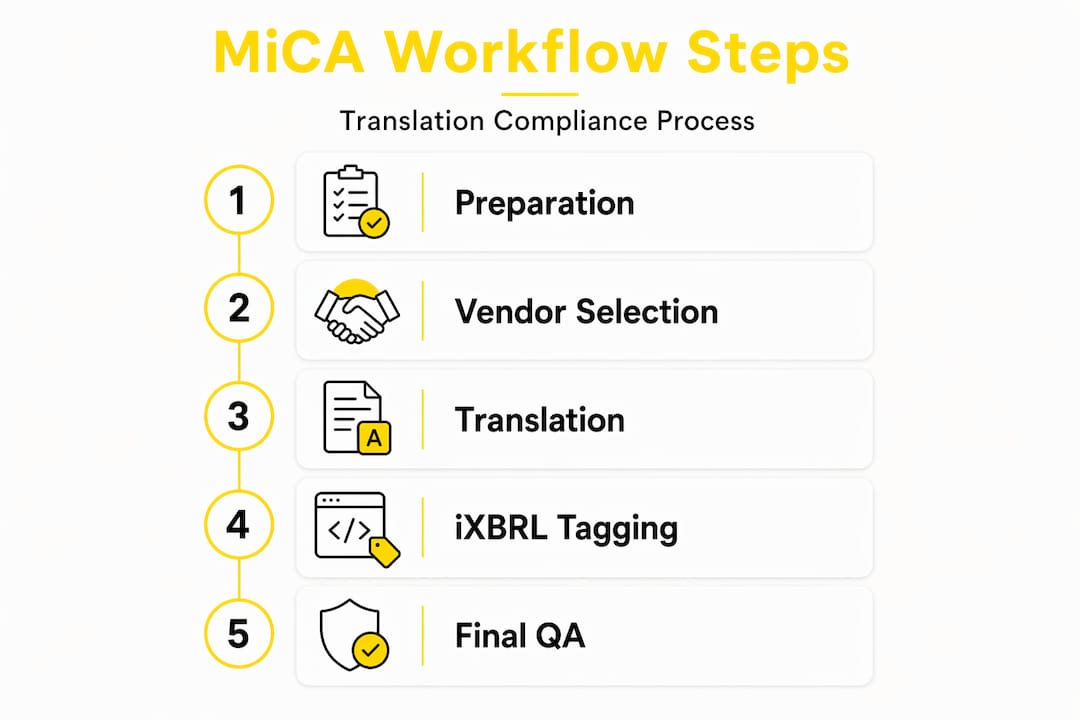
Pre-translation preparation
Before any translation work begins, secure the Legal Entity Identifier (LEI) and Digital Token Identifier (DTI) codes for the issuer and the token. Missing these identifiers causes immediate technical rejection by competent authorities, independent of document quality. Map the jurisdictions where the token will be marketed and identify the official languages required for each. This determines the number of iXBRL filings required.
Translation vendor selection criteria
Select translation providers certified to ISO 17100 (translation process standard), ISO 18587 (post-editing of machine translation output), and ISO 27001 (information security management). These three certification standards define the compliance baseline MiCA white paper translation demands. Generic legal translation services without financial domain expertise and iXBRL structural awareness carry elevated risk in this context.
The technical distinction matters here. Legacy machine translation (MT) produces literal output with weak context handling, creating a high likelihood of meaning errors in risk disclosures. Standard neural machine translation (NMT) engines, including widely available SaaS translation tools, introduce inconsistent terminology control and variable handling of negation and probability qualifiers. For MiCA white papers, the appropriate approach is AI+HUMAN hybrid translation with subject-matter expert oversight and ISO-aligned quality assurance.
Workflow structure
Phase | Action | Output |
Asset integration | Ingest client Translation Memories ™ and Term Bases (TB) | Terminology-governed translation environment |
LLM generation | Proprietary LLM produces target-language output constrained by client terminology | First-pass translation with terminology enforcement |
SME review | Certified legal and financial expert reviews for accuracy, compliance, and contextual nuance | Verified translation draft |
QA and iXBRL alignment | ISO 17100 and ISO 18587 aligned QA; parallel iXBRL tagging reconciliation against source | Audit-ready, structurally consistent iXBRL filing |
Pre-submission validation | Legal and technical review against ESMA taxonomy and national authority requirements | Final submission package |
A regulated document translation workflow that incorporates multi-phase quality assurance, terminology governance, and iXBRL tagging reconciliation is not optional for MiCA compliance. It is the process specification that produces defensible filings.

Compliant vs non-compliant translation scenarios
Concrete examples clarify where the effects of MiCA on translations produce pass or fail outcomes.
Scenario | Translation approach | iXBRL structure | Outcome |
Compliant multilingual submission | ISO 17100 and 18587 certified AI+HUMAN hybrid translation with financial SME review | Field-level identical to source; ESMA taxonomy compliant | Accepted by national competent authority; publicly accessible within required timeframe |
Structurally discrepant submission | Accurate translation; iXBRL field ordering differs from English source | Dimension mismatch in two tagged fields | Automated rejection; resubmission required before market access |
Risk disclosure phrasing error | NMT engine without legal review; probability qualifier omitted | Structurally correct | Legal review flags inconsistency; competent authority requests clarification; timeline delayed |
Terminology inconsistency | Multiple translators without shared Term Base; “collateral” translated as two different terms across sections | Structurally correct | ESMA taxonomy cross-check fails on field consistency; partial rejection |
The structurally discrepant scenario illustrates a point that experienced compliance officers often find counterintuitive. A translation that reads accurately in the target language can still fail MiCA compliance at the filing level. Consistent iXBRL field-level structure across language versions is as important as linguistic accuracy, and the two must be verified in parallel, not sequentially.
Correction and resubmission processes carry their own costs. Market access is delayed for the duration of the correction cycle. If the error is discovered post-publication rather than pre-submission, the notification and correction obligations become more complex. Early-stage translation compliance controls reduce the probability of reaching that stage.
My perspective on where MiCA translation actually breaks down
In my experience working with compliance and legal teams navigating MiCA white paper filings, the most consistent gap is not linguistic quality. It is the assumption that translation and iXBRL structuring are separate workstreams that can be coordinated loosely.
Issuers frequently engage a qualified legal translator for the text and a technical team for the iXBRL tagging, then reconcile the two at the end. That sequence creates structural misalignment risk at every field where the translator’s formatting decisions diverge from the iXBRL tagging schema. I’ve seen technically clean translations that generated multiple dimension errors simply because the translation workflow did not include parallel iXBRL reconciliation.
What I’ve found to be the more defensible model is treating terminology governance, translation, and iXBRL tagging as a single integrated workflow with shared audit controls. The MiCA Article 6 obligations do not separate linguistic content from structural format. Compliance programs that mirror that integration in their workflows produce fewer resubmissions.
The regulatory trajectory also points toward tighter enforcement. As national competent authorities build experience with iXBRL review, the tolerance for structural inconsistencies that currently produce requests for clarification will likely tighten into outright rejection. Issuers who establish ISO-certified AI+HUMAN hybrid translation processes now will be better positioned for that environment than those who retrofit compliance controls after a rejection.
— Viestarts
How AD VERBUM supports MiCA white paper translation
For crypto-asset issuers who need audit-ready multilingual white papers under MiCA Articles 6 and 9, the translation process requires certified quality standards, financial domain expertise, and iXBRL structural awareness working together.

AD VERBUM holds ISO 17100, ISO 18587, and ISO 27001 certifications, covering translation process quality, post-editing standards, and information security. The LangOps System operates on private EU-hosted infrastructure, with no reliance on public cloud processing, which addresses data sovereignty requirements that apply to sensitive pre-publication white paper content. Every translation follows the AI+HUMAN hybrid translation workflow: Term Base and Translation Memory integration first, LLM-based generation constrained by client terminology, certified legal and financial SME review, and ISO-aligned quality assurance before delivery. Turnaround runs 3x to 5x faster than traditional translation workflows without reducing the standard of output. For compliance officers coordinating multilingual filings across multiple EU jurisdictions, AD VERBUM’s certified localization services provide the structured, traceable process that MiCA white paper submissions demand.
FAQ
What does MiCA Article 6 require for white paper translation?
MiCA Article 6 requires crypto-asset issuers to publish a white paper in the official language of each EU member state where the token is marketed, structured as a separately filed iXBRL document using the ESMA-issued taxonomy.
Can a linguistically accurate translation still fail MiCA compliance?
Yes. Even a linguistically accurate translation will fail if the iXBRL field-level structure does not exactly replicate the source document’s field order and metadata, triggering automated rejection by the national competent authority.
What civil liability does MiCA impose for mistranslated risk disclosures?
Issuer management carries strict civil liability under MiCA for inaccurate white papers, including mistranslations that alter the meaning of risk disclosures, with accountability extending to administrative and supervisory bodies.
What certifications should a MiCA translation vendor hold?
Vendors should hold ISO 17100 (translation process), ISO 18587 (post-editing), and ISO 27001 (information security) as a minimum baseline for MiCA-compliant financial translation.
Is ESMA’s validation tool sufficient for iXBRL compliance verification?
No. Passing ESMA’s automated validation checks does not guarantee full MiCA compliance. Seven categories of error exist beyond schema-level failures, and robust integrated XBRL processes with expert manual review are necessary for genuine supervisory usability.
Sources:
MiCA White Paper iXBRL requirements. CoreFiling.
MiCA White Paper Is a Legal Filing, Not a Marketing Document. LegalBison.
Why passing iXBRL validation is not enough. MiCA Crypto Alliance.
MiCA Crypto Alliance feedback on ESMA’s XBRL implementation.
Localization. AD VERBUM.
Regulated Document Translation Workflow Guide. AD VERBUM.
Recommended