


Foreign Entity Legal Document Translation: 2026 Compliance Guide

Certified legal translation for foreign entity documents requires a signed Certificate of Accuracy, compliance with 8 CFR § 103.2(b)(3), and alignment with Federal Rule of Evidence 901 for court and agency acceptance in the United States. The table below covers the leading providers serving US legal teams and compliance officers in 2026.
Provider | Certifications and legal expertise | Languages | Specialization | Security and compliance | Pricing and turnaround | Technology | Human QA |
AD VERBUM | ISO 9001, 17100, 18587, 27001, 42001; Bureau Veritas audited | 150+ with regional variants | Legal, Life Sciences, Defense, Finance | ISO 27001, GDPR, HIPAA; EU-hosted private infrastructure | Not publicly listed; 3x–5x faster than traditional workflows | Proprietary LLM-based LangOps System | AI+HUMAN hybrid; SME legal scholars |
Esquire Deposition Solutions | Court-focused; deposition and litigation specialization | Not publicly listed | Litigation, depositions, court reporting | Not publicly listed | Not publicly listed | Not publicly listed | Human review |
Atlas Language Services | BBB-accredited; certified translators | Not publicly listed | Legal, immigration, corporate | Not publicly listed | Not publicly listed | Not publicly listed | Human review |
LinguaVox | ISO 9001 certified | 200+ | Legal, corporate, immigration | Not publicly listed | Not publicly listed | CAT tools | Human review |
LanguageLine Solutions | Large-scale provider; certified translators | 240+ | Immigration, legal, medical | Not publicly listed | Not publicly listed | Technology-assisted | Human review |
Table of Contents
How do leading legal translation providers compare on certification and compliance?
How to choose a legal translation provider for foreign entity documents
What types of foreign entity legal documents require certified translation?
What does an AI+HUMAN hybrid workflow look like for certified legal translation?
AD VERBUM handles your regulated legal translation from document to filing
How do leading legal translation providers compare on certification and compliance?
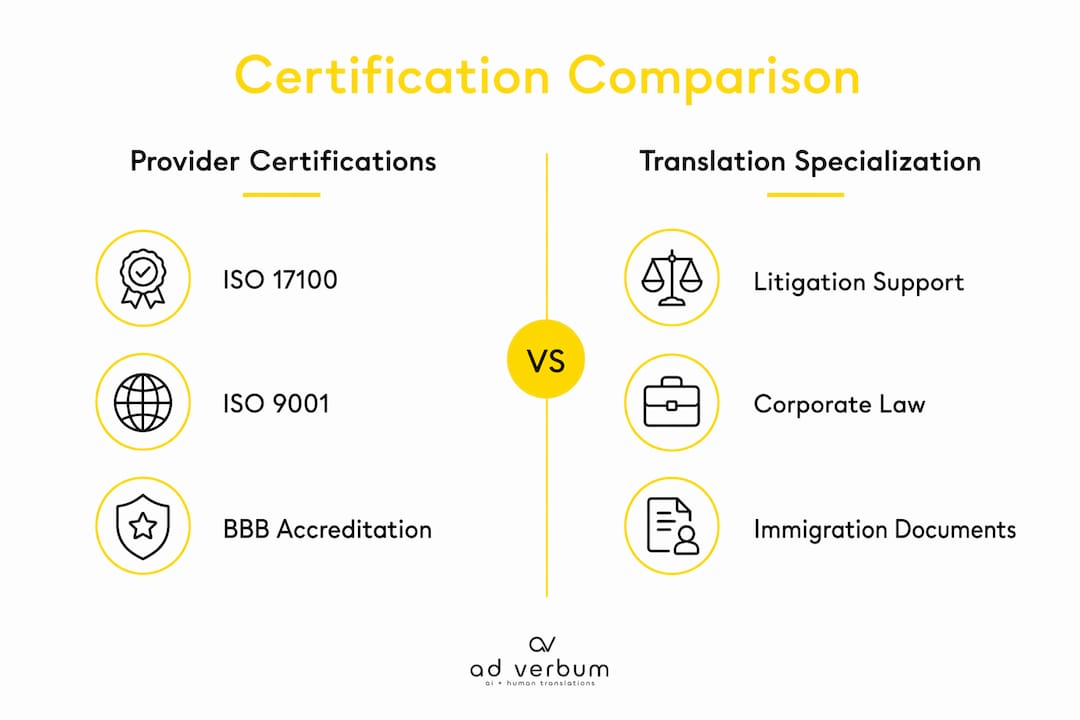
Certification type and legal specialization are the two variables that separate providers capable of handling regulated foreign entity documents from those that cannot. US courts and USCIS require a signed Certificate of Accuracy on every certified translation, and Federal Rule of Evidence 901 demands a sworn affidavit from the translator for evidentiary use. Providers that cannot produce both on request are not suitable for litigation or federal filings.
AD VERBUM holds ISO 17100 (translation services), ISO 18587 (post-editing of machine translation output), ISO 9001 (quality management), ISO 27001 (information security), and ISO 42001 (AI use and safety), all independently audited by Bureau Veritas. Its AI+HUMAN hybrid translation workflow covers 150+ languages, including regional variants, and is built specifically for regulated sectors: legal, Life Sciences, Defense, and Finance. Data is processed on private EU-hosted infrastructure with no reliance on public cloud tooling, which satisfies strict data sovereignty requirements. Turnaround is significantly faster than traditional workflows, per AD VERBUM’s stated figures.
Esquire Deposition Solutions focuses on litigation support, depositions, and court reporting, making it a fit for US-based litigation teams needing court-ready translations tied to deposition workflows. Detailed pricing and language coverage are not publicly listed.

Atlas Language Services is BBB-accredited and serves legal, immigration, and corporate clients. It operates with certified human translators but does not publish ISO certification details or security protocols publicly.
LinguaVox holds ISO 9001 certification and covers 200+ languages, with a focus on legal, corporate, and immigration documents. It uses computer-assisted translation (CAT) tools with human review but does not publish ISO 27001 or data security certifications.
LanguageLine Solutions operates at high volume across 240+ languages and serves immigration, legal, and medical sectors. It is a fit for organizations needing broad language coverage at scale, though its enterprise focus means less transparency on per-project pricing for smaller legal teams.
Pros and cons at a glance:
AD VERBUM: Full ISO stack including 27001 and 42001; proprietary LLM; EU data sovereignty; SME legal scholars. Pricing not publicly listed.
Esquire Deposition Solutions: Strong litigation and deposition integration. Limited public detail on language coverage and security certifications.
Atlas Language Services: BBB-accredited; accessible for immigration and corporate work. No published ISO certifications.
LinguaVox: ISO 9001; broad language coverage. No published data security certification.
LanguageLine Solutions: Widest language coverage; high-volume capacity. Less suited to bespoke regulated projects requiring terminology governance.
How to choose a legal translation provider for foreign entity documents
The single most disqualifying mistake legal teams make is treating translation as a commodity purchase. Legal translation is a risk management activity: a mistranslated defined term in a shareholder agreement or an uncertified court filing can trigger rejection, delay, or worse, unenforceability.
Certification requirements to verify:
Signed Certificate of Accuracy on every translation, compliant with USCIS 8 CFR § 103.2(b)(3)
Sworn notarized affidavit available on request for FRE 901 authentication
Translator qualifications verifiable in writing, including subject-matter legal expertise
ISO 17100 compliance for translation process quality
Confidentiality and data security questions to ask:
Where is client data processed and stored? Is it on private or shared cloud infrastructure?
Does the provider hold ISO 27001 certification? Has it been independently audited?
Are data sovereignty and access controls documented in a data processing agreement?
Does the provider align with GDPR and HIPAA where applicable?
Red flags to watch for:
Sole reliance on generic machine translation (MT) or neural machine translation (NMT) engines without certified human review. US courts reject translations produced by AI tools that cannot provide a signed competency certification.
Translators who are parties to the matter or have any personal stake in the outcome.
No published QA process or ISO certification.
Vague turnaround commitments with no escalation path for urgent filings.
Typical certified legal translation pricing runs on a flat per-page rate, with options for expedited delivery and notarization. Turnaround times generally range from 24 to 72 hours depending on document complexity. Providers that cannot give you a clear pricing structure upfront create budget risk on time-sensitive filings.
Pro Tip: Brief your translator with full case context: the jurisdiction, the filing destination, preferred terminology, and how the document will be used. Under-briefing is the leading cause of unusable output on complex foreign entity documents.
What types of foreign entity legal documents require certified translation?
The document type determines both the certification standard and the level of legal expertise required from the translator. Certified translations must reproduce every clause, footnote, court stamp, notarial seal, and handwritten margin note exactly, without summarizing or omitting any content.
Corporate and transactional documents:
Shareholder agreements, partnership agreements, and M&A transaction documents
Corporate bylaws, articles of incorporation, and board resolutions
Commercial contracts and cross-border service agreements
Litigation and court filings:
Foreign judgments, court orders, and evidentiary exhibits
Affidavits, declarations, and sworn statements
Discovery documents and deposition transcripts
Immigration and regulatory filings:
Visa petitions, asylum applications, and supporting evidence for USCIS
Birth certificates, marriage records, and identity documents
Compliance certifications and regulatory submissions
Official endorsements and notarial instruments:
Apostilles and notarial certificates
Ministry-of-justice marks and official government seals
Powers of attorney and certified copies of public records
Each category carries distinct compliance requirements. An apostille attached to a corporate document, for example, must be rendered with its full original content in English, not paraphrased. For guidance on avoiding terminology errors in cross-border contracts, the document type and target jurisdiction should drive terminology choices from the outset.
What does an AI+HUMAN hybrid workflow look like for certified legal translation?
Generic machine translation (MT) produces literal output with weak context handling, creating a high risk of meaning errors in regulated text. Neural machine translation (NMT) engines, including consumer SaaS platforms, improve on that but still show inconsistent terminology control and governance gaps for regulated documentation. The AI+HUMAN hybrid translation model used by AD VERBUM is a distinct approach: a proprietary LLM-based system with explicit instruction following and terminology governance, embedded within a certified human review process.
The workflow follows four stages:
Asset integration. Client Translation Memories ™ and Term Bases (TB) are ingested first, so every project starts from approved terminology rather than generic output.
LLM generation. AD VERBUM’s proprietary LangOps System produces target-language output constrained by client terminology and style guidance, with document-level context handling rather than sentence-by-sentence processing.
SME review. A certified subject-matter expert, including legal scholars for legal documents, reviews for technical accuracy, regulatory compliance, and contextual nuance.
Quality assurance. QA is aligned to ISO 17100 and ISO 18587 and, where applicable, sector-specific requirements.
Workflow stage | Role | Compliance checkpoint |
Asset integration | Terminology and TM ingestion | Client-approved term base applied |
LLM generation | Proprietary LangOps System | Terminology governance enforced |
SME review | Certified legal subject-matter expert | Accuracy, jurisdiction, regulatory compliance |
QA sign-off | ISO 17100 and 18587 aligned review | Final certification and delivery |
Data throughout this process stays on private EU-hosted infrastructure, with no public cloud exposure. For teams operating under audit requirements, every stage is documented and traceable, supporting the access control and auditability standards that regulated legal translation demands.
Key Takeaways
Certified foreign entity legal document translation requires a signed Certificate of Accuracy, ISO-aligned QA, and verified legal expertise to meet US court and agency standards in 2026.
Point | Details |
Certification is mandatory | Every translation for US courts or USCIS needs a signed Certificate of Accuracy and, for trial use, a notarized affidavit under FRE 901. |
AI+HUMAN hybrid translation improves compliance | Proprietary LLM-based workflows with SME review outperform generic MT or NMT for regulated legal documents. |
Security must be documented | ISO 27001 certification and a data processing agreement are the minimum for handling sensitive foreign entity documents. |
Brief translators fully | Providing case context, jurisdiction, and preferred terminology reduces errors and avoids unusable output. |
AD VERBUM for regulated work | AD VERBUM’s ISO 17100, 27001, and 42001 certifications, 3,500+ legal SMEs, and EU-hosted infrastructure fit audit-grade legal translation requirements. |
The part of legal translation that most providers get wrong
Most legal translation failures do not happen because a translator chose the wrong word. They happen because the provider treated the document as text to convert rather than as a legal instrument with jurisdiction-specific enforceability requirements.
The distinction matters most in foreign entity work, which makes choosing translators with expertise in legal documents for foreign entities essential for accuracy and compliance, as detailed in the benefits of legal real estate consultancy for inheritance. A shareholder agreement drafted under German law and filed in a Delaware court carries concepts that have no direct English equivalent. A translator who renders “Gesellschaft mit beschränkter Haftung” as “limited liability company” without noting the structural differences between German GmbH governance and US LLC governance has produced a translation that is technically accurate and legally misleading at the same time.
The providers that handle this well share one trait: they assign translators who understand the source jurisdiction’s legal framework, not just its language. ISO 17100 requires subject-matter competence as a condition of certification, but many providers interpret that as “legal vocabulary knowledge” rather than “jurisdictional legal reasoning.” Those are not the same thing.
For corporate legal teams managing cross-border M&A, regulatory filings, or international arbitration, the right question to ask a provider is not “Are you certified?” but “Does your translator know how this concept functions in the source jurisdiction?” The answer to that second question tells you far more about the risk you are taking on.
AD VERBUM handles your regulated legal translation from document to filing
Legal teams working with foreign entity documents need more than a translated PDF. They need a provider whose certifications, security controls, and subject-matter expertise can withstand scrutiny in court, at USCIS, or in an international arbitration proceeding.
AD VERBUM’s AI+HUMAN hybrid translation workflow covers 150+ languages, is backed by ISO 9001, 17100, 18587, 27001, and 42001 certifications audited by Bureau Veritas, and runs on private EU-hosted infrastructure with no public cloud exposure. Its network of 3,500+ subject-matter expert linguists includes legal scholars and practitioners with jurisdiction-specific expertise. Turnaround is 3x–5x faster than traditional workflows, without trading off the certified human review that US courts and agencies require.
For corporate legal teams, compliance officers, and law firms handling foreign entity documentation, AD VERBUM is built for exactly this workload. View AD VERBUM’s legal translation services or contact the team to discuss your current project requirements.
Recommended
