


Terminology Extraction Methods for Researchers: ISO Aligned Practice

Terminology extraction methods fall into five families: linguistic, statistical, hybrid, graph-based, and embedding/ML. For most research and production workloads, a hybrid pipeline combining linguistic filters with statistical or embedding-based ranking delivers the best precision-to-effort ratio. That framing follows the current survey literature and is reflected in tools like Termolator, which reports roughly 85% precision on its top-ranked candidates under specific test conditions.
Table of Contents
What Do Terminology Extraction Methods Actually Extract?
Terminology extraction depends on two separate judgments: unithood and termhood. Unithood asks whether a string of words forms a stable linguistic unit worth treating as one candidate (is “supply chain” a unit, or just two words that happen to sit next to each other?). Termhood asks whether that unit is specific enough to a domain to count as a term rather than ordinary vocabulary. Confusing the two is a common source of noisy output.
Extraction also has to handle single-word terms alongside multiword expressions, and it needs to catch variants (acronyms, inflections, reordered word sequences referring to the same concept) so they collapse into one entry rather than fragmenting a glossary.
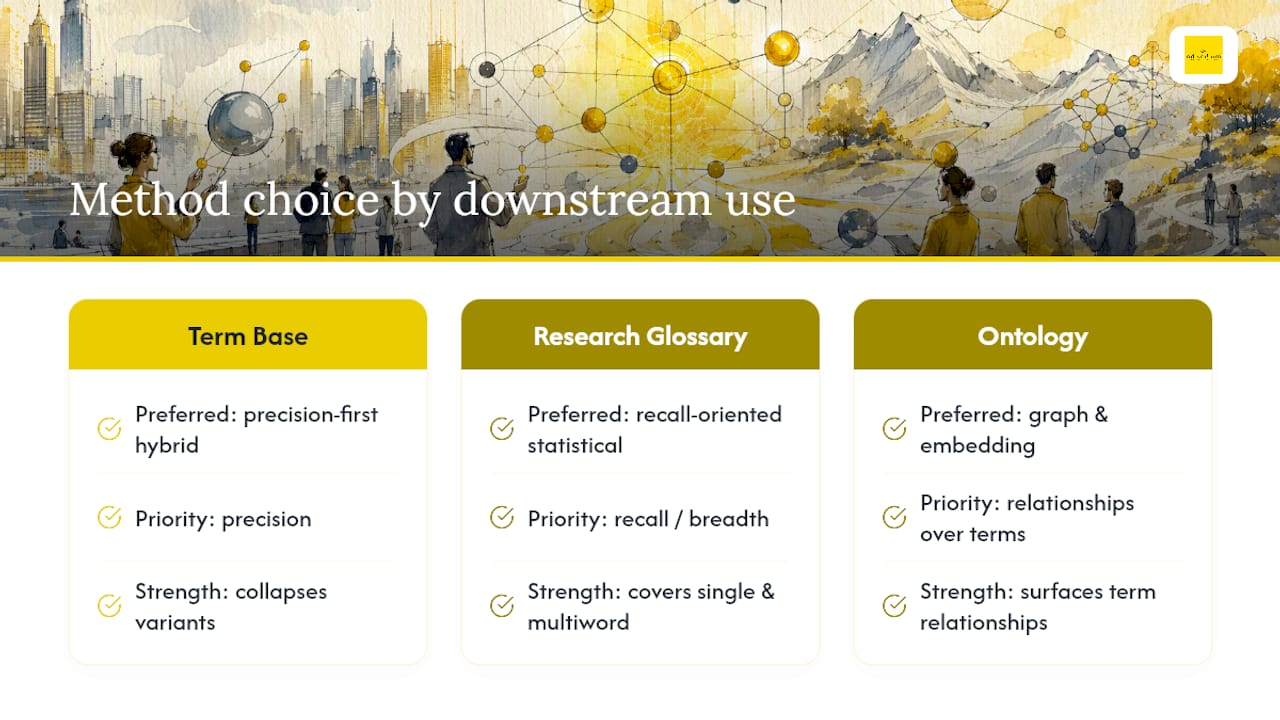
Downstream use dictates method choice. Feeding a Translation Memory or Term Base favors precision-first hybrid methods. Building a broad research glossary favors recall-oriented statistical methods. Ontology construction benefits from graph and embedding approaches that surface relationships between terms, not just the terms themselves.
How Do the Core Extraction Methods Compare?
Each method family trades off differently between precision, recall, language independence, and setup cost.
Linguistic methods rely on part-of-speech (POS) patterns, noun-phrase chunking, and templatic rules (adjective + noun, noun + preposition + noun, and similar sequences). They deliver strong precision, especially in morphologically rich languages where grammatical structure signals term boundaries clearly. The tradeoff is language dependence: every new language needs its own tagger and rule set, and rules trained for one domain often misfire in another.
Statistical methods score candidates using frequency and distribution: term frequency (TF), TF-IDF, pointwise mutual information (PMI), T-score, and log-likelihood ratio (LLR). These are language-agnostic and scale well, but output quality depends heavily on corpus design. A background or contrastive corpus (general-language text used as a baseline) is what lets these methods tell “domain-specific” apart from “just common.”
Hybrid methods combine linguistic templates with statistical ranking, and this is where most production systems land. The classic example is the C-value/NC-value technique, which explicitly handles nested terms (distinguishing “breast cancer” from “breast cancer screening protocol”) and weights candidates by how often they appear inside longer, more complex expressions. C-value/NC-value remains popular because it is lightweight to implement and holds up across domains without heavy retraining.
Graph-based methods build co-occurrence graphs from a text and rank candidates using centrality measures, the same principle behind TextRank. These methods are context-aware and often unsupervised, which makes them attractive when annotated training data doesn’t exist, though they can surface generically important phrases that aren’t actually domain terms.
Embedding and ML methods use supervised sequence taggers or transformer-based embeddings, ranking candidates by cosine similarity to document-level context (the approach KeyBERT popularized). These methods can outperform frequency-based scoring in noisy corpora, but they need either labeled training data or careful negative sampling. Without that, embedding rankers tend to surface common phrases that sound domain-specific but aren’t.
The practical trade-offs break down like this:
Linguistic methods: high precision, low recall, language-dependent, minimal compute.
Statistical methods: language-agnostic, corpus-size sensitive, moderate precision.
Hybrid methods: best balance of precision and recall, moderate setup cost.
Graph-based methods: no training data required, but weaker at distinguishing domain-specific from generically salient terms.
Embedding/ML methods: highest ceiling on noisy or ambiguous corpora, but the most data- and compute-hungry.
What Preprocessing Steps Matter Before You Extract Terms?
Extraction quality is set before a single scoring algorithm ever runs. A reproducible pipeline follows this sequence:
Compile the corpus, including a background or contrastive corpus of general-language text when using statistical or hybrid scoring, so the system has a baseline to compare against.
Clean the text, removing boilerplate, markup, and encoding artifacts that inflate false candidates.
Tokenize, lemmatize, and POS-tag the corpus so linguistic filters and statistical counts operate on consistent units.
Chunk into noun phrases or other syntactic patterns to generate the candidate pool.
Set n-gram length and minimum frequency thresholds, and decide how nested terms get handled (keep both the full phrase and its substrings, or collapse to the longest form).
Align bilingual or multilingual corpora when doing cross-lingual extraction, using sentence-level alignment hints to map candidate terms across languages.
Skipping the background corpus step is the most common mistake in statistical extraction. Without it, high-frequency general words routinely outrank genuine domain terms.
How Do You Measure Extraction Quality?
Extraction quality is reported using precision@k (the share of correct terms among the top k candidates), recall (the share of true terms actually found), F1 (their harmonic mean), and mean average precision (MAP) for ranked output. Reproducibility guidance recommends publishing corpus construction details, preprocessing steps, and parameter settings alongside these figures, since scores are not comparable across differently built corpora.
Reported figure: Termolator, an open-source hybrid tool combining chunking, statistical scoring, and search-based signals, reports approximately 85% precision for its top 5,000 ranked terms under the test conditions described in its supporting papers. That figure is domain- and corpus-specific, not a universal benchmark.
Gold-standard creation matters as much as the metric itself. Annotator agreement should be reported, and sampling for manual review should be stratified across frequency bands, not just pulled from the top of a ranked list. When the goal is downstream, extrinsic evaluation, measuring whether extracted terms actually improve translation consistency or search retrieval, tells you more than an isolated precision score ever will.
What Tools Actually Implement These Methods?
A handful of tools cover most of the method space researchers work with:
Termolator: hybrid, combining statistical scoring with search-based knowledge signals; strong for English biomedical and technical text.
YAKE: purely statistical and unsupervised, using term frequency and positional features; no training data required.
RAKE: heuristic, based on word co-occurrence within candidate phrases; fast, but weaker at filtering non-specific terms.
KeyBERT: embedding-based, ranking candidates by cosine similarity between phrase and document embeddings.
spaCy-based rule extractors: linguistic, built on custom POS and dependency patterns for a target domain.
A workable reproducible workflow looks like this: run a linguistic chunker to generate the candidate pool, score candidates with a statistical or embedding ranker, route the top-ranked list to human review, then push validated terms into a term base. Open-source multilingual coverage is uneven. YAKE and spaCy pipelines support many languages reasonably well; Termolator’s published results are English-focused, so non-English deployments generally require retuning or a different tool entirely.
Pro Tip: Run two extractors in parallel on the same corpus, a statistical one and an embedding one, and treat only the overlap as high-confidence candidates for automatic term base entry. Everything outside the overlap goes to manual review instead of getting auto-approved.
Which Extraction Method Fits Your Project?
Method choice comes down to four constraints: corpus size, annotation budget, required language coverage, and whether the project needs precision or recall more.
Small corpus, tight budget: linguistic rules plus manual review. Statistical methods need volume to produce reliable frequency signals.
Large unlabeled corpus, no annotation budget: statistical or graph-based methods, since neither requires labeled training data.
Production glossary for regulated content: hybrid extraction plus subject-matter-expert (SME) quality assurance. Precision failures here carry compliance risk, not just inconvenience.
Multilingual project: favor tools with demonstrated non-English support (YAKE, spaCy-based pipelines) over English-only systems like Termolator unless you plan to retrain.
Ambiguous or noisy source text: embedding methods, if you can afford to compute and can build a negative-sampling strategy to suppress generically salient but non-specific phrases.
Embedding and ML methods carry the highest compute and data cost of the five families, so they’re rarely the first choice unless statistical and hybrid methods have already failed to hit the required precision.
How Should Extracted Terms Be Governed in Production?
Extraction output is a candidate list, not a finished glossary. Turning it into something usable in a regulated translation workflow means integrating validated terms into Translation Memories ™ and Term Bases (TB), routing ambiguous candidates to subject-matter-expert sign-off, and running QA checkpoints aligned to ISO 17100 and ISO 18587.
A typical AI+HUMAN hybrid workflow illustrates one version of this governance model: asset integration (ingesting existing TM/TB first), LLM-based generation constrained by that terminology, certified SME review for technical accuracy, then QA aligned to ISO 17100/18587 and sector requirements where applicable.

Common failure modes include noisy candidate lists from under-filtered statistical output, nested-term inflation (where “cancer,” “breast cancer,” and “breast cancer screening” all get logged as separate unrelated entries), and domain drift as a corpus ages. Mitigation is procedural: contrastive corpora refreshed periodically, explicit nested-term collapsing rules, and mandatory SME review before terms enter a live term base.
Pro Tip: Set a nested-term collapsing rule before extraction runs, not after. Deciding retroactively which of ten overlapping candidate phrases is the “real” term creates far more rework than defining the rule up front.
Where Should Research Teams Start With Adoption?
Adoption stalls when teams try to pick one method and commit before testing it. A better sequence: build a small annotated gold set, run two extraction families against it in parallel, and only integrate the winner into a term base with SME validation attached. That comparison tells you more in a week than months of debate about which method is theoretically superior.
— Eric Brown
Sources
For teams scaling extraction across multiple language pairs, multilingual workforce planning becomes a factor once validated terms need review across regional linguist teams rather than a single reviewer. Operationalizing extracted terminology into live, audited translation workflows is where AD VERBUM’s multilingual SEO and LLMO and professional translation services apply, particularly for regulated content requiring ISO-aligned QA and SME sign-off at scale.
FAQ
What Are the Different Types of Extraction Methods?
Terminology extraction methods split into linguistic (POS patterns and chunking), statistical (TF-IDF, PMI, C-value/NC-value), hybrid (combining both), graph-based (TextRank and co-occurrence centrality), and embedding/ML approaches (transformer-based ranking like KeyBERT).
What Are the Three Types of Extractions?
If reduced to three broad categories, the standard survey framing groups methods as linguistics-based, statistics-based, and hybrid, with graph-based and embedding methods treated as more recent extensions to that base taxonomy.
What Are the Different Methods Used to Extract Data?
For terminology specifically, extraction methods include rule-based linguistic chunking, statistical scoring (TF-IDF, log-likelihood ratio), hybrid ranking formulas like C-value/NC-value, and machine-learning approaches using supervised taggers or embeddings.
What Are Other Words for Extraction?
In terminology work, “extraction” is often used interchangeably with “term identification,” “candidate term mining,” or “keyphrase extraction,” though the last term more commonly refers to lighter-weight keyword-focused methods like RAKE and YAKE rather than full termhood-based term extraction.
Recommended

