


Avoid ITAR Violations: Export Controlled Translation with U.S. Person Processing

If a document contains technical data on items listed on the U.S. Munitions List or the Commerce Control List, its translation is an export controlled act, not a routine language task. The immediate move is to classify the content before a single word gets translated, restrict access to authorized personnel, and route the job through a workflow that produces an audit trail. AD VERBUM fits projects that need ISO-aligned QA, subject-matter expert review, and documentation regulators or auditors can actually check.
TL;DR:
Strict classification and USML or CCL citation recording are essential before translating any technical data on regulated lists to avoid export violations.
Onshore processing with U.S.-person staff, encrypted transfer, and detailed audit trails are mandatory for ITAR-controlled documents, especially those with USML data.
Using a vendor with ISO-certified quality management, data sovereignty infrastructure, and certified review processes reduces export control risks during translation.
Proper personnel vetting, role-based access, and retaining detailed logs are critical to defend against potential federal investigations for export violations.
Many compliance failures stem from operational gaps like unvetted translators, inconsistent terminology, or missing audit records, rather than technical complexity.
Table of Contents
What Counts as Export Controlled Translation?
Two federal regimes govern this. The International Traffic in Arms Regulations (ITAR), enforced by the Directorate of Defense Trade Controls (DDTC), covers defense articles and technical data on the U.S. Munitions List (USML). The Export Administration Regulations (EAR), enforced by the Bureau of Industry and Security (BIS), covers dual-use and commercial items on the Commerce Control List (CCL). Translating technical data linked to either list can constitute a “deemed export,” meaning simply giving foreign national access to that technical content, even inside the U.S., counts as an export.
Document types that commonly trigger controls include:
Engineering drawings and CAD files with dimensional or performance specifications
Software source code and firmware documentation for controlled systems
R&D reports, test data, and failure analysis for defense or dual-use hardware
Technical manuals, spec sheets, and material composition data
Export license applications and their supporting technical annexes
Regulatory translation work carries the same expectation as the source documentation: version control, documented review steps, and terminology governance baked into the process, not bolted on afterward.
How Do You Build a Secure Translation Workflow?
A defensible workflow follows a fixed sequence, and skipping a step is usually where exposure creeps in.
Classify the document and record the specific USML or CCL citation, along with a note on whether a license is required for the target audience or country.
Ingest translation memories and term bases under controlled access before generation starts. Nobody outside the authorized project team should touch the source files first.
Assign only vetted personnel. For ITAR material, that generally means U.S. citizens or lawful permanent residents, backed by signed NDAs and background screening.
Run the AD VERBUM AI+HUMAN hybrid translation sequence: asset integration, then LLM generation constrained by the client’s terminology, then certified subject-matter expert review for technical accuracy and regulatory nuance, then quality assurance aligned to ISO 17100 and ISO 18587.
Lock down hosting and transfer. Encrypted transfer, role-based access, version control, and full activity logging need to be active before, not after, the file moves.
Retain the evidence. Access logs, timestamps, reviewer notes, and final sign-off should sit in a record any auditor could pull on short notice.
Pro Tip: Ask your vendor to show you a sample audit trail before you sign anything. If they can’t produce one on request, that’s your answer about whether they can produce one during an actual audit.
When Does ITAR Require U.S.-Only Processing?
Not every controlled document needs the same level of restriction. Mapping content correctly saves both cost and risk; understanding how to source TAA compliant hand tools can similarly help manage procurement and regulatory obligations.
Check the list first. DDTC’s USML categories cover defense articles directly; BIS’s CCL covers dual-use and commercial items, often with a lower control threshold. A document tied to USML content almost always demands stricter handling than one tied to CCL alone.
Apply the U.S. person rule. ITAR generally restricts access to U.S. citizens, lawful permanent residents, and certain protected individuals. Ownership and staffing screening, including the so-called 50% rule some contracts apply to foreign ownership thresholds, can affect which vendor entities even qualify.
Decide on hosting. ITAR-controlled technical data typically requires U.S.-based hosting and U.S.-person-only processing to avoid a deemed export. EAR-controlled content sometimes tolerates enterprise-grade controls outside the U.S., but that depends on the specific classification and license conditions.
Demand vendor evidence. ISO 17100 and ISO 9001 certifications, proof of subject-matter expert review, access logs, and role-based access controls are the baseline documentation to request before signing.
Set a minimum audit package. Every deliverable should ship with a classification record, a reviewer sign-off, and a timestamped log of who touched the file and when.
Two Scenarios: Defense Drawings vs. Medical Submissions
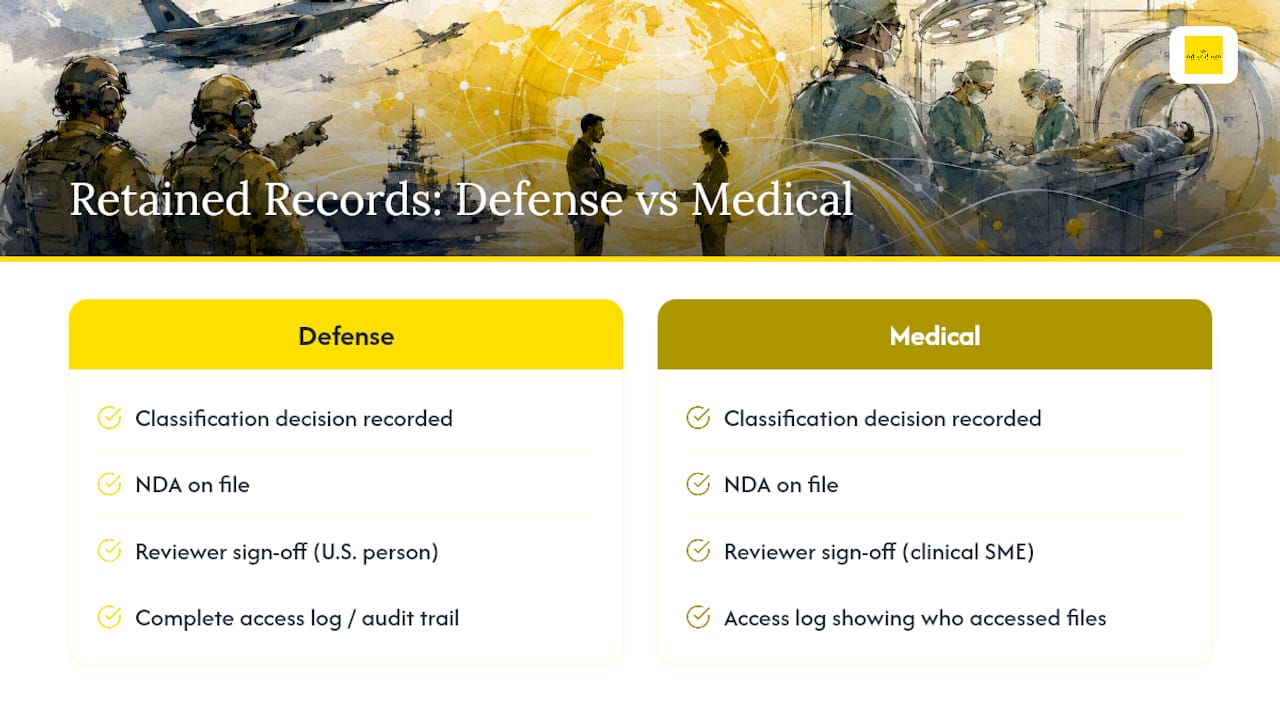
Example A: a defense engineering drawing. A subcontractor needs a technical drawing translated for a foreign partner review. Because the drawing carries USML-level dimensional and performance data, the project requires onshore-only processing, U.S.-person translator and reviewer assignment, encrypted handover, and a complete audit trail from intake to delivery.

Example B: a medical device regulatory submission. A manufacturer needs a technical file translated for an overseas regulatory filing that touches sensitive but non-munitions technical data. Here an ISO-aligned workflow with a subject-matter expert clinical reviewer and contractual data-processing safeguards is usually sufficient. An EU-hosted vendor may be acceptable if the contract terms and access controls pass review by export-control counsel.
Both cases need the same retained records: the classification decision, the NDA on file, the reviewer’s sign-off, and a log showing exactly who accessed the source and target files.
What Mistakes Create Export Control Exposure?
Most exposure comes from a handful of recurring gaps, not exotic edge cases.
Misclassification. Skipping upstream classification and legal sign-off means nobody catches a USML citation until it’s too late. Mitigation: make classification a mandatory gate before any file leaves the originating team.
Unvetted translator assignment. Sending controlled files to a freelance pool without screening is how deemed-export violations happen. Mitigation: enforce U.S. person staffing rules for ITAR work, or use a vendor with documented vetting controls.
Term drift. Inconsistent terminology across versions muddies technical meaning and creates regulatory ambiguity. Mitigation: lock the term base and translation memory, and require subject-matter expert sign-off on terminology changes.
Weak or missing logs. No revision history means no defense during an audit. Mitigation: require immutable logs, time-stamped sign-offs, and retained QA records for every project.
Even a single mishandled ITAR-controlled file can trigger a federal investigation, and penalties for violations can be severe, which is exactly why the paperwork matters as much as the linguistics.
Pro Tip: If your vendor can’t tell you, in writing, who reviewed a file and when, treat that as a missing control, not a minor gap.
Where Does AD VERBUM Fit for Regulated Translation?
AD VERBUM is a reasonable fit when a project needs ISO/QMS-level auditability, subject-matter expert review, tight terminology governance, and faster turnaround than a traditional agency model delivers. The company runs an AI+HUMAN hybrid translation workflow in a fixed sequence: asset integration of client translation memories and term bases, LLM generation constrained by that terminology, certified subject-matter expert review for technical accuracy, then QA aligned to ISO 17100 and ISO 18587.
Proof points worth checking against your own vendor requirements:
Decades of experience operating in regulated language services with a large network of subject-matter expert linguists
Support for many languages and regional variants
Multiple certifications including ISO standards, independently audited
EU-hosted infrastructure designed for data sovereignty without reliance on outsourced public cloud tooling
For strict ITAR projects that require U.S.-hosted processing and U.S.-person-only staffing throughout, verify the hosting and personnel clauses directly during contracting. AD VERBUM’s EU-hosted infrastructure suits EAR-level and regulatory documentation well; ITAR-specific engagements need that onshore confirmation up front.
Compliance Checklist for Export Controlled Translation Projects
Classify first: confirm USML or CCL status with your legal or export control office before translation begins.
Demand vendor evidence: hosting location, access logs, role-based access, and current ISO/QMS certificates.
Apply personnel rules: U.S. persons for ITAR content; documented vetting for other sensitive material.
Retain records: classification notes, NDAs, reviewer sign-offs, and access logs, kept for the retention period your legal counsel sets.
Escalate uncertainty: when classification is unclear, involve legal counsel before the file moves anywhere.
A single missed license determination is one of the most cited triggers for ITAR investigations in industry writeups on translation risk, which is reason enough to make classification the first step, not an afterthought.
The Compliance Gap Most Teams Miss
Most guidance on this topic treats translation as an afterthought bolted onto export compliance programs built for hardware, shipping, and licensing. That gets the sequence backward. Translation is one of the more common ways technical data actually crosses a boundary, whether that boundary is national or just a foreign national sitting at a desk in Ohio. A “deemed export” doesn’t need a border crossing to happen.
The conventional advice tells compliance teams to “use a certified translator.” That’s necessary but nowhere near sufficient. Certification speaks to language competence. It says nothing about hosting location, personnel citizenship, or whether the vendor can produce a timestamped log six months after delivery when an auditor asks for one. The real gap sits in operational controls, not linguistic skill.
If there’s one priority, it’s this: treat your translation vendor selection with the same rigor you apply to a cloud services provider handling controlled data. Ask for the audit trail before you need it, not after.
— Eric Brown
Request a Compliant Translation Engagement
AD VERBUM fits projects that need ISO-aligned QA, subject-matter expert review, locked terminology governance, and turnaround measured in days rather than weeks. That combination matters most when a compliance team can’t afford to explain a missing audit log after the fact.
The AI+HUMAN hybrid translation workflow, built on asset integration, LLM generation, certified SME review, and QA aligned to ISO 17100 and ISO 18587, gives compliance officers and localization leads a documented process they can hand to an auditor without editing it first. If your project involves regulated technical documentation and needs audit evidence built in from day one, request an engagement through AD VERBUM Services or reach the team directly via Contact to scope classification requirements before translation starts.
Sources
Compliance and legal teams should verify current DDTC and BIS guidance directly for any active licensing determination, since classification rules and license conditions change independently of vendor practices.
Recommended

