


Fix Terminology in 180 Days: ISO Governance for Regulated Translation

Adopt a governed terminology program built on four elements: an authoritative termbase as the single source of truth, documented policies with clear ownership, integration with your TMS/CMS toolchain, and ISO-aligned quality assurance. For regulated content, this is the only defensible posture, since inconsistent terms in labels, safety instructions, or contracts create real compliance exposure. Start by piloting a termbase for your highest-risk terms before scaling further.
TL;DR:
Establishing a single source of truth with an ISO-aligned, concept-based termbase is essential for regulatory compliance and effective governance.
Clear ownership roles, approval workflows, and hard SLAs prevent overlooked or outdated terminology, ensuring audit readiness.
Integrating termbases directly into authoring, translation, and AI workflows minimizes errors and enforces approved terminology automatically.
Regular audits, version control, and detailed documentation are critical for maintaining quality and passing regulatory inspections.
Most failures stem from organizational issues like unclear ownership or weak enforcement rather than technical shortcomings.
Table of Contents
What Is Terminology Governance in Translation?
Terminology governance is the set of policies, processes, and ownership structures that control how approved terms get created, approved, stored, and applied across every language version of your content. It sits above translation execution, not inside it: execution is the act of rendering a document into another language, while governance is the standing system that decides which term is correct, who approved it, and how that decision gets enforced.
The scope includes your termbase, the distinction between authoritative and informative language versions, and your style guides. It excludes day-to-day project management or vendor selection, though it directly shapes both. Terminology work is foundational to accurate, legally sound translation in regulated environments, where a mistranslated term in a device label or a contract clause carries measurable legal risk.
What Are the Core Components of Terminology Governance?
Effective governance rests on five interlocking pillars. Miss one, and the others tend to erode within a few quarters.
Single source of truth. A TBX-capable termbase aligned to ISO 704 and ISO 30042 principles and terminology, so every stakeholder pulls from the same record rather than a spreadsheet variant.
Policy and authorization. Written rules defining who can propose, approve, and retire a term, with named roles rather than “the team.”
Standard operating procedures. The concrete workflow that turns policy into repeatable action, from request to publication.
Tool integration and enforcement. Termbase connections to translation memory, TMS, CMS, and AI generation layers so approved terms surface automatically instead of relying on memory.
Multi-stage QA and audit readiness. Checks at pre-translation, review, and post-publication, with records that can survive an external audit.
ISO 17100 explicitly ties terminology specifications to translation service provider obligations, which means governance isn’t a nice-to-have layered on top of quality. It’s part of what the standard expects a compliant supplier relationship to include.
How Do You Build an Authoritative Termbase?
The termbase is the mechanical core of the whole system, and its data model determines whether governance actually holds up under scrutiny. A termbase built as a flat glossary will not survive a regulatory audit or a multilingual expansion; one built on concept-based entries will.
Define term entry fields. Each entry needs a concept ID, preferred term, definition, usage context, source, approval status, and an authority flag marking whether it’s mandatory or advisory.
Use TBX for interoperability. Export and import in TBX or an ISO-compliant format so the termbase moves cleanly between your TMS, CAT tools, and any vendor you engage without manual reformatting.
Map authoritative versus informative language versions. Not every target language carries equal legal weight. ENOSEMA’s multilingual terminology guidance recommends explicit equivalence mapping so translators know which version governs in a dispute.
Lock down version control. Every change needs a timestamp, a change log entry, and role-based access control limiting who can edit a live entry versus who can only propose one.
A termbase without authority flags is just a dictionary. One with them becomes an enforceable contract between your content teams and your translators.
Who Owns Terminology Decisions and How Are They Approved?
Governance fails most often not from bad tools but from unclear ownership. A workable role matrix assigns a terminology owner (usually a localization lead), an SME approver (a regulatory, legal, or technical expert), a localization project manager, the translator or reviser doing the work, and a legal or compliance reviewer for regulated terms.
Every proposed term change routes through a defined approval gate with a service-level agreement, not an open-ended email thread.
Escalation paths exist for disputed terms, typically routing to the SME approver first and legal review second.
Each change carries documentation: the rationale, supporting evidence, and the name of the approver on record.
The standard sequence runs request, review, approve, publish, then sync to the translation memory and TMS.
Pro Tip: Set a hard SLA on term approval with defined timelines for standard and safety-critical terms. Undefined timelines are the single most common reason governance programs quietly collapse.
How Do You Integrate Termbases Into Translation Workflows?
Governance only works if the correct term is the path of least resistance, not an extra step someone skips under deadline pressure. The flow should run from authoring, through the CMS, into the TMS, and finally sync with your TM and termbase in both directions.
Configure real-time term checks in authoring tools so writers see flagged terminology before content ever reaches translation.
Run pre-translation term extraction to surface every candidate term in a document before a linguist starts work.
Constrain AI-generated output with an enforced term list fed directly into the generation instructions, rather than correcting after the fact.
Apply access controls and data residency rules for sensitive content, particularly where regulatory frameworks like GDPR or HIPAA govern where source material can be processed.
Treating governance as both a people problem and a tooling problem is the detail most programs get wrong. Policy without enforcement hooks just becomes a document nobody reads.
How Do You Measure Terminology Quality and Prove Auditability?
Quality assurance needs to happen in layers, not as a single pass at the end. Pre-checks catch terminology errors before a linguist even starts. SME review catches technical and regulatory nuance. LQA sampling catches what automated checks miss. Post-publish monitoring catches drift after the fact.
Track term reuse rate: how often the approved term gets used versus a synonym slipping through.
Track TM leverage improvement over successive projects as the termbase matures.
Track LQA scores against a defined error typology, not a vague pass/fail.
Track issue ticket volume tied to terminology, which should trend downward as governance takes hold.
Programs with documented approval records, version history, and sample LQA reports on file are the ones that pass a regulatory audit without a scramble. Programs without them spend weeks reconstructing decisions after the fact.
What Is the Implementation Sequence for Terminology Governance?
Assess. Inventory existing terms, systems in use, stakeholders, and the highest-risk content areas before touching a tool.
Pilot. Pick a narrow, high-impact scope, such as safety-critical terms in one product line or one regulated market, and prove the workflow there first.
Integrate. Connect the termbase to your TMS and CMS, and configure enforcement so approved terms surface automatically rather than relying on manual checks.
Roll out. Train the full team, set a KPI baseline from the pilot data, schedule recurring audits, and treat the whole thing as a continuous cycle rather than a one-time project.
Most programs stall at step three because integration gets treated as an IT ticket instead of a governance requirement with its own sign-off. Budget for it as a project milestone, not an afterthought.
What Are the Most Common Governance Failures?
Terminology programs tend to fail in predictable ways, and each one has a straightforward fix.
Decentralized edits create orphaned terms. Mitigate with enforced workflow gates and access control that prevents direct edits to the live termbase.
The termbase goes stale. Mitigate with scheduled quarterly audits and a visible change log so drift gets caught early, not discovered during an audit.
SMEs disengage from the process. Mitigate with tight SLAs, visible cost-savings data from reduced rework, and a permanent seat for SMEs in the approval matrix rather than ad-hoc consultation.
Tooling gaps stall enforcement. Mitigate with lightweight pre-commit term checks first, then phase in fuller TMS integration once the workflow proves itself.
Pro Tip: If your SME approvers are missing their SLAs more than once a quarter, that’s not a discipline problem. It’s a sign the approval workload is too heavy for the role as scoped, and you need a second approver or a narrower escalation trigger.
How Does AD VERBUM Operationalize Terminology Governance?
AD VERBUM runs terminology governance through a defined sequence: asset integration pulls in a client’s existing translation memory and termbase first, its proprietary LLM-based system generates output constrained by that terminology, a certified subject-matter expert reviews for technical and regulatory accuracy, and quality assurance follows ISO 17100 and ISO 18587 protocols.
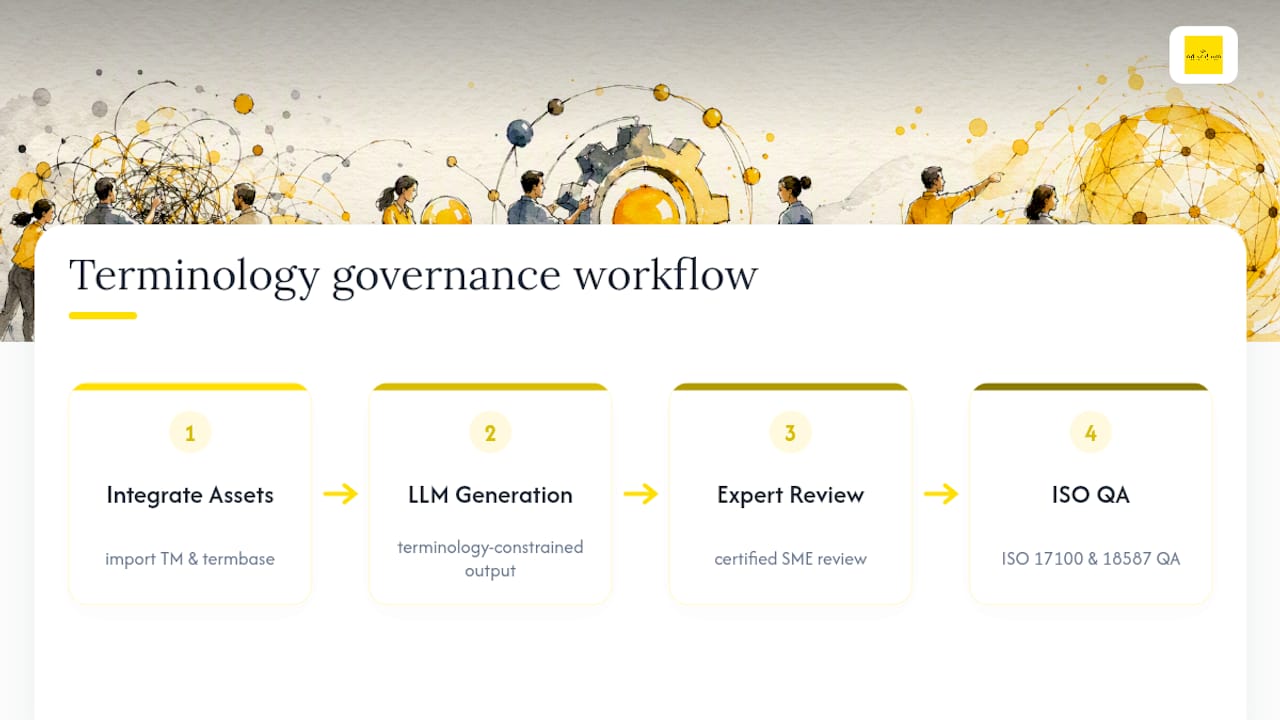
This is AI+HUMAN hybrid translation, not machine translation with a spell-check layer. AD VERBUM holds ISO 9001, ISO 17100, ISO 18587, ISO 13485, ISO 27001, ISO 42001, and AQAP2110 certifications, independently audited by Bureau Veritas. That certification stack matters most when a reader is choosing a partner for regulated content that needs an audit trail, strict data sovereignty, and enforced terminology rather than best-effort consistency.
What Should You Do in the Next 30, 90, and 180 Days?
Days 1 to 30: Align stakeholders, name your terminology owner, and inventory the terms for your pilot scope.
Days 31 to 90: Integrate the pilot termbase with your TMS, set a KPI baseline, and train the pilot team.
Days 91 to 180: Roll governance out beyond the pilot, schedule recurring audits, and treat improvement as ongoing, not a one-time fix.
Why Auditability Beats Ad-Hoc Fixes in Regulated Translation
Every regulated-sector project I’ve reviewed converges on the same lesson: the programs that hold up under audit are the ones where SME involvement was built into the approval gate from day one, not bolted on after a compliance officer raised a flag. Teams that treat terminology as a documentation exercise, something to tidy up before a submission, consistently rediscover the same errors project after project.
The uncomfortable truth is that most governance failures aren’t technical. They’re organizational. A termbase without an enforced approval matrix is a wish list. What separates a program that survives a regulator’s questions from one that doesn’t is whether every term change left a paper trail before anyone asked for one. Integration work, the unglamorous part of connecting a termbase to a TMS and configuring real enforcement, does more for compliance than any policy document ever will.
— Eric Brown
Where Does AD VERBUM Fit for Regulated Translation Needs?
If your content touches medical devices, financial disclosures, defense specifications, or legal filings, terminology governance stops being optional and becomes a documented obligation. AD VERBUM is built for exactly that gap: an AI+HUMAN hybrid translation workflow that ingests your existing termbase and translation memory, constrains generation to your approved terms, and routes every project through certified subject-matter expert review and ISO-aligned QA.
The service runs across 150+ languages, on EU-hosted infrastructure with no reliance on outsourced public cloud processing, aligned to GDPR, HIPAA, and MDR requirements. That combination gives compliance and localization leads an audit trail they can hand to a regulator without reconstruction. If your team is evaluating a partner for regulated documentation, review AD VERBUM’s translation and localization services and request a project quote to see how the terminology enforcement workflow maps to your existing termbase.
Where Can You Find Authoritative Terminology Standards?
ISO 17100:2015(E) — Translation Services Requirements
Sources
Recommended
