


Data-Secure Localization Examples for Regulated US Documents

Data-secure localization, in the context of regulated US documentation, means a translation and localization service that enforces documented information security controls throughout the entire workflow: from file intake to encrypted delivery. Qualifying examples include:
An ISO/IEC 27001-scoped Information Security Management System (ISMS) covering the translation management system (TMS), CAT tools, and all vendor access points
Encrypted TMS with role-based access controls (RBAC) and multi-factor authentication (MFA)
A signed Business Associate Agreement (BAA) for any project touching HIPAA-covered protected health information (PHI)
Translation Memory ™ and Term Base (TB) integration with versioned exports and access logs for full traceability
An audited AI+HUMAN hybrid translation workflow with SME review and ISO 17100/18587-aligned QA
EU-hosted private infrastructure with no reliance on public cloud tooling for core processing
Documented retention and disposition schedules with audit-ready evidence delivery
EDGAR-compliant English translations of foreign-language exhibits, with the unabridged source document available on request
This article does not cover national data-localization laws or data-residency mandates. Those are a separate legal topic with a different audience.
Key Takeaways
Data-secure localization for regulated US documents requires a documented ISMS, certified QA processes, and contractual controls that produce audit-ready evidence at every project stage.
Point | Details |
Require ISO 27001 scope confirmation | Verify your project falls within the vendor’s certified ISMS scope, not just that a certificate exists. |
Demand a BAA for PHI | Any project touching HIPAA-covered content requires a signed BAA before file transfer. |
Insist on TM/TB traceability | Versioned TM exports and locked TB update permissions are the primary controls against terminology drift. |
Require segment-level QA logs | Summary QA reports do not satisfy EDGAR or MDR audit evidence standards; segment-level logs do. |
AD VERBUM as a vetted pilot vendor | AD VERBUM holds ISO 27001, ISO 17100, ISO 18587, ISO 13485, and NATO AQAP2110 certifications, audited by Bureau Veritas, with EU-hosted infrastructure and BAA capability. |
Table of Contents
What does data-secure localization actually mean for regulated documents?
How do you implement a secure localization workflow step by step?
What must your vendor contract include for US regulated work?
What are the most common failure modes in regulated localization?
What procurement teams consistently get wrong about secure localization
AD VERBUM handles regulated localization with audit-ready evidence
What does data-secure localization actually mean for regulated documents?
Data-secure localization is the practice of applying documented information security and quality controls to translation and localization workflows that handle sensitive, regulated, or legally consequential content. The term is not an industry standard phrase; the recognized frameworks are ISO/IEC 27001 (information security management), ISO 17100 (translation process quality), and ISO 18587 (post-editing of machine translation output).
In-scope document types for US regulated work include:
EDGAR filings with foreign-language exhibits under 17 CFR §232.306
Clinical trial protocols, informed consent forms, and case report forms containing PHI
Medical device Instructions for Use (IFUs) and labeling under FDA MDR requirements
Financial disclosures, prospectuses, and regulatory correspondence
Defense technical manuals and NATO-aligned documentation
Out of scope for this article: national data-localization laws, data-residency mandates, and cross-border data transfer regulations. Those govern where data is stored geographically. This article covers how translation workflows protect the content itself.
How do you implement a secure localization workflow step by step?
Defining the ISMS scope is the first and most consequential step. Scope must map every system that touches client data: TMS, CAT tools, MT/AI engines, cloud storage, and all supplier access points. A scope that is too narrow leaves gaps auditors will find; too broad and the certification becomes unmanageable.
Intake and classification. Classify each document by sensitivity level (PHI, CUI, confidential commercial). Assign a data handling tier before any file moves. Control: encrypted transfer only (SFTP or equivalent), no email attachments for regulated content.
ISMS boundary alignment. Confirm the vendor’s ISO 27001 scope statement covers the specific systems and personnel handling your project. Request the Statement of Applicability (SoA). Control: written confirmation that your project falls within the certified scope.
TMS/CAT configuration. Configure RBAC so only assigned linguists and reviewers access project files. Enable MFA. Disable export permissions for non-authorized roles. Control: access log retained for the duration of your audit cycle.
TM/TB ingestion. Load client-owned Translation Memories and Term Bases before any generation begins. Lock terminology updates behind an approval workflow. Control: versioned TM exports with timestamps and user attribution.
Constrained AI generation. If the vendor uses an LLM-based system, confirm it operates on private infrastructure (not a shared public API) and that generation is constrained by the ingested TM/TB. Legacy MT and generic NMT engines carry higher terminology-drift risk in safety-critical text.
SME human review. A certified subject-matter expert reviews every segment for technical accuracy, regulatory compliance, and contextual nuance. This step satisfies the ISO 18587 post-editing requirement and is non-negotiable for HIPAA-covered or MDR-relevant content.
QA with audit logs. Run QA checks aligned to ISO 17100 and ISO 18587. Log every revision with reviewer ID, timestamp, and change rationale. For EDGAR filings, retain the QA log as evidence of the “fair and accurate” translation standard.
Encrypted delivery and retention. Deliver final files via encrypted channel. Document the retention period and disposition method in writing. For HIPAA-covered projects, the BAA governs minimum retention; for EDGAR, retain the unabridged foreign-language source and the English translation together.
Pro Tip: Lock Term Base update permissions to a single designated terminology manager and require a written change request for any new entry. Run a versioned TM diff report after every project to catch unauthorized segment changes before they propagate into future translations.
What must your vendor contract include for US regulated work?
Procurement teams routinely underestimate how much contractual specificity matters here. An NDA alone does not satisfy ISO 27001 supplier controls or HIPAA requirements.
Mandatory technical and organizational controls to verify:
ISO 27001 certificate with scope statement covering the systems handling your data
ISO 17100 and ISO 18587 evidence (certificates plus recent internal audit summary)
BAA for any project involving PHI, signed before file transfer
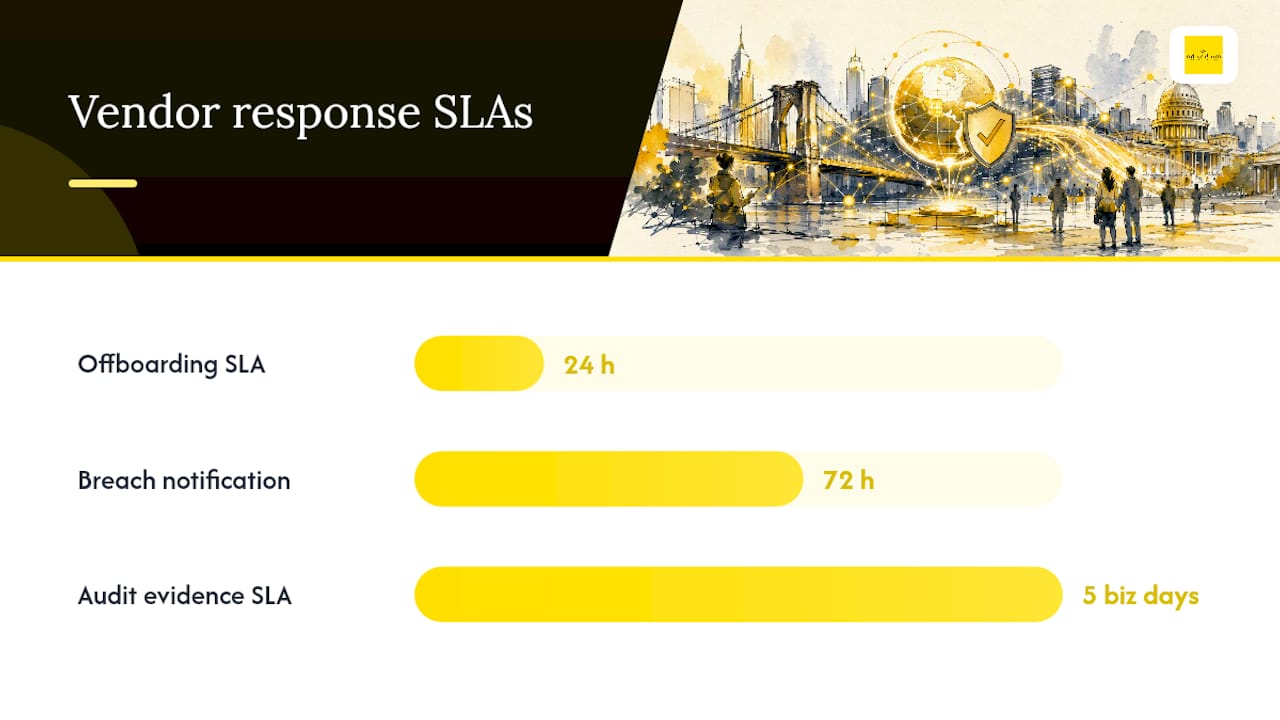
Client audit rights: contractual right to request evidence within a defined SLA (typically 5 business days)
Documented retention and disposition schedule, with destruction certificates on request
Personnel screening records for all staff with access to your files
Subprocessor list with controls evidence for each named subprocessor
Breach notification timeline (72 hours is the GDPR standard; align to your own incident response policy)
Offboarding procedure: credential revocation and access termination within 24 hours of project close
RFI questions that reveal actual maturity:
Provide your ISO 27001 scope statement and confirm this project falls within it.
Share your most recent internal audit summary (redacted for sensitive findings is acceptable).
Describe your supplier onboarding and offboarding procedure for freelance linguists.
What is your SLA for delivering audit evidence (access logs, QA records, TM exports)?
How do you handle a data incident involving a client’s regulated content?
Score responses as pass/fail on items 1, 3, and 5. Items 2 and 4 are maturity indicators: a vendor who cannot answer them in writing has not operationalized their ISMS. For financial services projects, confidentiality controls in regulated environments follow the same audit-evidence logic.
Two examples of secure localization in practice
Example A: EDGAR filing with a foreign-language exhibit

A foreign private issuer files an annual report on Form 20-F that includes a material contract originally executed in German. Under 17 CFR §232.306, the filing must include a fair and accurate English translation; the unabridged German original must be available on SEC request.
Minimum evidence an auditor will request:
Translator credentials and ISO 17100 process evidence
QA log showing segment-level review with reviewer ID and timestamp
Signed attestation that the translation is “fair and accurate”
Retained copy of the unabridged German source, stored with the same access controls as the filing itself
Timeline: allow several business days for a contract of standard length when SME review and QA logging are required. Rush timelines compress QA and increase risk; document any timeline exception in writing. For additional context on legal document translation requirements for EDGAR filings, the controls above apply at every step.
Key audit principle: The SEC’s “fair and accurate” standard is not a style judgment. It is a legal attestation. The translation workflow must produce evidence that a qualified reviewer verified accuracy at the segment level, not just at the document level.
Example B: Clinical trial informed consent with PHI
A sponsor localizing informed consent forms (ICFs) for a US-based Phase II trial into Spanish and Mandarin must treat every ICF as PHI under HIPAA. Controls required:
BAA executed before any file transfer
TMS access restricted to named linguists and the sponsor’s review team only
SME reviewer with clinical credentials (not a general medical translator)
QA log retained for the HIPAA minimum retention period
Disposition: secure deletion with written certificate at project close
For detailed controls on secure medical document localization, the same ISMS scope and BAA requirements apply to IFUs and device labeling under MDR.
What are the most common failure modes in regulated localization?
Most failures are predictable and preventable. The pattern is almost always a gap between what the ISMS policy says and what actually happens operationally.
Uncontrolled MT outputs. A project manager routes a file through a public NMT engine to save time. The output bypasses the TM/TB, introduces inconsistent terminology, and leaves no audit trail. Mitigation: contractually prohibit use of any MT/AI engine not listed in the vendor’s ISMS scope; require written confirmation before any tool change.
Terminology drift. New linguists add terms to the TB without approval, or the TM accumulates conflicting segments across projects. Mitigation: lock TB update permissions; run a TM diff report after every project delivery and flag conflicts before sign-off.
Missing audit trail. QA was performed but not logged at the segment level. The auditor requests evidence; the vendor provides a summary report. Mitigation: require segment-level QA logs as a contractual deliverable, not a best-effort artifact.
Inadequate supplier offboarding. A freelance linguist retains access to the TMS after project close because no one triggered the offboarding workflow. Mitigation: require a written offboarding confirmation within 24 hours of project close, with credential revocation evidence.
Insecure file exchange. Files sent via personal email or consumer file-sharing services. Mitigation: specify approved transfer methods in the contract; reject any delivery outside those channels.
Terminology drift compounds silently across projects. Catching it early costs far less than a regulatory correction.
When does AD VERBUM fit the vendor decision criteria?
AD VERBUM’s capability set maps directly to the mandatory checklist above. The relevant proof points:
ISO 27001 certification (independently audited by Bureau Veritas) covering the LangOps System and associated workflows
ISO 17100 and ISO 18587 certification for translation process and post-editing QA
ISO 13485 for medical device documentation; NATO AQAP2110 for defense content
ISO 42001 for AI governance, covering the proprietary LLM-based LangOps System
HIPAA alignment and BAA capability for PHI-covered projects
EU-hosted private infrastructure with no public cloud tooling for core processing, supporting data sovereignty requirements
TM/TB integration at the start of every project, with versioned exports available as audit artifacts
A large network of subject-matter expert linguists, including medical professionals, engineers, and legal scholars, for SME review
AD VERBUM is the appropriate choice when the content is safety-critical or regulatory-facing, when audit evidence is a contractual requirement, when terminology governance across a multi-project program matters, or when the data cannot touch public cloud infrastructure. A simpler provider may suffice for internal communications or marketing content with no regulatory consequence.
To operationalize AD VERBUM for a pilot:
Define the document scope and sensitivity classification with your compliance team.
Confirm the project falls within AD VERBUM’s ISO 27001 scope statement.
Transfer your existing TM and TB assets for ingestion before the first project begins.
Align on SME reviewer credentials required for your sector (clinical, legal, engineering).
Request a sample audit evidence package (QA log, access log, TM export) from a pilot delivery before scaling.
The secure document translation process AD VERBUM follows covers each of these steps with documented controls.
What procurement teams consistently get wrong about secure localization
The most common procurement mistake is treating ISO 27001 certification as a checkbox rather than a governance signal. A certificate tells you the vendor has a documented ISMS. It does not tell you whether your specific project falls within the certified scope, whether the controls are actually operating, or whether the vendor’s freelance network is governed by the same ISMS.
The second mistake is separating quality and security into different vendor evaluation tracks. A translation that is terminologically accurate but produced outside the ISMS scope is both a quality risk and a security risk. The two frameworks, ISO 17100 and ISO 27001, are complementary and should be evaluated together.
For legal documents handled under protective orders, the umbrella protective order framework is worth reviewing before specifying how translated exhibits should be handled in cross-border discovery.
AD VERBUM handles regulated localization with audit-ready evidence
AD VERBUM delivers AI+HUMAN hybrid translation for pharma, medical device, finance, and defense documentation, with ISO 27001, ISO 17100, ISO 18587, ISO 13485, and NATO AQAP2110 certifications independently audited by Bureau Veritas. The LangOps System runs on private EU-hosted infrastructure, enforces TM/TB terminology from the first segment, and produces segment-level QA logs as standard deliverables.
For procurement teams ready to scope a pilot or issue an RFP, the next step is a direct conversation about scope, ISMS boundary alignment, and evidence delivery format:
Professional translation services with AI+HUMAN hybrid workflows and SME review
Full services overview covering technical, legal, medical, and defense documentation
Multilingual SEO and LLM optimization for regulated content programs
Contact AD VERBUM to request a compliance capability summary and sample audit evidence package before committing to a full engagement.
Sources
17 CFR § 232.306 - Foreign language documents and symbols. | Electronic Code of Federal Regulations (e-CFR) | US Law | LII / Legal Information Institute
This article is general information, not a substitute for advice from a qualified lawyer. Consult a qualified legal professional about your own circumstances before acting on anything here.
Recommended
