


Compliance Requirements for Medical Translation – Ensuring Accuracy and Security

Over 80 percent of global pharmaceutical companies report facing unique regulatory hurdles with american, European, and Asian medical translation standards. For Chief Compliance Officers, one missed requirement risks costly legal exposure and diminished trust. This article breaks down the compliance essentials that keep medical translations accurate, secure, and market-ready from the United States to Japan, ensuring your global communications always pass scrutiny.
Table of Contents
Key Takeaways
Point | Details |
Medical Translation Compliance | Adhere to rigorous standards, including linguistic accuracy and patient confidentiality to ensure safe medical communications. |
Regulatory Frameworks | Familiarize with major regulations like ISO 17100 and HIPAA to ensure compliance and protect patient information. |
Quality Assurance Processes | Implement multi-stage review processes for translations to minimize errors and enhance document integrity. |
AI+HUMAN Workflow | Leverage AI in combination with human expertise to achieve precise translations and maintain compliance standards. |
Defining Medical Translation Compliance Requirements
Medical translation compliance represents a complex framework of regulatory standards that ensure precise, secure communication of medical documentation across different linguistic contexts. Healthcare organizations must navigate intricate requirements to maintain patient safety, legal integrity, and professional standards.
The fundamental compliance requirements stem from multiple regulatory domains. Healthcare communication standards mandate that medical translations must achieve multiple critical objectives:
Absolute linguistic accuracy
Preservation of medical terminology
Maintenance of original document’s clinical intent
Protection of patient confidentiality
Adherence to professional ethical guidelines
Regulatory frameworks like Title VI of the Civil Rights Act and professional guidelines from organizations such as the American Medical Association establish clear expectations. These standards require healthcare providers to offer language assistance that goes beyond mere word-for-word translation, demanding comprehensive cultural and contextual understanding.
Professional medical translators must demonstrate specialized competencies including:
Advanced medical terminology knowledge
Understanding of target language medical nomenclature
Comprehensive training in translation ethics
Certification from recognized professional bodies
Ongoing professional development
Pro tip: Develop a rigorous internal review process that includes multiple professional translators to cross-validate complex medical translations and minimize potential communication errors.
Major Regulatory Frameworks and Standards
Medical translation compliance involves navigating a complex landscape of international and national regulatory frameworks that establish rigorous standards for linguistic accuracy and professional practice. Translation service regulations provide comprehensive guidelines that ensure medical documentation maintains its clinical precision across different linguistic environments.
Key international regulatory frameworks include:
ISO 17100:2015 Translation Services Standard
European Medical Device Regulations (AIMDD, MDD, IVDD)
Title VI of the Civil Rights Act
Health Insurance Portability and Accountability Act (HIPAA)
General Data Protection Regulation (GDPR)
These standards mandate specific requirements for medical translators, including professional certification, specialized medical terminology expertise, and adherence to strict confidentiality protocols. Organizations must implement robust quality assurance processes that validate linguistic accuracy while protecting patient information and maintaining the original clinical intent of medical documents.
Medical translation regulatory compliance extends beyond mere linguistic translation. It encompasses understanding cultural nuances, maintaining precise medical terminology, and ensuring that translated documents meet the legal and ethical standards of both source and target healthcare systems. Medical device translation regulations require meticulous attention to detail, with different international markets presenting unique regulatory challenges that demand specialized knowledge and expertise.
Here’s a structured overview of major medical translation regulatory frameworks and their unique areas of focus:
Regulatory Framework | Primary Focus | Geographic Scope |
ISO 17100:2015 | Translation process quality | International |
HIPAA | Patient data protection | United States |
GDPR | Personal data privacy | European Union |
Title VI of Civil Rights Act | Equal language access | United States |
EU Medical Device Regulations | Clinical safety and labeling | Europe |
Pro tip: Develop a comprehensive internal compliance checklist that maps each translation project against multiple international regulatory standards to minimize potential legal and clinical risks.
Essential Documents and Translation Workflows
Medical translation encompasses a comprehensive range of critical documents that require meticulous attention to linguistic precision and regulatory compliance. Clinical research document translations represent a complex workflow that demands specialized expertise and rigorous quality assurance processes.
The most essential medical documents requiring precise translation include:
Clinical trial protocols
Informed consent forms
Patient information leaflets
Medical device instructions
Regulatory submission documentation
Safety reports and adverse event documentation
Pharmaceutical marketing materials
Scientific research publications
A comprehensive medical translation workflow typically involves multiple critical stages that ensure accuracy and regulatory compliance. These stages include document extraction, initial translation, specialized medical terminology verification, professional editing, quality assurance review, and final proofreading. Each stage requires professionals with specific linguistic and domain-specific expertise to maintain the integrity of medical information.

Medical translation processes demand a systematic approach that goes beyond traditional language translation. Translators must understand complex medical terminology, maintain the original document’s clinical intent, and navigate intricate cultural and regulatory nuances across different healthcare systems. This requires not just linguistic skills, but deep understanding of medical terminology, regulatory requirements, and professional communication standards.
Pro tip: Implement a multi-stage review process with at least three independent reviewers to ensure maximum accuracy and minimize potential translation errors in critical medical documentation.
Critical Roles of Data Security and Terminology Enforcement
Data security and terminology enforcement represent two fundamental pillars of medical translation compliance that protect both patient information and clinical communication integrity. AI-powered translation risks highlight the critical need for robust security measures and precise linguistic protocols in healthcare communication.
Data security in medical translation involves multiple comprehensive protective strategies:
Encryption of sensitive patient information
Secure transmission protocols
Restricted access to translation materials
Compliance with HIPAA and GDPR regulations
Comprehensive audit trails of document handling
Controlled cloud storage with geographic restrictions
Terminology enforcement goes beyond simple word-for-word translation. Medical translators must maintain absolute consistency in technical terminology, ensuring that complex medical concepts are accurately represented across different languages. Terminology management strategies involve creating and maintaining centralized terminology databases that serve as authoritative references for translation projects.
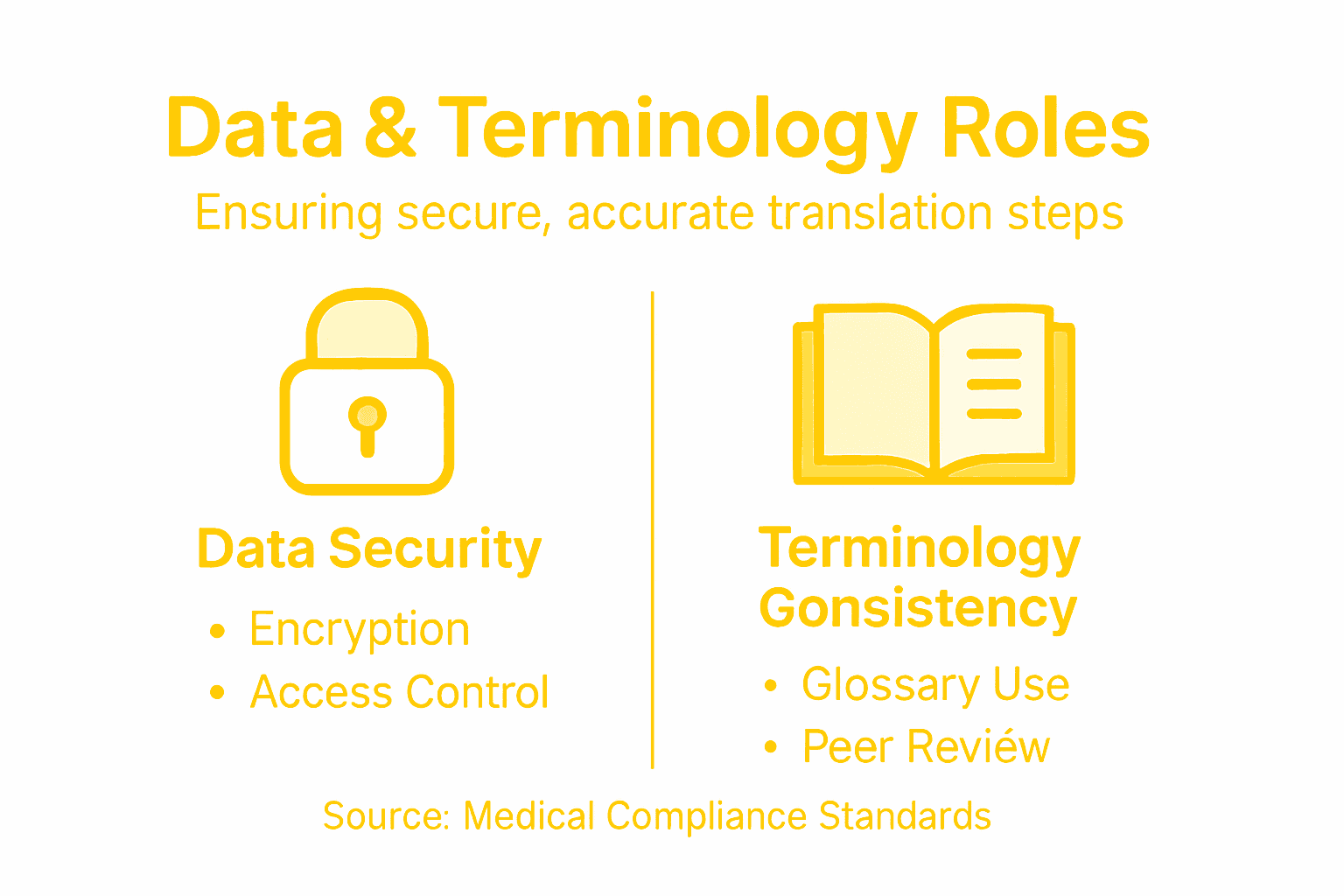
The intersection of data security and terminology enforcement requires sophisticated technological and human expertise. Professional medical translators must understand not just linguistic nuances, but also intricate medical nomenclature, regulatory requirements, and the potential legal implications of translation errors. This demands a multidisciplinary approach that combines technological safeguards with human expertise to protect patient information and ensure precise medical communication.
The following table summarizes how data security and terminology enforcement jointly support medical translation compliance:
Aspect | Data Security Role | Terminology Enforcement Role |
Protects Patients | Secures health info | Delivers clear instructions |
Regulatory Compliance | Meets legal mandates | Maintains terminology standards |
Risk Mitigation | Prevents data leaks | Reduces miscommunication risk |
Workflow Impact | Requires audits and controls | Demands database management |
Pro tip: Develop a comprehensive terminology database with built-in security protocols that tracks every modification and restricts access based on professional credentials.
Risks, Legal Exposure, and Common Pitfalls
Medical translation involves complex legal and professional risks that extend far beyond simple linguistic challenges. Medical translation legal risks demonstrate the potential for catastrophic consequences when translation processes fail to meet rigorous compliance standards.
Key risks and legal exposure points include:
Potential patient harm from mistranslated medical instructions
Privacy breaches compromising sensitive health information
Regulatory sanctions for non-compliant translation practices
Malpractice liability for translation errors
Potential discrimination through biased translation
Financial penalties for inadequate documentation
Translation regulatory compliance requires understanding nuanced legal frameworks that govern medical communication. Professional translators must navigate intricate requirements involving patient safety, data protection, and precise medical terminology. Even minor translation errors can lead to significant legal consequences, including potential lawsuits, professional decertification, and substantial financial penalties.
Common pitfalls in medical translation often stem from insufficient quality control, inadequate professional training, and overreliance on automated translation technologies. Organizations must implement comprehensive verification processes, maintain strict qualification standards for translators, and develop robust review mechanisms that prioritize accuracy and patient safety over speed or cost efficiency.
Pro tip: Implement a mandatory four-eye review process where two independent certified medical translators verify each critical document translation to minimize potential errors.
AD VERBUM’s AI+HUMAN Workflow for Compliance
AD VERBUM’s AI+HUMAN workflow represents a sophisticated approach to medical translation that fundamentally transforms how complex medical documentation is processed and verified. AI-human collaboration techniques demonstrate how technological capabilities can be strategically combined with human expertise to achieve unprecedented levels of accuracy and compliance.
The AI+HUMAN workflow follows a precise, multi-stage process:
Initial AI-generated translation draft
Subject matter expert linguistic review
Technical terminology validation
Contextual accuracy verification
Compliance standards cross-checking
Final human refinement
Medical translation hybrid workflows emphasize that artificial intelligence serves as a powerful initial translation tool, while human translators provide critical nuanced understanding. This approach ensures that translations maintain not just linguistic accuracy, but also critical contextual and regulatory compliance requirements.
By integrating advanced language models with certified medical translators, AD VERBUM creates a translation ecosystem that dramatically reduces errors, accelerates processing times, and maintains the highest standards of professional excellence. The workflow prioritizes security, precision, and regulatory adherence, making it uniquely suited for high-stakes medical documentation.
Pro tip: Develop clear, measurable performance metrics for each stage of your AI+HUMAN translation workflow to continuously optimize accuracy and efficiency.
Elevate Medical Translation Compliance with AD VERBUM’s AI+HUMAN Workflow
Ensuring accuracy, data security, and strict terminology enforcement in medical translation is not optional. The complex regulatory landscape demands advanced solutions that go beyond traditional language services. Common challenges such as mistranslation risks, breaches of patient confidentiality, and fragmented terminology management require a targeted, compliant approach that safeguards both clinical intent and legal integrity.
AD VERBUM offers a transformative response with its proprietary AI+HUMAN workflow engineered specifically for healthcare and life sciences sectors. Combining a secure Large Language Model ecosystem hosted exclusively on EU servers with expert medical linguists, the service ensures:
Absolute adherence to regulatory standards like GDPR, HIPAA, and Medical Device Regulation
Rigorous terminology enforcement aligned with client glossaries and industry norms
Robust data protection through ISO 27001 certified private cloud infrastructure
Experience unmatched precision and security designed for your most critical medical documents. Learn how AD VERBUM’s AI+HUMAN workflow mitigates risk and delivers compliant medical translation solutions. Discover more about our regulated and specialized industry translation offerings today and protect your organization from costly errors and legal exposure.
Make compliance your competitive advantage. Visit AD VERBUM now to request a consultation or a customized quote.
Frequently Asked Questions
What are the key compliance requirements for medical translation?
Medical translation compliance requires absolute linguistic accuracy, preservation of medical terminology, maintenance of the original document’s clinical intent, protection of patient confidentiality, and adherence to professional ethical guidelines.
How do regulatory frameworks impact medical translation?
Regulatory frameworks like HIPAA, GDPR, and ISO 17100 set strict standards for medical translation, requiring professional certification, specialized terminology expertise, and procedures to ensure patient data protection and document integrity.
What types of documents require medical translation compliance?
Essential documents include clinical trial protocols, informed consent forms, patient information leaflets, medical device instructions, regulatory submission documentation, safety reports, and pharmaceutical marketing materials.
How can organizations mitigate risks in medical translation?
Organizations can mitigate risks by implementing robust quality assurance processes, using a multi-stage review system involving professional translators, and developing a comprehensive compliance checklist to ensure adherence to various regulatory standards.
Recommended

