


AI Translation Risks in 2025: A Regulated Industry Guide

AI translation risks in 2025 are defined as the measurable probability that automated translation systems produce hallucinated, biased, or terminologically inconsistent output that compromises regulatory compliance, data security, or operational accuracy. The industry term for this category of failure is machine translation quality risk, though the scope has expanded significantly as large language model (LLM)-based systems replace legacy MT and NMT engines. Top-tier AI translation models hallucinate or fabricate content 10–18% of the time. For professionals in Life Sciences, Legal, Finance, or Defense, that error rate is not a product limitation. It is a compliance liability.
What are the core AI translation risks in 2025?
AI translation risk falls into four distinct categories, each with a different failure signature and regulatory consequence.
Hallucination and content fabrication
Hallucination is the most widely documented AI translation challenge. AI translation errors in benchmarks account for 30–60% of apparent model failures, which means reliability statistics reported by vendors frequently understate real-world risk. The critical problem is detectability. Most AI hallucinations look indistinguishable from correct translations, and only multi-model consensus or expert human review can reliably surface them. A fabricated dosage instruction in a medical device manual or an invented clause in a contract does not announce itself.

Terminology inconsistency and translation debt
Uncontrolled terminology variation damages regulatory audit trails, fragments SEO keyword relevance, and complicates compliance reviews in regulated sectors. This accumulation of inconsistent translations across documents is called translation debt. It compounds over time. A pharmaceutical company that uses three different translations of the same controlled substance name across its regulatory submissions creates an audit exposure that no post-hoc review can easily resolve.
Bias and stereotype reproduction
Neural machine translation tools reinforce harmful social stereotypes, causing allocational and representational harm, particularly in professional contexts. The European Commission has documented gender and occupational bias in AI-generated translations. In HR documentation, legal filings, or clinical trial materials, these biases carry legal weight.
Safety cliffs in low-resource languages
AI safety guardrails, primarily trained in English, can be bypassed 79% of the time when prompts are translated into other languages.
This figure reframes the question of how safe AI translation is. A system that performs reliably in English may produce unfiltered or inaccurate output in Croatian, Swahili, or Tagalog. For multinational regulated operations, this is not an edge case. It is a structural gap.
How do these risks impact compliance and accuracy in regulated industries?
Regulated industries operate under zero-ambiguity documentation standards. Average AI translation accuracy fluctuates between 85% and 92%, with approximately 40% of errors classified as lexical and 30% as syntactic. An 85% accuracy rate means roughly 1 in 7 sentences contains an error. In a 50-page regulatory submission, that translates to hundreds of potentially non-compliant statements.
The compliance consequences vary by sector:
Life Sciences and Medical Devices. A mistranslated contraindication in an Instructions for Use document triggers MDR non-compliance. Under EU MDR, manufacturers bear direct liability for translation accuracy in all supported languages.
Legal and Contracts. Mistranslated obligation clauses or jurisdiction-specific terms can void enforceability. Courts in the EU and US have ruled against parties whose translated contracts contained material discrepancies from the source document.
Finance and Regulatory Filings. Inconsistent translation of defined financial terms across prospectus documents creates disclosure risk under MiFID II and SEC requirements.
Defense and Manufacturing. Safety manuals with mistranslations affecting EU product liability expose manufacturers to claims under the EU Product Liability Directive.
The table below maps risk categories to their compliance consequences:
Risk Category | Compliance Consequence | Affected Standard |
Hallucination / fabrication | Incorrect regulatory data in submissions | MDR, FDA 21 CFR |
Terminology inconsistency | Audit trail fragmentation | ISO 13485, GxP |
Bias in translation | Discriminatory documentation | EU AI Act, GDPR |
Safety guardrail bypass | Unfiltered output in non-English content | ISO 27001, HIPAA |
Low-resource language errors | Undetected errors with no uncertainty signal | AQAP 2110, MDR |
Data security adds a second compliance dimension. Many public NMT tools process documents on shared cloud infrastructure. Submitting a confidential clinical trial protocol or a defense procurement document to a public translation API creates a data processing event that may violate GDPR Article 28 requirements for data processor agreements. The security and compliance impact of this practice is frequently underestimated during procurement decisions.
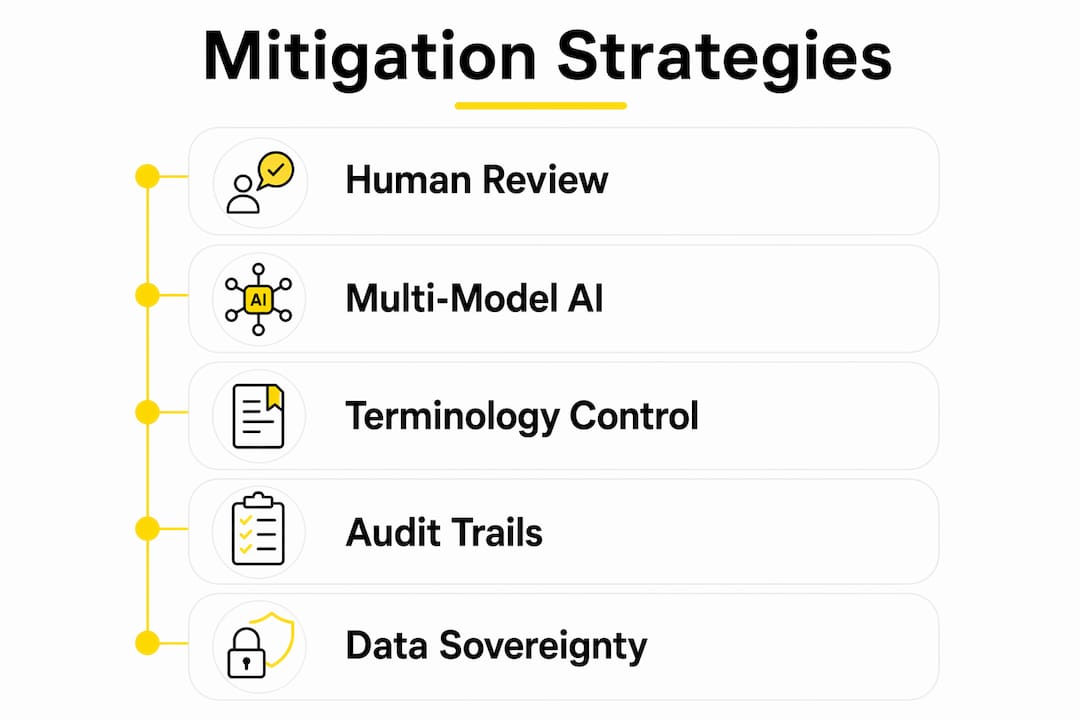
What mitigation strategies reduce AI translation risk effectively?
The most effective mitigation for AI translation accuracy issues is structural, not procedural. Patching errors after the fact is less reliable than building controls into the translation workflow before output is generated.
84% of industry professionals report that clients demand human post-editing of AI translation outputs to ensure quality. That figure reflects a market consensus: AI alone does not meet the quality bar for regulated content. Human oversight is not optional. It is the expected delivery standard.
Pro Tip: Never rely on a single-model AI translation output for regulated documentation. Single-model hallucination rates of 10–18% are too high for zero-ambiguity compliance contexts. Require either multi-model consensus validation or certified subject-matter expert review before any translated document enters a regulatory workflow.
The comparison below shows how different translation approaches handle the core risk factors:
Approach | Hallucination Rate | Terminology Control | Audit Trail | Data Sovereignty |
Legacy MT | High | None | None | Variable |
Public NMT (SaaS) | 10–18% (single model) | Inconsistent | Limited | Shared cloud |
Multi-model consensus | Under 2% | Depends on setup | Partial | Variable |
AI+HUMAN hybrid (governed) | Under 2% with SME review | Enforced via TM/TB | Full | Configurable |
Multi-model consensus approaches reduce hallucination errors to under 2%, compared to 10–18% for single-model outputs. That improvement is significant, but consensus alone does not address terminology governance, bias detection, or audit trail requirements. Those controls require human expert integration.
Terminology governance is the most underinvested mitigation in most organizations. Maintaining enforced Term Bases (TB) and Translation Memories ™ constrains AI output to approved vocabulary before generation occurs. This prevents translation debt from accumulating and keeps regulatory terminology consistent across document versions and languages. The AI vs. NMT risk comparison for regulated industries shows that terminology enforcement is the single largest differentiator between compliant and non-compliant translation workflows.
How does Adverbum address these risks through ai+human hybrid translation?
Adverbum’s approach to the future of AI translation in regulated sectors is built on a four-step AI+HUMAN hybrid translation workflow that addresses each risk category identified above.
Step 1: Asset integration. Client Translation Memories ™ and Term Bases (TB) are ingested before any generation occurs. This constrains the LLM output to approved terminology from the first token.
Step 2: LLM generation. Adverbum’s proprietary LangOps System, hosted on private EU servers, produces target language output governed by client terminology and style guidance. No document is processed on shared public cloud infrastructure, which directly addresses GDPR Article 28 and HIPAA data processing requirements.
Step 3: Subject-matter expert review. A certified linguist with domain expertise in the relevant sector reviews output for technical accuracy, regulatory compliance, and contextual nuance. Adverbum’s network includes 3,500+ subject-matter expert linguists spanning medical professionals, engineers, and legal scholars.
Step 4: Quality assurance. QA is aligned to ISO 17100 and ISO 18587 and, where relevant, sector-specific requirements such as MDR for medical devices.
The result is a workflow that delivers AI+HUMAN translation process compliance at 3x to 5x the speed of traditional translation workflows, without sacrificing the audit trail or terminology control that regulated industries require. Adverbum holds ISO 27001 certification for information security and aligns its processes to GDPR, HIPAA, and MDR. For organizations subject to jurisdiction-specific EU compliance requirements, the EU-hosted infrastructure eliminates the data transfer risk that public NMT tools introduce.
Key takeaways
AI translation risks in regulated industries are manageable only when terminology governance, human expert review, and data sovereignty controls are built into the workflow before output is generated, not applied as corrections afterward.
Point | Details |
Hallucination is structural | Single-model AI outputs carry a 10–18% fabrication rate; multi-model consensus drops this below 2%. |
Terminology debt compounds | Uncontrolled terminology variation fragments audit trails and creates long-term compliance exposure. |
Safety guardrails fail in non-English | 79% bypass rate in non-English languages makes public AI tools unreliable for multilingual regulated content. |
Human oversight is the market standard | 84% of clients require human post-editing; regulated content demands certified SME review, not general editing. |
Data sovereignty is a compliance control | Processing regulated documents on shared cloud NMT tools creates GDPR and HIPAA data processor risk. |
The risk nobody budgets for
I have reviewed translation workflows across Life Sciences, Legal, and Defense organizations for over a decade. The failure mode I see most consistently is not hallucination. Organizations have started to understand hallucination risk. The failure mode that actually costs money is terminology debt.
A company will deploy an AI translation tool, achieve fast turnaround, and declare the project a success. Eighteen months later, the same controlled term appears in four different translations across their regulatory dossier. The audit flags it. The remediation costs more than the original translation project.
The 2025 AI translation trends point toward multi-model consensus and hybrid workflows as the emerging standard. That is the right direction. But consensus without terminology governance is still a system that can drift. The organizations that get this right are the ones that treat their Term Bases as a compliance asset, not a nice-to-have configuration file.
My recommendation for regulated industry professionals is direct: before evaluating any AI translation tool, ask two questions. First, where is the data processed, and under what legal framework? Second, how does the system enforce approved terminology before generation, not after? If the vendor cannot answer both questions with specificity, the tool is not ready for regulated content.
How Adverbum can help you manage AI translation risk
Regulated industries cannot afford to treat translation as a commodity workflow. Adverbum’s localization services for regulated sectors are built specifically for organizations where accuracy, auditability, and data security are non-negotiable requirements.
Adverbum combines its proprietary LangOps System with 3,500+ certified subject-matter expert linguists to deliver AI+HUMAN hybrid translation across 150+ languages, with full ISO 27001 security, GDPR and HIPAA alignment, and QA processes mapped to ISO 17100, ISO 18587, and MDR. Every project maintains a complete audit trail and enforced terminology governance from the first document to the last. Contact Adverbum to discuss your compliance requirements and receive a workflow assessment tailored to your sector.
FAQ
What is the hallucination rate for AI translation tools?
Top-tier AI translation models hallucinate or fabricate content 10–18% of the time in single-model outputs. Multi-model consensus approaches reduce this rate to under 2%.
Is AI translation safe for regulated industry documents?
AI translation alone is not sufficient for regulated content. Human expert oversight is required in legal, medical, and compliance contexts where errors carry financial or safety consequences.
What is translation debt and why does it matter for compliance?
Translation debt is the accumulation of inconsistent terminology across AI-translated documents over time. It fragments regulatory audit trails and creates non-compliance exposure during inspections and submissions.
Do AI translation tools comply with GDPR?
Public NMT tools that process documents on shared cloud infrastructure may not satisfy GDPR Article 28 data processor requirements. Organizations handling personal or sensitive data should use tools with private, EU-hosted infrastructure and documented data processing agreements. GDPR compliance for AI tools is a separate evaluation from translation quality.
How does AI translation accuracy compare to human translation for technical documents?
Average AI translation accuracy ranges from 85% to 92%, with approximately 40% of errors classified as lexical and 30% as syntactic. For technical and regulatory documents, these error rates require certified subject-matter expert review before the output is used in any compliance context.
Recommended