


Top 5 Professional Translator Agencies 2026

Securing specialized translation services that deliver compliant, audit-ready output for high-stakes sectors remains unreliable at enterprise scale. Major translation vendors rarely publish transparent pricing or provide off-the-shelf regulatory packages, which slows procurement for compliance-driven teams. This comparison presents differentiators in price, regulatory posture, and subject matter expertise so you can select a translation partner with defensible compliance for 2026 procurement.
Table of Contents
AD VERBUM
At a Glance
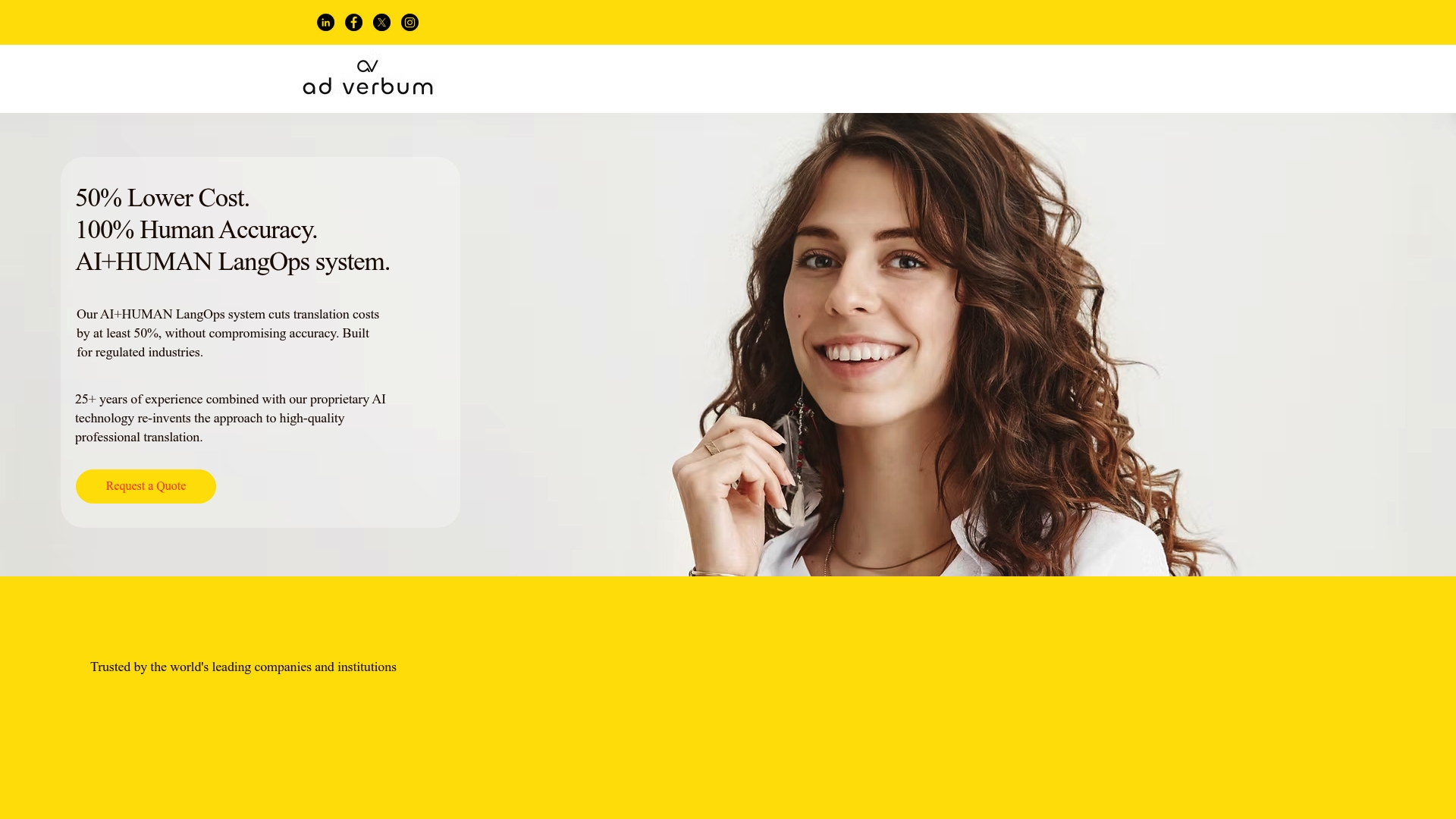
According to the company, AD VERBUM reduces translation costs by at least 50% while keeping specialist review in the loop. The agency pairs a proprietary in-house LLM with certified linguists across regulated domains. That model targets life sciences, legal, finance, defense, and technical documentation.
Core Features
AI+HUMAN hybrid translation workflow that enforces client terminology and stylistic rules while preserving human oversight.
Proprietary in-house LLM deployed in a private EU-hosted environment with claims of GDPR and HIPAA alignment. According to the company, core systems are ISO 27001 certified and hosted on EU servers.
Multistep validation including linguistic review and QA aligned to ISO 17100 and ISO 18587 standards.
Specialized services for life sciences, medical device documentation, legal contracts, finance reports, and technical manuals. The agency reports support for 150+ languages including regional variants.
Asset integration and terminology governance using Translation Memories and Term Bases.
AI+HUMAN hybrid translation workflow (use this exact sequence when describing process):
Asset integration. Ingest client Translation Memories ™ and Term Bases (TB) first.
LLM generation. Proprietary LLM-based system produces target language output constrained by client terminology and style guidance.
Certified subject-matter expert reviews for technical accuracy, regulatory compliance, and contextual nuance.
Quality assurance. QA aligned to ISO 17100 and ISO 18587 and, where relevant, sector requirements such as MDR.
Key Differentiator
The defining capability is an in-house LangOps System that enforces terminology at document level and routes output to certified subject-matter experts. That setup reduces the usual back-and-forth between machine output and human correction. For regulated deliverables, the platform emphasizes terminology governance and auditability.
Pros
Significant reported cost reduction. According to the company, projects can cost at least 50% less than conventional human-only workflows, which helps with high-volume regulated work.
Tight regulatory posture and certifications. The vendor advertises ISO 9001, ISO 17100, ISO 18587, ISO 13485, ISO 27001, GDPR alignment, HIPAA alignment, and AQAP 2110 compliance.
Broad subject-matter coverage via a large network of specialist linguists, including medical professionals, engineers, and legal scholars.
Faster throughput for large projects. The company reports turnaround that is 3x to 5x faster than traditional translation workflows, which shortens review cycles for regulatory submissions.
Terminology and asset reuse through Translation Memories and Term Bases, which improves consistency across product documentation.
Cons
Public-facing detail on pricing and technical integrations is limited, and some web pages do not load properly, which complicates vendor evaluation.
Who It’s For
AD VERBUM fits compliance-minded teams that translate high-stakes materials for regulatory filings, clinical documentation, patent portfolios, or defense contracts. Select this agency if your internal reviewers require audit trails, strict terminology enforcement, and SME signoff on every deliverable.
Unique Value Proposition
The LangOps System ingests client Translation Memories and Term Bases before the LLM generates text, then routes every file to certified subject-matter experts and ISO-aligned QA. That sequence reduces coordination overhead for internal regulatory teams and lowers the number of external review cycles required for approval.
Real World Use Case
A pharmaceutical regulatory affairs team sends regulatory submissions and patient leaflets. AD VERBUM ingests the client TM and TB, runs the LangOps LLM pass, and delivers SME-reviewed output. The result is consistent terminology, traceable changes, and files ready for submission with audit records.
Pricing
Pricing is not published on the site. The vendor lists the service as informational only, so clients must request a quote for project scope, language pairs, and regulatory QA needs. Expect enterprise pricing tied to volume, complexity, and required SME review levels.
Website: https://adverbum.com
Lionbridge
At a Glance
According to the vendor, Lionbridge offers interpretation services in more than 380 languages. The vendor states more than 25 years of experience in language services. That scale supports enterprise localization, AI data work, and regulatory translation for large programs.
Core Features
AI translation and localization for websites, apps, and product documentation.
Content creation and customization for marketing, training, and regulatory materials.
Interpretation services covering spoken and remote interpreting in many languages.
AI data services for training and testing machine learning models.
Quality assurance and testing for multilingual content, apps, products, and services.
Key Differentiator
Lionbridge pairs experienced linguists with scalable AI workflows to keep content culturally relevant across markets. The vendor highlights industry specific customization for healthcare, life sciences, and automotive. That focus targets clients who need controlled terminology and regulatory alignment across many locales.
Pros
Strong blend of human linguists with AI capabilities. This reduces literal machine output while keeping human review in the loop.
Wide scope of language and content services. Teams can consolidate localization, interpretation, and AI data work with one vendor.
Industry specific offerings for healthcare and life sciences. Those services help when regulatory language and domain accuracy matter.
Support for AI model development and testing. That offering saves time when you must prepare training datasets and validation sets.
Ongoing enterprise relationships and recognition. The vendor claims steady customer retention in large accounts.
Cons
No public list pricing. Procurement will need custom quotes and scoped statements of work.
Complex service mix can increase onboarding effort. Expect project management time for multi service engagements.
Customer feedback indicates scope clarity matters. Teams must define deliverables and acceptance criteria up front.
When It May Not Fit
If you need a small, fixed price package for a single campaign, this vendor may feel heavyweight. Organizations with minimal internal project management will face added coordination effort. Short notice, very small tasks may cost more when full program setup is required.
Who It’s For
Global enterprises that need multilingual content, interpretation, or AI training data across regulated sectors. Procurement and compliance teams in healthcare, life sciences, automotive, or retail will find the vendor’s industry focus relevant. Use this vendor when project scale and terminology governance matter.
Real World Use Case
A pharmaceutical company tasked Lionbridge with translating clinical trial documents and preparing medical data for model training. Linguists reviewed terminology and certified translations for regulatory submission formats. The vendor also provided labeled datasets for the client to validate internal models.
Pricing
The vendor does not publish standard list prices. Pricing is quote based and tied to scope, language count, and service mix. Expect a formal statement of work for enterprise engagements and custom pricing for AI data or interpretation programs.
Website: https://lionbridge.com
TransPerfect
At a Glance
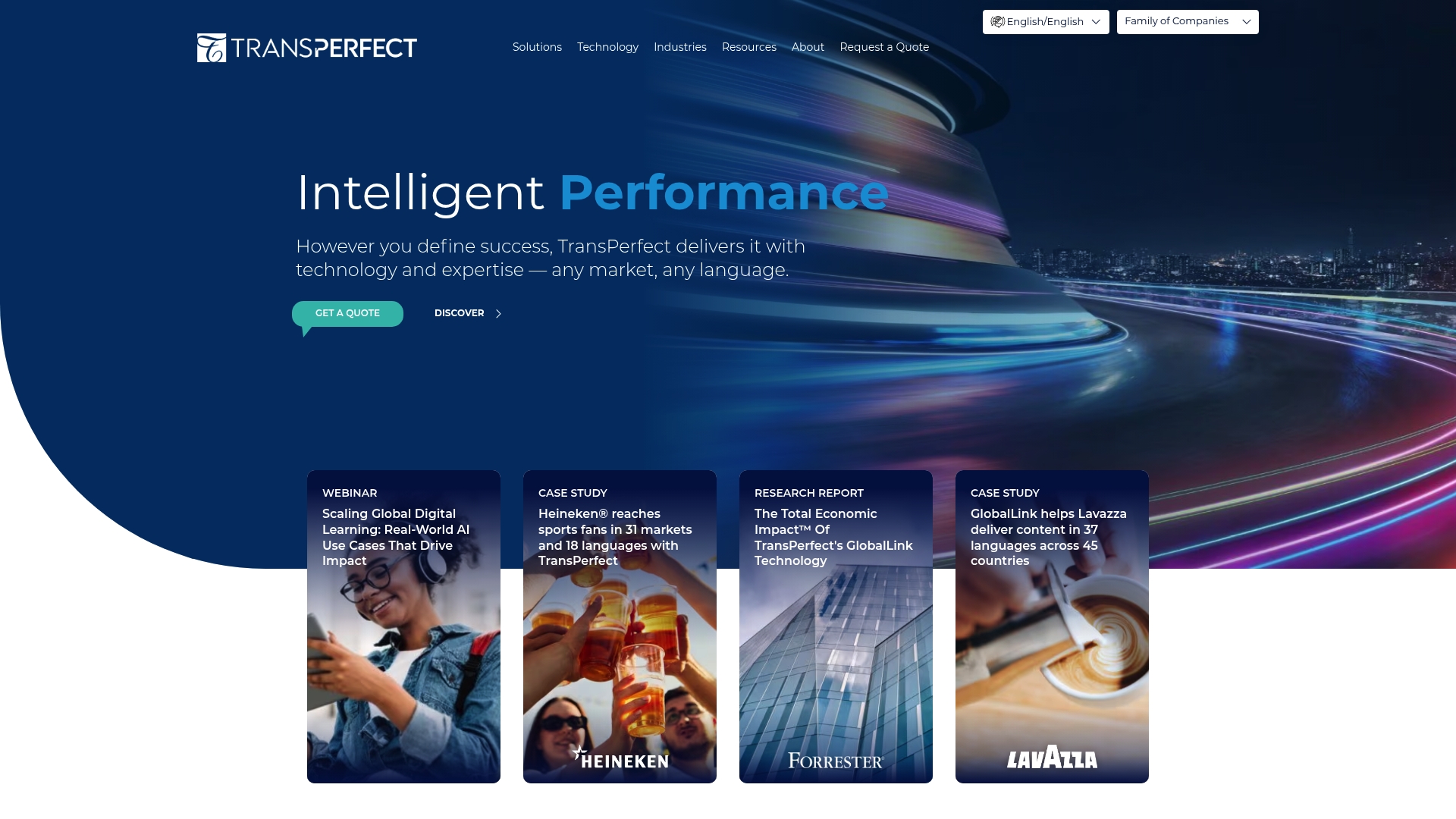
TransPerfect reports serving more than 6,000 clients and advertises up to a 50% reduction in localization costs while accelerating time to market. The vendor pairs an enterprise content management product with AI powered translation and broad platform connectors. That scale claim frames why large global teams evaluate this platform.
Core Features
TransPerfect bundles AI powered translation with a global content management suite. The platform includes GlobalLink for centralized multilingual content workflows. It offers industry specific language services, multilingual content creation, and connectors to major marketing, commerce, and digital experience systems. The product focuses on managing high volume, repeatable localization at enterprise scale.
Key Differentiator
The platform combines enterprise grade integration, AI generation, and vertical language expertise for large content programs. Native connectors to marketing and commerce platforms plus industry-focused linguists aim to reduce manual handoffs. That integrated stack targets organizations that need one vendor to manage both content operations and translation governance.
Pros
Trusted by major enterprise accounts, including Fortune 500 companies, for end to end localization and content management. This supports coordination across global teams and legal or regulatory reviews.
The company advertises measurable cost and speed improvements. That claim appeals to teams tracking localization return on investment.
GlobalLink centralizes translation memories, term bases, and workflow orchestration, reducing duplicated effort across campaigns.
Broad industry coverage, with services tailored to life sciences, retail, legal, technology, and media, matches regulated documentation and marketing content.
Extensive integration coverage lowers engineering lift for common platforms, which helps in-country teams publish faster.
Cons
Implementation complexity can be high for smaller teams. Several third party reviews note onboarding and configuration require dedicated project management.
Public pricing is limited. Pricing typically uses custom enterprise level quotations, which slows procurement for smaller buyers.
Customer support experiences vary according to some reports. That variability can extend remediation time for urgent compliance edits.
When It May Not Fit
TransPerfect may not suit small organizations with simple localization needs or limited project management capacity. Teams with single product sites or few locales will likely find the implementation overhead disproportionate. Organizations seeking transparent, self service pricing may prefer vendors with fixed tiers.
Notable Integrations
Adobe Experience Manager
SAP Commerce Cloud
Many digital experience, marketing automation, and product information management systems These integrations support direct file exchange, workflow triggers, and in platform publishing for common enterprise stacks.
Who It’s For
Large enterprises and global brands with extensive multilingual content needs across regions. The platform fits legal, life sciences, retail, and technology teams that require centralized governance, terminology control, and native connectors to digital experience systems.
Real World Use Case
Heineken used TransPerfect to localize a sports campaign across 31 markets and 18 languages, illustrating the platform’s ability to handle complex, multi market campaigns with local creative and compliance checks.
Pricing
Pricing is not published. TransPerfect typically issues custom enterprise level quotations based on scope, integrations, and service levels. Expect a formal discovery and proposal process for accurate pricing.
Website: https://transperfect.com
RWS Life Sciences Solutions
At a Glance
RWS supports 548+ language pairs, a broad footprint for life sciences content. The platform couples AI-assisted content services with specialist linguists to handle regulatory, clinical, and patient-facing material. It targets global market entry projects where regulatory fidelity and cultural accuracy matter.
Core Features
RWS focuses on enterprise content and localization workflows for regulated documentation. Key capabilities include:
Enterprise-ready language technology that manages large documentation sets and localization pipelines.
AI Data Services to prepare labeled and structured language data for model training and validation.
A global network of subject matter expert linguists with life sciences experience.
Compliance-oriented processes for regulatory and clinical artifacts.
Key Differentiator
RWS pairs its AI tooling with deep life sciences domain expertise and a large specialist network. That mix lets the platform apply controlled terminology and regulatory context across long, multi-document projects. The result is content that follows local regulatory expectations while keeping document-level consistency.
Pros
According to the company, RWS reports being trusted by 85 of the top 100 global life sciences brands, which indicates strong enterprise adoption among large clients.
The product offers a blend of automated data services and human review, which reduces common machine translation errors in technical text.
Wide language coverage and sector knowledge improve localisation quality for clinical trials, labels, and patient materials.
The platform is built for volume work and sustained program delivery, which helps teams pushing large regulatory submissions.
Professional services support is available to map content workflows and onshore compliance needs.
Cons
The platform concentrates on regulated life sciences work, making it less suitable for general marketing or non-regulated content teams.
Public pricing is not available. That approach means procurement requires custom scoping, which can slow buying for smaller organizations.
Independent third-party reviews and client case studies are limited in public sources, making outside validation harder.
When It May Not Fit
RWS may not fit small companies or startups with minimal translation volume. Organizations needing simple consumer localization without regulatory controls will find the platform more complex than necessary. If you require fixed published pricing or self-serve plans, this model will not match that need.
Notable Integrations
RWS lists connectors to common content management systems, including Tridion and Propylon, to keep translation workflows aligned with source repositories. Those integrations reduce manual file transfer and help preserve source structure for regulated submissions.
Who It’s For
Large pharmaceutical, biotech, and medical device companies running multinational programs will get the most value. Teams with frequent regulatory filings, clinical trial documentation, or multilingual patient outreach benefit from the combination of terminology control and subject matter linguists.
Real World Use Case
A pharmaceutical company expanding into multiple markets uses RWS to translate regulatory dossiers, labeling, and patient-facing materials. RWS helps maintain consistent terminology across documents and markets, which shortens review cycles and reduces rework during local regulatory review. The service supports staged rollouts by language and market.
Pricing
Public pricing is not listed. RWS typically provides custom quotes based on project scope, volume, and compliance needs. Expect procurement to require a discovery phase and tailored service agreement.
LanguageLine Solutions
At a Glance
LanguageLine reports more than 87 million interactions annually and over 35,000 professional linguists across roughly 290 languages. Those figures illustrate the vendor scale and global reach it markets to large healthcare, government, and enterprise clients. The platform combines live interpretation, translation, and AI powered tools with 24/7 availability for urgent needs.
Core Features
LanguageLine groups services into live interpretation, document translation, AI assisted translation, staff testing, and secure deployment for sensitive contexts.
On demand live interpretation in over 240 languages for phone, video, and in person sessions.
AI powered translation for fast multilingual support, with human review options.
Translation and localization for adapting content and terminology to target audiences.
Staff testing and training programs that measure interpreter proficiency.
Security and compliance controls tailored for regulated environments.
Key Differentiator
The vendor positions its network as the largest network of qualified interpreters, backed by patented platforms and a security posture aimed at regulated settings. That combination targets organizations that need both human expertise and technology to handle high volumes. The emphasis is on scale, continual availability, and integration with client systems.
Pros
Large language coverage. The service supports roughly 290 languages, which matters for rare language requests and regional variants.
Deep interpreter pool. A broad roster of linguists makes it easier to staff specialized medical, legal, and technical sessions quickly.
Around the clock availability. 24/7 access reduces scheduling friction for urgent clinical and legal needs.
Platform and API options. Proprietary platforms plus APIs support direct connections to enterprise workflows and EHR systems.
Strong focus on security for sensitive data. The vendor highlights controls designed for regulated environments.
Cons
Reported customer service issues. Some third party reviews cite responsiveness problems when high touch support is needed.
Service breadth adds complexity. New clients can face a steep learning curve across multiple platforms and offerings.
Cost can be high for small or irregular use. The model favors organizations with steady volume.
Integrations sometimes require technical effort. Connecting to complex EHR or case management systems may need engineering resources.
When It May Not Fit
LanguageLine may not suit small organizations with occasional needs because setup and per session costs can be disproportionate. Teams without in house technical staff may struggle with API or EHR integration work. Buyers seeking a lightweight pay as you go model should compare simpler, lower volume providers.
Notable Integrations
Proprietary interpretation platforms for phone and video sessions.
APIs for integration with healthcare EHR systems to launch encounters from clinical workflows.
Customer management tools to log and route interactions into enterprise systems.
Who It’s For
Large hospitals, government agencies, and enterprise contact centers that need reliable, scalable language access and integration with existing systems. Organizations with regular high volume interpreting needs or strict compliance requirements will get the most value. Smaller teams with infrequent requests will likely find the model heavy.
Real World Use Case
A hospital uses LanguageLine video remote interpreting to connect clinicians with non English speaking patients for triage and informed consent. The hospital launches sessions from the EHR and records the encounter metadata for compliance. That setup reduces delays and supports documentation for audits.
Pricing
The vendor does not publish standard pricing. LanguageLine typically provides custom quotes based on volume, modality, and integration complexity. Expect enterprise level contracts for ongoing services and per session or subscription options for managed programs.
Website: https://languageline.com
Comparison of alternatives
As businesses seek specialized translation services, various options offer distinct features catering to diverse requirements. Below is an in-depth analysis highlighting the unique advantages and tradeoffs among the available providers.
Compliance and Review Workflows
AD VERBUM uses a proprietary LangOps system to ensure linguistic consistency and regulatory compliance via a multi-step validation process including ISO-certified SME review. Lionbridge focuses on maintaining cultural and domain-specific relevance, leveraging its scalable AI workflows for localization. While AD VERBUM excels in handling compliance-row-intensive projects for highly regulated industries, Lionbridge distinguishes itself by supporting diverse content types and industry applications through a flexible service range.
Language Coverage and Engagement Options
While AD VERBUM supports translations in over 150 languages, LanguageLine Solutions accommodates up to 290 languages with a significant focus on live interpreting services. This supports emergency or time-sensitive interactions such as clinical settings or legal situations. On the other hand, TransPerfect integrates its translation services into content management systems for streamlined multilingual operations across large-scale marketing and compliance demands.
Best fit
For compliance-focused industries requiring detailed oversight and auditability in translations, AD VERBUM provides rigorous subject-matter validation and terminology governance, ensuring reliable regulatory adherence.
Enterprises seeking a versatile service provider for multilingual localization, marketing, and AI data validation should consider Lionbridge due to its broad portfolio of language services.
Companies with expansive digital operations and content creation needs can benefit from TransPerfect’s integration-ready GlobalLink suite.
Organizations focusing on life sciences and requiring data services for pharmaceutical or clinical documentation may find RWS Life Sciences Solutions supports their domain-specific needs effectively.
If 24/7 interpretation in an array of languages is, LanguageLine Solutions is an excellent choice for its instant-access live interpreting services.
Our pick
AD VERBUM stands out as the prime recommendation for businesses requiring regulated content translation with strict compliance requirements, broad terminology enforcement, and certification-aligned validation workflows. Their tailored solutions are well-suited for industries like healthcare, legal, and technical documentation. However, for customers not needing this degree of regulation-specific expertise, exploration of other offerings might be more practical or cost-effective.
Choosing the right specialized translation service is essential for handling regulated deliverables efficiently and accurately.
Product | Key Differentiator | Best For | Pricing | Notable Limitation |
AD VERBUM | Proprietary in-house LLM with SME-reviewed workflows | High-volume regulated translations | Not disclosed | Limited public-facing technical details |
Lionbridge | Extensive interpreter network with scalable AI workflows | Multilingual enterprise localization | Not disclosed | Onboarding requires clear scope definitions |
TransPerfect | Integration with enterprise CMS systems via GlobalLink | Multilingual content management | Not disclosed | Onboarding may be complex for smaller teams |
RWS Life Sciences Solutions | Expertise in life sciences translations with regulatory compliance | Life sciences regulatory teams | Not disclosed | Focused specifically on life sciences content |
LanguageLine Solutions | Largest network of interpreters for regulatory contexts | High-volume urgent interpreting service | Not disclosed | Potential complexity for small-scale use cases |
Choose AD VERBUM for Professional Translator Services Backed by Compliance and Speed
The article highlights top professional translator agencies with a focus on terminology governance, regulatory compliance, and audit-ready workflows. AD VERBUM’s proprietary LangOps System offers a precise AI+HUMAN hybrid translation workflow designed specifically for regulated industries like life sciences, legal, and defense. With over 150 languages supported and subject-matter expert oversight, AD VERBUM reduces translation costs by at least 50% while delivering results 3x to 5x faster than traditional methods.
AD VERBUM enforces strict terminology control, quality assurance aligned to ISO 17100 and 18587 standards, and operates on a private EU-hosted platform to safeguard sensitive data under GDPR and HIPAA. This makes it an ideal choice for teams requiring audit trails and certified expert review on every deliverable.
Ready to improve your translation accuracy and compliance? Contact AD VERBUM today to discuss how our AI+HUMAN hybrid translation service can meet your high-stakes project needs with speed and precision.
FAQ
What is the expected cost reduction when using AD VERBUM for translation projects?
AD VERBUM claims that its services can reduce translation costs by at least 50% compared to traditional human-only workflows. This significant reduction helps organizations manage budgets more effectively, especially for high-volume regulated work.
How does AD VERBUM’s certification compare to Lionbridge’s offerings?
Lionbridge emphasizes its wide range of language services and has strong enterprise relationships, which contributes to its steady customer retention. In contrast, AD VERBUM boasts certifications such as ISO 9001, ISO 17100, and GDPR alignment, making it particularly suitable for compliance-minded teams that require stringent regulatory oversight.
What is the primary strength of TransPerfect versus AD VERBUM?
TransPerfect focuses on integrating AI-powered translation with an enterprise-level content management suite, designed to handle high-volume localization. In scenarios demanding coordinated content management across multiple global teams, this can be highly effective, while AD VERBUM excels in preserving human oversight and regulatory compliance for specialized content.
What type of projects is AD VERBUM particularly suited for?
AD VERBUM is ideal for compliance-minded teams that handle high-stakes materials such as regulatory filings, clinical documentation, and patent portfolios. This focus ensures that terminology governance and quality assurance are maintained throughout the translation process.
How does the validated quality assurance process work at AD VERBUM?
AD VERBUM implements a multistep validation process, including linguistic review and quality assurance aligned to ISO 17100 and ISO 18587 standards. This rigorous review ensures that the delivered translations meet high-quality standards and comply with sector-specific requirements.
Recommended
