


Why workflow architecture is key in AI+human translation

Most conversations about translation in regulated industries get stuck on the wrong question. Teams debate whether to use AI or human translators, as if that choice alone determines quality and compliance. It does not. Compliance requirements drive the need for robust translation workflows, and the architecture governing those workflows is what actually separates a defensible, audit-ready process from one that creates regulatory exposure. Whether you are managing clinical trial documentation, cross-border legal filings, or financial disclosures, the structural design of your translation workflow matters more than the technology label attached to it.
Table of Contents
Key Takeaways
Point | Details |
Workflow drives compliance | Robust workflow architecture is more important than choosing between translation methods for regulated sectors. |
Hybrid boosts efficiency | AI+human hybrid translation maximizes speed and compliance when properly architected. |
Audit trails are essential | Including clear process documentation and layered reviews helps ensure compliance for technical and legal translations. |
Common pitfalls | Skipping human review or lacking documentation undermines regulatory translation quality. |
Actionable workflow steps | Assess, redesign, document, and review translation workflows regularly to keep them compliance-ready. |
Understanding the landscape: AI+human hybrid vs. human-only translation
Let’s first clarify what sets these translation approaches apart and why the debate often misses the mark.
Human-only translation relies entirely on professional linguists to produce and review target language content. It carries an implicit assumption: that skilled humans, given enough time, will produce accurate, consistent output. That assumption holds reasonably well for low-volume, low-frequency projects. It breaks down fast when you are managing thousands of pages of regulatory submissions across multiple languages under tight deadlines.
Hybrid translation balances speed and compliance by combining AI-generated output with certified subject-matter expert review. But not all hybrid approaches are equal. Legacy machine translation (MT) produces literal output with weak context handling, creating real risk in safety-critical text. Neural machine translation (NMT), the kind powering most consumer SaaS tools, improves fluency but introduces inconsistent terminology control and governance gaps that are difficult to manage in regulated documentation. A proprietary LLM-based system, by contrast, generates context-sensitive output constrained by client terminology and style guidance from the start, before any human reviewer touches the document.

Here is how the approaches compare across the factors that matter most in regulated sectors:
Factor | Human-only | NMT-based hybrid | Proprietary LLM hybrid |
Terminology consistency | Variable under volume | Inconsistent without controls | Enforced at generation stage |
Speed | Slowest | Fast | 3x to 5x faster than traditional |
Audit readiness | Depends on documentation | Weak without enterprise controls | Built into QA framework |
Data sovereignty | Depends on provider | Often public cloud | EU-hosted, ISO 27001 certified |
Regulatory compliance | Manual, error-prone | Variable | ISO 17100, ISO 18587, MDR aligned |
Key characteristics of each approach in regulated contexts:
Human-only: Best for low-volume, highly nuanced content where speed is not a constraint and terminology programs are minimal.
NMT-based hybrid: Suitable for general business content; requires significant enterprise controls to meet regulated sector standards.
Proprietary LLM hybrid: Designed for regulated content programs requiring terminology governance, HIPAA-compliant workflows, and ISO-aligned QA at scale.
The misconception is that human-only is inherently safer. Under volume and regulatory pressure, the opposite is often true.
Why workflow architecture matters more than translation method
Now that we have compared translation methods, let’s turn to what actually governs their performance: workflow architecture.
The translation method you choose sets a ceiling on quality. The workflow you build around it determines whether you actually reach that ceiling consistently. A poorly designed workflow will undermine even the best human translators. A well-designed workflow will extract reliable, auditable output from a hybrid system at scale.
“A robust workflow design is the foundation of regulatory-grade translation. Without it, even expert linguists cannot guarantee the consistency and traceability that compliance demands.”
Workflows provide a framework for error mitigation and quality assurance that no single translator or tool can replicate alone. The architecture creates the conditions for systematic review, version control, and audit trail generation. These are not optional features in life sciences, legal, or finance. They are baseline requirements.
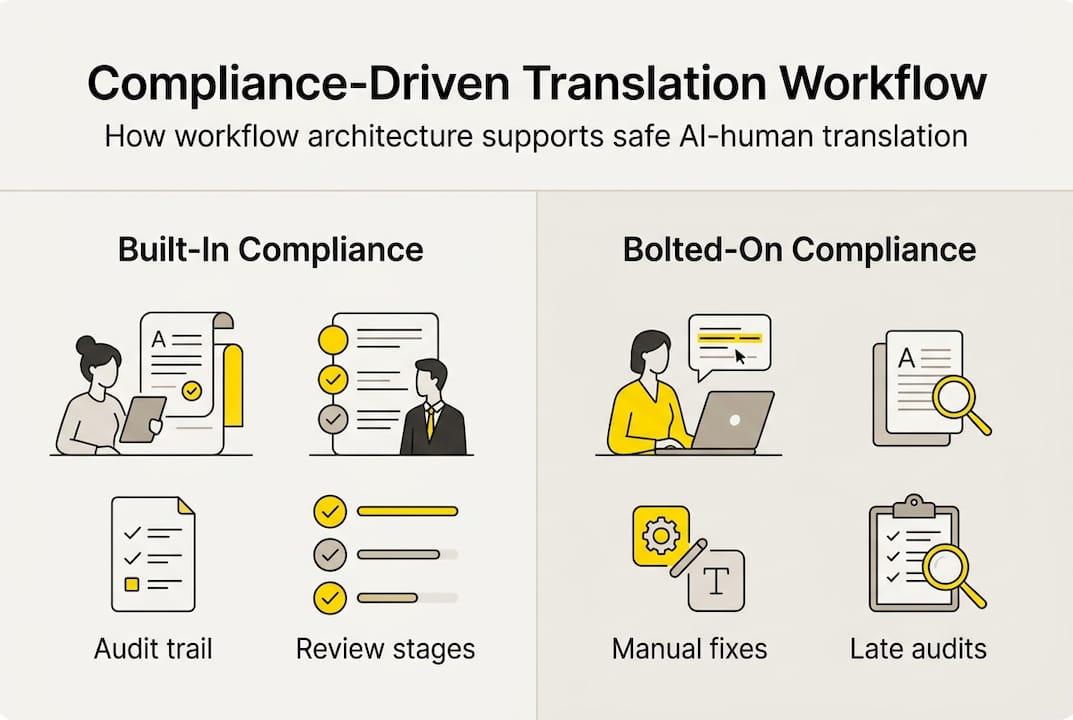
Effective workflow design reduces compliance risks by building checkpoints into the process rather than relying on end-stage review to catch everything. The factors that make workflow architecture critical include:
Layered review stages that separate AI generation, SME editing, and compliance verification into distinct, documented steps.
Terminology governance enforced at the generation stage, not patched in during editing.
Audit trail integrity that captures every decision point for regulatory review.
Role clarity so that each reviewer knows exactly what they are accountable for and what the previous stage covered.
Escalation protocols for flagging ambiguous or high-risk content before it reaches final QA.
Workflow architecture is where compliance is either built in or bolted on. Built-in compliance is defensible. Bolted-on compliance is a liability.
Elements of an effective workflow for regulated industries
Let’s look at what makes a workflow truly fit for regulated sectors, from technical quality to compliance assurance.
Regulated workflows often include multiple expert review stages that correspond to distinct quality gates. Here is the sequence that reflects best practice for compliance-grade translation:
Intake and asset integration. Ingest client Translation Memories ™ and Term Bases (TB) before any translation begins. This step locks in approved terminology and style guidance so that AI generation starts from a controlled baseline.
LLM generation. The proprietary LLM-based system produces target language output constrained by the ingested assets. Context-sensitive generation at this stage reduces the correction burden on human reviewers.
Certified SME review. A subject-matter expert, whether a medical professional, legal scholar, or engineer, reviews for technical accuracy, regulatory compliance, and contextual nuance. This is not a light proofread. It is a substantive review.
Quality assurance. QA aligned to ISO 17100 and ISO 18587 and, where relevant, sector-specific requirements such as MDR, verifies that the output meets defined quality criteria before delivery.
Compliance sign-off. A final review confirms that the document meets the regulatory requirements of the target jurisdiction, including any secure research workflow or data handling obligations.
Workflow stage | Primary function | Compliance impact |
Asset integration | Terminology lock-in | Prevents terminology drift |
LLM generation | Controlled AI output | Reduces error surface |
SME review | Technical accuracy | Catches domain-specific errors |
QA | Standards alignment | ISO 17100, ISO 18587 verification |
Compliance sign-off | Regulatory confirmation | Audit trail closure |
For a deeper look at workflow types for compliance and how to match them to your content program, the regulated document workflow guide covers sector-specific configurations in detail.
Pro Tip: Build audit trails into your workflow from the intake stage, not as an afterthought at delivery. Regulators want to see decision points, not just final outputs.
Common pitfalls and how to avoid them
Even well-designed workflows can falter without attention to the details. Here is what to watch out for.
Lack of process documentation creates compliance risk that surfaces at the worst possible moment: during an audit. The most common workflow failures in regulated translation programs share a pattern. They are not technology failures. They are process failures.
The main risks and their impact:
Skipping human review to save time. This removes the layer that catches AI-generated errors in domain-specific or safety-critical content. The cost of a missed error in a clinical label or legal contract far exceeds the time saved.
Unclear role definitions. When reviewers do not know where their accountability begins and ends, gaps appear. Content falls through without adequate review.
Weak or missing documentation. Without documented process steps, version histories, and reviewer sign-offs, you cannot demonstrate compliance to an auditor. The translation may be accurate; the process is still indefensible.
Over-reliance on AI output without governance. Using a public NMT tool without enterprise terminology controls and then applying a light human review is not a hybrid workflow. It is a risk transfer exercise.
Inconsistent QA criteria. If QA standards vary by project or reviewer, output quality varies too. ISO-aligned QA frameworks exist precisely to prevent this.
For guidance on translation technical compliance and how to evaluate providers against these criteria, the resources on choosing translation providers and the compliance translation RFP guide offer practical frameworks.
Pro Tip: Before any regulatory audit, verify that your process documentation reflects what your team actually does, not what the workflow diagram says they should do. The gap between the two is where compliance risk lives.
Practical steps to architect your compliant translation workflow
So, what should you actually do next to ensure your translation workflows are up to the task?
Workflow design is critical for compliant translation provider selection, and the same logic applies internally. Before you can improve your workflow, you need to know where it currently fails. Start with an honest audit.
Audit your current workflow. Map every step from intake to delivery. Identify where human review happens, where documentation is generated, and where accountability is unclear.
Identify compliance gaps. Compare your current process against the requirements of your sector, whether that is MDR for medical devices, HIPAA for health information, or equivalent standards in legal and finance.
Redesign around quality gates. Restructure the workflow so that each stage has a defined input, a defined output, and a documented reviewer. Remove steps that add time without adding verifiable quality.
Integrate terminology governance early. If you are using a hybrid approach, ensure that TM and TB assets are ingested before AI generation begins, not applied as a post-edit correction layer.
Train reviewers on their specific accountability. SME reviewers in regulated sectors need to understand what the AI generation stage covered and what it cannot catch. Training closes the gap between process design and process execution.
Document everything and review regularly. Workflow documentation should be a living record, updated when processes change and reviewed before major regulatory submissions.
For teams already using hybrid translation, optimizing hybrid translation processes often yields the fastest compliance improvements because the infrastructure is already in place. The gains come from tightening the governance layer around it.
Enhance your compliance-grade translation with AD VERBUM
Ready to apply these insights? Here is how you can leverage expert support for advanced workflows.
AD VERBUM has spent 25+ years building translation workflows for the sectors where errors carry real consequences: life sciences, legal, finance, defense, and manufacturing. The proprietary LangOps System combines EU-hosted LLM generation with a network of 3,500+ certified subject-matter expert linguists, delivering output that is 3x to 5x faster than traditional workflows without compromising the ISO 17100, ISO 18587, and ISO 27001 standards your compliance program depends on.
If your current translation program is scaling under regulatory pressure, or if an upcoming audit has exposed gaps in your process documentation, the right next step is a structured conversation about workflow design. Explore AD VERBUM’s translation services and workflow features to see how a compliant hybrid architecture is built in practice, or contact our team to discuss a bespoke workflow design for your content program.
Frequently asked questions
What’s the main difference between AI+human hybrid and human-only translation?
Hybrid approaches combine AI generation with certified expert review, enabling terminology governance and faster turnaround, while human-only workflows rely entirely on translators and tend to break down under volume and regulatory pressure.
Why is workflow design so crucial for regulated industries?
Workflow design ensures multiple review levels and generates the audit trails that regulators require, making it the structural foundation of any compliant translation program rather than a secondary concern.
What are common mistakes in translation workflows for compliance?
Insufficient process documentation is the most damaging mistake, followed by skipping human review stages and failing to define clear reviewer accountability, all of which create defensibility gaps during audits.
How can I improve my organization’s translation workflow?
Audit your current process against your sector’s compliance requirements, add layered QA and compliance sign-off stages, integrate terminology assets before AI generation begins, and document every step so the process is auditable from intake to delivery.
Recommended

