Why Terminology Enforcement Matters for Regulated Translation
Updated: Sep 16

Terminology enforcement in translation and localization is the single most effective control for preventing regulatory rework, protecting patient and user safety, and reducing translation-driven cost overruns. When approved term bases, glossaries, and style rules are applied, validated, and audited consistently across every target language, organizations gain an auditable single source of truth that satisfies FDA, EMA, and ICH expectations and holds up under submission review. Without it, a single inconsistent label term can trigger a quality deficiency letter, delay market authorization, or misclassify an adverse event in a pharmacovigilance report.
Key Takeaways
Terminology enforcement in regulated translation is a compliance control, not a quality preference — and the evidence, standards, and audit requirements all point to the same conclusion.
Point | Details |
Regulatory risk is quantifiable | Programs using managed terminology databases reported ~43% fewer translation-related regulatory queries. |
ISO 30042 (TBX) is the baseline standard | Require TBX import/export and automated term compliance reports in every RFP for regulated content. |
Enforcement authority must be named | Assign a terminology steward with documented power to block non-compliant deliveries. |
LLM drift requires upstream constraints | Lock approved terms as generation constraints, not just post-edit QA flags, in any AI-assisted workflow. |
AD VERBUM fits high-risk regulated programs | ISO 17100, ISO 18587, ISO 13485, and ISO 27001 certified; TBX integration and SME review built into every project. |
Table of Contents
What does terminology enforcement mean in translation workflows?
Why terminology enforcement matters for compliance, safety, and cost
Which standards and systems should you specify for terminology control?
Two examples of enforcement preventing a compliance or safety failure
The case for treating terminology enforcement as a compliance control
What does terminology enforcement mean in translation workflows?
In translation and localization, terminology enforcement means systematically applying, validating, and auditing approved term bases and glossaries across every workflow stage — not just checking a word list at the end. The scope covers:
Termbase / TBX: a structured, machine-readable glossary in ISO 30042 (TBX) format, the international standard for term exchange between systems
Controlled glossaries: domain-specific approved terms with definitions, usage notes, and forbidden variants
Style guides: register, tone, and formatting rules that govern how approved terms appear in context
TM/TMS integration: translation memories and translation management systems that surface approved terms in real time during drafting
CMS and authoring connectors: hooks that flag unapproved terms before content leaves the source system
Automated verification: QA automation that checks term compliance before delivery
SME review: subject-matter expert sign-off on domain accuracy and regulatory alignment
Lifecycle and versioning controls: draft, review, approved, deprecated, and retired states for every term entry
This article is strictly about terminology control in translation and localization workflows. It does not address legal enforcement actions or regulatory enforcement proceedings.
Pro Tip: When onboarding a new vendor, request a sample TBX export from a live project. If they cannot produce one within 24 hours, their termbase infrastructure is almost certainly manual — and manual means unauditable.
Why terminology enforcement matters for compliance, safety, and cost
Inconsistent terminology in regulated documents carries direct, measurable consequences. Translation inconsistencies in drug labeling and regulatory submissions are a documented cause of quality deficiency letters from regulators, and pharmacovigilance translation errors have contributed to misclassification of adverse event severity. The risk categories stack up quickly:
Regulatory rejection or query: A term rendered differently across a dossier’s language versions signals inconsistency to reviewers and can trigger a deficiency letter, adding weeks or months to an approval timeline.
Patient safety incident: Ambiguous dosing instructions or contraindication language — caused by a missing or overridden approved term — can reach patients with the wrong meaning intact.
Label and instruction ambiguity: In medical device Instructions for Use (IFU), a single unapproved synonym for a safety-critical component can create liability exposure under FDA 21 CFR Part 801 or EU MDR Article 10.
Clinical trial integrity: Inconsistent translation of inclusion/exclusion criteria or informed consent language across sites undermines protocol equivalence and can invalidate data.
Translation rework cost: Every inconsistency caught late in review cycles requires retranslation, re-review, and re-formatting across all affected language versions.
Organizations using managed pharmaceutical terminology databases reported approximately 43% fewer translation-related regulatory queries compared with programs relying on general translation resources. This improvement alone justifies the governance investment for any program filing in multiple markets.
Stat: Programs using managed terminology databases reported ~43% fewer translation-related regulatory queries. (Aoxya)
Which standards and systems should you specify for terminology control?
ISO 704 and ISO 30042 (TBX) are the foundational standards. ISO 704 establishes principles for concept systems and term formation; ISO 30042 defines the TBX data format for exchanging termbases between authoring tools, TMS platforms, and QA systems. The ISO 10241 series covers international terminology standards for specific domains. Together, they define what a compliant termbase looks like and how it moves between systems.
For vendor certification, the relevant ISO standards in language services are:
ISO 17100 — translation service quality requirements
ISO 18587 — post-editing of machine translation output
ISO 13485 — quality management for medical devices (required for IFU and labeling translation)
ISO 27001 — information security management
Technical integration points to specify in any RFP:
TBX import and export at project intake and delivery
Real-time term verification API or plugin within the TMS
QA automation hooks that flag non-compliant terms before delivery
CMS or authoring-system connectors (DITA, MadCap Flare, Vasont) that enforce terms at the source
Pro Tip: Add a contract clause requiring the vendor to deliver a term compliance report with every project. Specify the format: term name, approved variant used, flagged deviations, and reviewer sign-off. This becomes your audit artifact.
How to implement terminology enforcement step by step
A terminology enforcement workflow for regulated content follows a clear sequence. Each step has a defined owner.
Define scope (Day 1–5, Localization Lead + Regulatory): Identify document types, target languages, and regulatory markets. Prioritize by risk: labeling and IFU first, then clinical, then marketing.
Build the single source of truth termbase (Day 5–20, Terminology Steward): Consolidate existing glossaries into one TBX-format termbase. Assign lifecycle states: Draft, Under Review, Approved, Deprecated. Every entry needs a definition, usage note, and forbidden variants.
Integrate with TMS and CMS (Day 20–35, IT + Localization): Connect the TBX to your TMS and authoring system. Configure automated term-check rules. Test with a controlled document set.
Configure automated verification (Day 35–45, QA Lead): Set QA rules to flag any target-language segment that uses a non-approved variant. Define severity levels: critical (safety term), major (regulatory term), minor (style preference).
Assign stewards and approval workflows (Day 45–50, Regulatory + Legal): Name a terminology steward per domain (clinical, device, financial). Define who can propose, review, and approve term changes. Document the workflow.
SME review and QA (ongoing, SME + QA Lead): Pharmaceutical translation requires back-translation for patient-facing materials per ICH E6(R3) and integration into the quality management system per ICH Q10. Apply the same discipline to device and finance documentation.
Versioning and change control (ongoing, Terminology Steward): Log every term change with date, requester, approver, and rationale. Maintain a change history in the TBX. Roll back is possible only if the log is complete.
Pro Tip: On Day 1, run a term coverage audit on your last three delivered projects. Count how many target-language segments used an approved term versus a synonym or free translation. That baseline number is your starting term compliance rate — and the number you will present to auditors in 90 days.
How do you measure terminology compliance and run audits?
Metric | Formula | Target threshold | Reporting cadence |
Term compliance rate | Approved term uses / total term occurrences × 100 | ≥ 95% for regulated docs | Per project + quarterly |
Term coverage | Terms in TBX / total unique domain terms identified | ≥ 90% for active domains | Quarterly |
Audit-discovered inconsistencies | Flagged deviations per segment | < 5 for labeling/IFU | Per project |
Time-to-fix | Hours from deviation flag to approved correction | < 48 hours for critical | Per project |
Quarterly audits should compare term compliance rates across vendors, document types, and language pairs. Trigger-based reviews apply whenever a new product version, regulatory market, or language is added. A governed glossary with lifecycle states and approval workflows reduces definition drift and gives auditors a traceable record of every term decision — which is what makes regulatory reporting defensible.
Assign audit ownership to the Localization Lead, with Regulatory sign-off on findings. Every audit report should include: term compliance rate by language pair, deviation count by severity, time-to-fix averages, and a list of terms flagged for lifecycle review.
What causes terminology drift and how do you fix it?
The most common failure modes in terminology enforcement for regulated industries follow predictable patterns:
Decentralized ownership: Multiple teams maintain separate glossaries with no reconciliation process. Fix: appoint a single terminology steward with enforcement authority and merge all glossaries into one TBX.
No enforcement authority: Translators can override approved terms without a documented reason. Fix: configure TMS to require a justification field for any deviation; route deviations to the steward for approval.
CAT/TM mismatch: Translation memory segments contain older, pre-approved terminology that conflicts with the current TBX. Fix: run a TM audit against the current TBX before each project and purge or flag conflicting segments.
Ad hoc updates: Terms are updated in the TBX without notifying active translators or re-checking in-progress projects. Fix: implement a change notification workflow that pauses affected segments for re-review.
LLM output drift: LLM-assisted drafts generate contextually plausible but unapproved synonyms. Fix: sandbox LLM outputs and lock approved terms as hard constraints before generation, not as a post-edit check.
Pro Tip: The LLM drift vector is the one most teams underestimate. Locking approved terms as generation constraints — not just QA flags — cuts unapproved synonym generation at the source. Require vendors to document how their LLM enforces term constraints, not just how they check output afterward.
What should your RFP and vendor contracts require?
For regulated content, vendor procurement criteria should be structured as must-have, should-have, and optional.
Must-have (regulatory-critical):
TBX import and export at project intake and delivery
Automated term compliance reporting per project
Role-based access control for termbase editing
Full audit logs with reviewer identity, timestamp, and change rationale
ISO 17100 and ISO 18587 certification (independently audited)
ISO 13485 for medical device and IFU translation
ISO 27001 for information security
Data residency declaration and encryption standards
SME reviewer pools with documented domain credentials
Should-have:
Real-time TMS term verification API
Back-translation capability for patient-facing materials
Remediation SLA: critical deviations corrected within 48 hours
Optional (for high-volume programs):
CMS/authoring connector for source-side term enforcement
Multilingual MedDRA or ICD mapping support
Contract clauses for cross-border regulated content should specify: term compliance rate thresholds (≥ 95% for labeling), remediation SLAs, audit rights (right to inspect term compliance reports and change logs), versioning and rollback obligations, and liability boundaries for translation errors that cause regulatory findings.
Two examples of enforcement preventing a compliance or safety failure
Example 1: multilingual labeling inconsistency caught before submission
A pharmaceutical company preparing a multilingual dossier for EMA submission discovered during internal review that the term for “contraindication” had been rendered using different target-language variants across the SmPC and PIL translations. No enforced TBX was in place; each language pair had been managed by a separate freelance team.
The enforcement step applied: consolidate all 12 language pairs into a single TBX, run automated term compliance checks against the merged termbase, and require SME sign-off on all deviations before final delivery.
Outcome: multiple deviations corrected before submission
Regulatory queries on labeling terminology: none at final review
Estimated rework avoided: significant re-translation of several language versions
Example 2: pharmacovigilance ICSR mistranslation averted
A medical device manufacturer’s pharmacovigilance team received an Individual Case Safety Report (ICSR) translated from Japanese. The adverse event term had been rendered using a general consumer synonym rather than the controlled MedDRA-mapped term, which would have placed the event in a lower-severity category.
The enforcement step applied: a controlled adverse-event glossary with MedDRA mappings, back-translation QA per ICH E6(R3) and GMP guidance, and SME review by a pharmacovigilance specialist.
Outcome: severity reclassified correctly before submission to FDA MedWatch
Downstream impact: signal detection algorithm received accurate severity input; no false-negative safety signal
More enforcement examples across translation scenarios illustrate how these controls apply beyond pharma to finance and defense documentation.
How AD VERBUM implements terminology enforcement
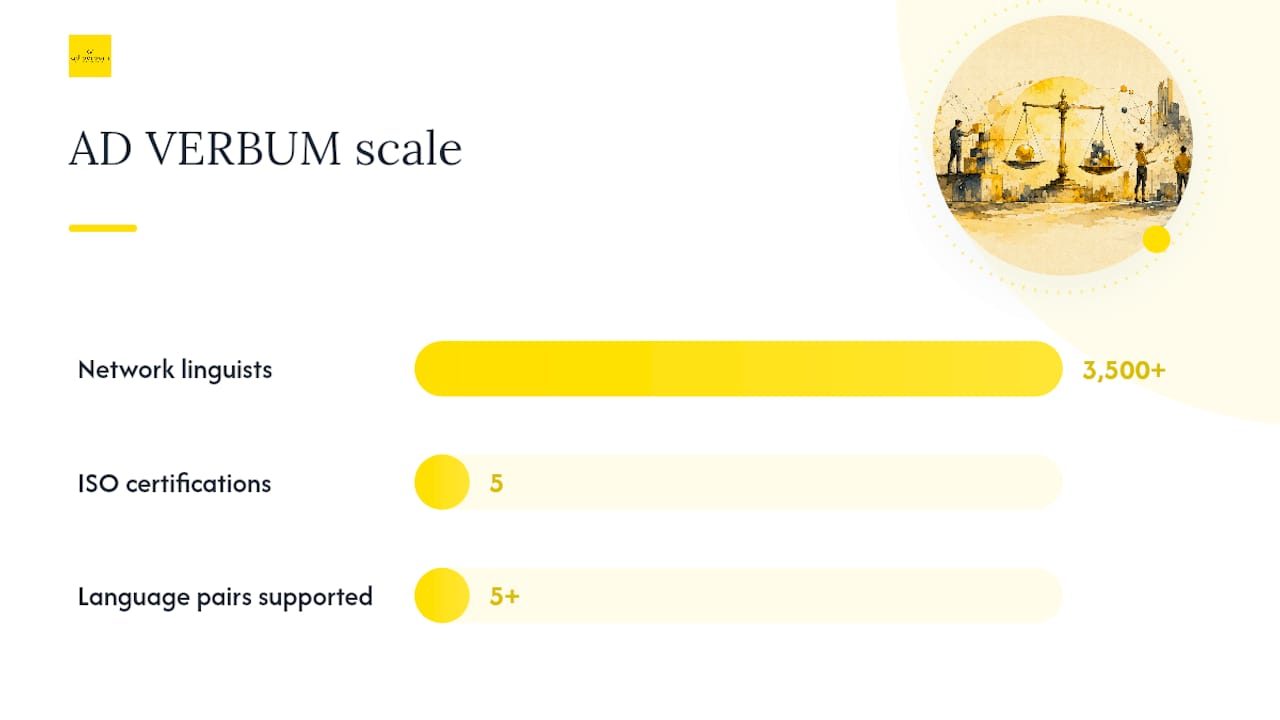
AD VERBUM’s AI+HUMAN hybrid translation workflow is built around terminology enforcement as a structural requirement, not as an optional QA step.
The sequence:
Asset integration: Client TMs and TBs are ingested first. Approved terms are locked as hard constraints before any generation begins.
LangOps System processing: AD VERBUM’s proprietary LLM-based system, hosted on EU servers, produces target-language output constrained by client terminology and style guidance. This is not generic NMT — the system follows explicit term instructions at the generation stage.
SME domain review: A certified subject-matter expert from AD VERBUM’s network of 3,500+ linguists reviews for technical accuracy, regulatory compliance, and contextual nuance.
ISO-aligned QA: QA is aligned to ISO 17100 and ISO 18587 and, where relevant, MDR and sector-specific requirements. TBX export and audit logs are delivered with every project.
When to engage AD VERBUM:
High-risk labeling, SmPC, PIL, or IFU translation requiring ISO 13485-aligned QA
Pharmacovigilance ICSR translation with MedDRA mapping requirements
Cross-market dossier harmonization across 5+ language pairs
Programs with audit rights clauses requiring documented term compliance reports
Sensitive documentation requiring EU-hosted, GDPR and HIPAA-aligned data processing
AD VERBUM holds ISO 17100, ISO 18587, ISO 27001, ISO 13485, and ISO 42001 certifications, all independently audited by Bureau Veritas. Client-reported turnaround is 3x–5x faster than traditional workflows when TM/TB integration is in place from project start.
First-90-days terminology enforcement checklist
Day 0–30
Define document scope and regulatory markets; rank by risk level
Appoint a terminology steward per domain with documented enforcement authority
Consolidate all existing glossaries into a single TBX-format termbase
Assign lifecycle states to every term entry (Draft, Under Review, Approved)
Run a baseline term compliance audit on the last three delivered projects
Owner: Localization Lead + Regulatory Director
Day 31–60
Integrate TBX with TMS and CMS; configure automated term-check rules
Set QA severity levels: critical, major, minor
Pilot on one high-risk document set (labeling or IFU)
Activate SME sign-off workflow for all deviations
Owner: IT Lead + QA Lead + SME
Day 61–90
Audit pilot results against baseline term compliance rate
Finalize RFP and contract language (term compliance thresholds, audit rights, SLAs)
Scale TBX integration to remaining document sets
Schedule quarterly terminology audits and assign report owners
Owner: Localization Lead + Legal + Compliance Director
Pro Tip: Use terminology management best practices to build your stewardship charter before Day 30. A one-page document defining who can propose, review, and approve term changes prevents the single most common enforcement breakdown: competing authorities.
The case for treating terminology enforcement as a compliance control
Most organizations treat terminology management as a translation quality nicety. That framing is wrong, and it costs them. In regulated industries, a term is not a preference — it is a data point in a submission, a safety instruction in a label, or a severity classification in a pharmacovigilance report. When that data point is inconsistent across languages, the downstream consequences are regulatory, not editorial.

The governance model matters as much as the technology. A well-structured glossary with stewardship roles and lifecycle controls is what separates a defensible audit trail from a spreadsheet someone updates when they remember to. Enforcement authority — the actual power to block a delivery that fails term compliance — has to sit with a named person, not a process document.
The LLM drift problem deserves particular attention in 2026. AI-assisted translation introduces a new failure mode that manual QA alone cannot catch at scale: contextually plausible but unapproved synonyms generated fluently and consistently across thousands of segments. The mitigation is upstream constraint, not downstream correction. Any vendor who cannot explain how their LLM enforces approved terms at the generation stage — not just how they flag deviations afterward — is describing a QA process, not a terminology enforcement architecture.
AD VERBUM supports your terminology enforcement program
Regulated translation programs that need auditable term compliance, ISO-certified QA, and EU-hosted data processing have a direct path forward with AD VERBUM. The LangOps System ingests your existing TMs and TBs, enforces approved terminology at the LLM generation stage, and delivers TBX exports and term compliance reports with every project. A network of 3,500+ certified subject-matter experts covers pharma, medical devices, finance, defense, and manufacturing. Certifications include ISO 17100, ISO 18587, ISO 27001, ISO 13485, and ISO 42001, all audited by Bureau Veritas.
Whether you need a terminology enforcement audit on an existing program, RFP support for a new vendor selection, or a pilot on a high-risk document set, AD VERBUM’s localization services are scoped to your regulatory requirements. Contact AD VERBUM to request a terminology audit or pilot engagement.
Sources
The sources below support the compliance claims, standards references, and operational data cited in this article. Each is relevant for audit documentation or RFP requirements.
Recommended