


Which Pharma Documents Suit AI Translation With Human Review

Five pharma document types carry a language obligation across the EU, and every one of them can move through AI translation, as long as a certified linguist signs off on the result. What changes from document to document is how much review, not whether you get to skip it. A dosing line a patient reads is not the same risk as a section header in a regional dossier, and the workflow should not treat them the same way.
AD VERBUM is an EU-hosted translation company that runs all five of these documents through a client-tuned language model and certified life-sciences linguists, human-verified under ISO 17100 and ISO 18587, with no training on your data. We handle informed consent forms, package leaflets, summaries of product characteristics, eCTD Module 1 documents, and periodic safety update reports, in the 24 official EU languages plus Icelandic and Norwegian where a market requires them.
No EMA rule names a translation tool. The obligation is that product information reaches the patient and the assessor accurate and in the right language, and the EMA product-information requirements set what each document must contain and how it is checked. So the real question is which pharma documents suit AI translation, and how much certified review each needs before it stands up, which we also weigh in our piece on whether AI translation is accurate enough for SmPC and PIL. Here they are, ranked from the highest patient-facing risk to the lowest.
The five documents, ranked by how much review they demand
These are the pharma documents suited to AI translation with certified human review, ordered from the text a patient acts on directly to the report an assessor reads. For each, here is the EU language rule, what goes wrong if raw model output ships unreviewed, and the certified control that keeps the document defensible.
1. Informed consent forms
The informed consent form is the highest-stakes document, because a trial participant decides whether to join a study based on what it says. The Clinical Trials Regulation, Regulation (EU) 536/2014, requires the information given to a subject to be in a language they easily understand, written so a layperson can follow it, under Article 29(1) and Annex I. Two things go wrong with unreviewed output. A model can render a risk or a procedure in phrasing that is technically correct but too dense to consent to, and it can mistranslate a study procedure in a way an ethics committee catches on review. Consent forms also carry health data, so processing them falls under Article 9 of the GDPR, which is why where the text is handled matters as much as who signs off. The control is certified review by a life-sciences linguist working to plain-language readability, inside an EU-hosted workflow.
2. Package leaflet
The package leaflet is what the patient reads at home, so an error reaches a user directly. It sits in Annex IIIB of the marketing authorisation, and the readability of the final text is user-tested before approval, which means a translation that scans awkwardly can fail the test even when every word is defensible. The failure mode with raw output is subtle: a dose interval, a warning, or a contraindication that reads plausibly but shifts meaning in the target language. Full human post-editing under ISO 18587 by a certified linguist, with terminology locked to the approved QRD template and the product term base, is what keeps the leaflet both correct and readable. This is the document where readability and accuracy are the same requirement, not two.
3. Summary of product characteristics
The summary of product characteristics is the reference a prescriber relies on, and it anchors the leaflet and the labelling beneath it. Its content and the language duty behind it sit in Directive 2001/83/EC, and in the centralised procedure the translations go through the day-5 linguistic review before the Commission decision. A wrong strength, an inverted interaction, or a drift between the SmPC and the leaflet built from it is exactly what that review is designed to catch, and it is expensive to fix late. AI translation produces a fast, consistent first version constrained by the QRD template, then a certified reviewer checks it against the approved English and the product term base. On product information the assessor reads the translation, not just the source, so two-step review is the baseline.

4. eCTD Module 1 regional documents
Module 1 is the national and regional part of the electronic submission, and it holds the application form, product information, and national annexes in each member state's language. The volume is high and the text is repetitive, which is exactly where AI translation earns its place, and where consistency is the whole battle. The risk is drift: the same standard phrase rendered two ways across markets, which an assessor reads as a discrepancy in the dossier. A governed term base carries one approved equivalent per language, and certified review holds every regional document to it, the same approach we set out for AI translation in EMA eCTD submissions. Lower narrative risk than a leaflet, but the demand for a single consistent wording is just as strict.
5. Periodic safety update reports
Periodic safety update reports are the lowest translation demand of the five, because the single assessment is conducted in English and the core report is not translated market by market. Where translation enters is the local follow-up: national safety communications, updated product information triggered by a signal, and the patient-facing wording that flows from a PSUR outcome. The failure mode is a signal described one way in the report and another way in the leaflet update that follows it, which reads as inconsistent safety wording to a regulator. Certified review keeps the pharmacovigilance vocabulary aligned across the report and everything downstream of it, so a safety signal means the same thing in every language it appears in.
The certified status comes from the sign-off, not the model
A regulator does not audit your translation engine. It reads the released text and expects a record showing a competent person reviewed and took responsibility for each version, which is what ISO 17100 requires of the translation process and what ISO 18587 requires of post-edited output. The model is a tool inside that process. What makes a translated consent form or leaflet defensible is the documented certified review behind it, the same point we make on AI translation for pharma clinical trials.
This is why the same document can suit AI translation for one sponsor and fail for another. The text is identical. The difference is whether a qualified life-sciences linguist took responsibility for it under a certified workflow, and whether the record proves it. We keep that trail on every job, so a sponsor or marketing authorisation holder can hand an inspector a version history, not an assurance.
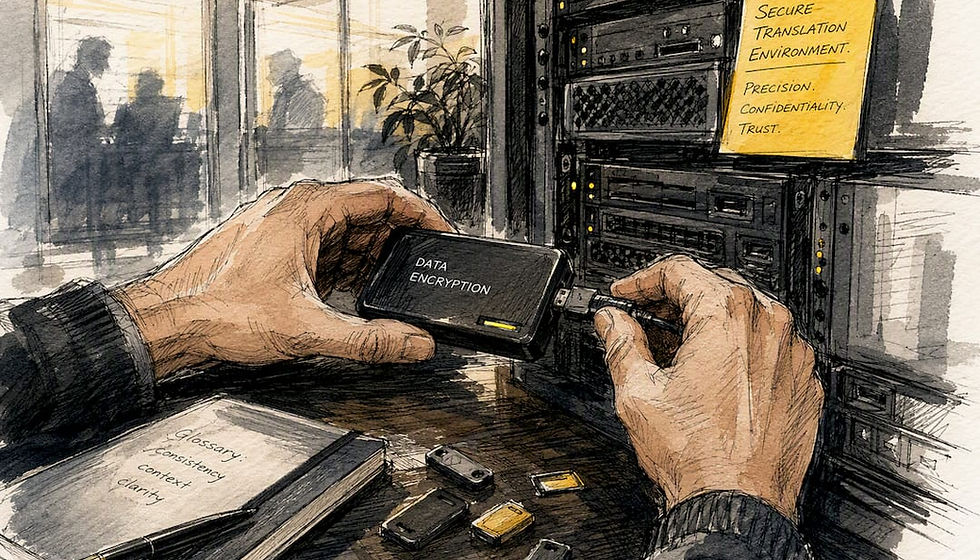
Why EU hosting and ISO 27001 belong in this
Pharma documents carry patient data and pre-approval content, so where the text is processed counts as much as who reviews it. Four things separate a defensible AI translation workflow from a convenient one:
EU-hosted processing, so consent forms, safety data and pre-authorisation content do not transit public-cloud endpoints outside the jurisdiction that regulates them.
No training on your data, so your clinical and product content never becomes a model's future output, a distinction we explain in what AI translation means for regulated content.
ISO 27001 information security across the whole workflow, from file intake to delivery, with access controlled per project.
GDPR data residency, so the health data in consent forms and safety reports stays within EU infrastructure end to end, in line with Article 9.
We built this stack for regulated pharma, not adapted a consumer tool to it. Our certified life-sciences linguists work under ISO 17100 and ISO 18587, on client-tuned open-weight models we host in the EU, which is the same workflow behind our AI translation services for EMA and eCTD submissions. For the wider life-sciences picture, see our guide to AI translation companies for life sciences.
Our pharma translation services
Our translation services for regulated sectors run on ISO 27001 and ISO 42001 certified, EU-hosted infrastructure, with no reliance on public cloud tooling for core processing. Every project runs through our AI+HUMAN hybrid workflow: we ingest client Translation Memories and Term Bases first, our proprietary LLM-based LangOps System generates output constrained by client terminology on client-tuned open-weight models, and our certified subject-matter experts review for technical accuracy and regulatory compliance. Our QA is aligned to ISO 17100 and ISO 18587, with sector-specific requirements such as the EMA product-information rules and GDPR Article 9 handling of patient data applied where relevant. We serve Life Sciences, Legal, Finance, Defense, and Manufacturing clients across 150+ languages with 3,500+ subject-matter linguists. For teams managing audit-sensitive content, contact us to discuss your security and compliance requirements directly.
FAQ
Which pharma documents can use AI translation?
Informed consent forms, package leaflets, summaries of product characteristics, eCTD Module 1 documents, and the local wording that follows a periodic safety update report can all use AI translation with certified human review. Each carries an EU language obligation, under the Clinical Trials Regulation 536/2014 for consent forms and Directive 2001/83/EC for product information. The document does not change whether review is needed, only how much.
Does EMA require human review of AI translation?
No EMA rule names a tool, but product information is verified through the QRD template and the day-5 linguistic review, and ISO 17100 and ISO 18587 make a competent human responsible for each released version. In practice that means certified post-editing, not unreviewed model output, before a submission stands up.
What is the highest-risk pharma document to translate?
The informed consent form, because a trial participant decides whether to join a study based on it. Under Article 29(1) of Regulation 536/2014 it must be in a language the subject easily understands and written for a layperson, so it takes certified review to plain-language readability every time.
In which languages must pharma documents be translated?
Product information must appear in the official language or languages of each member state where the medicine is authorised, which across the EU means up to 24 languages plus Icelandic and Norwegian for the centralised procedure. Consent forms must be in a language each trial participant easily understands, under Regulation 536/2014.
Are periodic safety update reports translated?
The core PSUR is assessed in English through the single assessment, so it is usually not translated market by market. Translation enters through the national safety communications and product-information updates that follow a signal, where certified review keeps the pharmacovigilance wording consistent across every language.
Is AI translation of pharma documents secure?
It is when the workflow is EU-hosted, ISO 27001 certified, and trains no model on your data. AD VERBUM processes consent forms and safety data inside EU infrastructure with GDPR data residency under Article 9, so patient and pre-approval data never leaves the jurisdiction that regulates it.
