


What Is a Subject-Matter Expert Linguist?
- Jun 11
- 9 min read

A subject-matter expert linguist is a professional who combines deep domain knowledge in a specialized field with advanced linguistic skills to produce accurate, contextually reliable translations and localizations. The role is formally recognized across regulated industries including Life Sciences, Legal, Finance, and Defense, where terminology errors carry compliance and safety consequences. Understanding what a subject-matter expert linguist does, and why the role differs fundamentally from general translation, is the starting point for any organization managing high-stakes multilingual content.
What is a subject-matter expert linguist, exactly?
The industry term for this role is “SME linguist,” short for subject-matter expert linguist. Language and linguistics SMEs provide specialized expertise in translation, interpretation, and localization processes. That definition matters because it separates the role from a general translator, who may be fluent in two languages but lacks the domain depth to evaluate whether a translated medical protocol or legal clause is technically correct.
An SME linguist holds qualifications in both a subject discipline and a target language. A medical device SME linguist, for example, may hold a degree in biomedical engineering alongside a formal translation credential. A legal SME linguist may have practiced law before specializing in legal translation. The U.S. Office of Personnel Management notes that first-level supervisors qualify as SMEs when they possess bona fide expert knowledge in their job area. That same standard applies in translation: the SME linguist must be credible in the subject domain, not just in the language pair.

The importance of linguists in specialized fields comes down to one practical reality. Terminology in regulated sectors is not interchangeable. A mistranslated dosage instruction, a misrendered contract clause, or an incorrectly localized safety warning can trigger regulatory non-compliance, product recalls, or litigation. General translators are not equipped to catch those errors. SME linguists are.
How do SME linguists shape ai+human hybrid translation workflows?
The role of subject-matter experts in localization has shifted significantly with the adoption of AI+HUMAN hybrid translation. SME linguists no longer function only as final reviewers. They now operate at multiple points in the workflow, shaping the inputs that determine AI output quality before a single sentence is generated.
SMEs in AI-based translation systems act as quality gatekeepers by defining quality standards in context and improving AI outputs upstream through feedback loops and annotations. That upstream function is the critical distinction. When an SME linguist contributes to a Term Base or validates a Translation Memory before the AI generates output, every subsequent translation inherits that domain accuracy. The alternative, correcting errors after generation, is slower and introduces audit risk.
Specifically, SME linguists contribute to AI+HUMAN workflows in three ways:
Terminology governance. SME linguists build and validate Term Bases that constrain AI output to approved domain vocabulary. This prevents the AI from substituting a near-synonym that is technically incorrect in a regulated context.
Annotation and feedback. SMEs provide structured inputs that enhance enterprise-grade multilingual AI solutions beyond generic tools. Those inputs include flagging ambiguous source segments and documenting preferred constructions for recurring document types.
Post-generation review. The SME linguist reviews AI output for technical accuracy, regulatory compliance, and contextual nuance before the content reaches QA.
Pro Tip: When integrating SME linguists into an AI+HUMAN workflow, assign them to Term Base validation before the first translation run. Errors caught at the terminology stage cost a fraction of what post-generation corrections cost in both time and compliance exposure.
The AI+HUMAN hybrid translation workflow that delivers the most consistent results follows a fixed sequence: asset integration first, then LLM generation constrained by client terminology, then SME review, then ISO-aligned QA. Skipping or reordering those steps degrades output quality in ways that are difficult to detect until an audit or incident surfaces the problem.
What differentiates SME linguists from general linguists or translators?
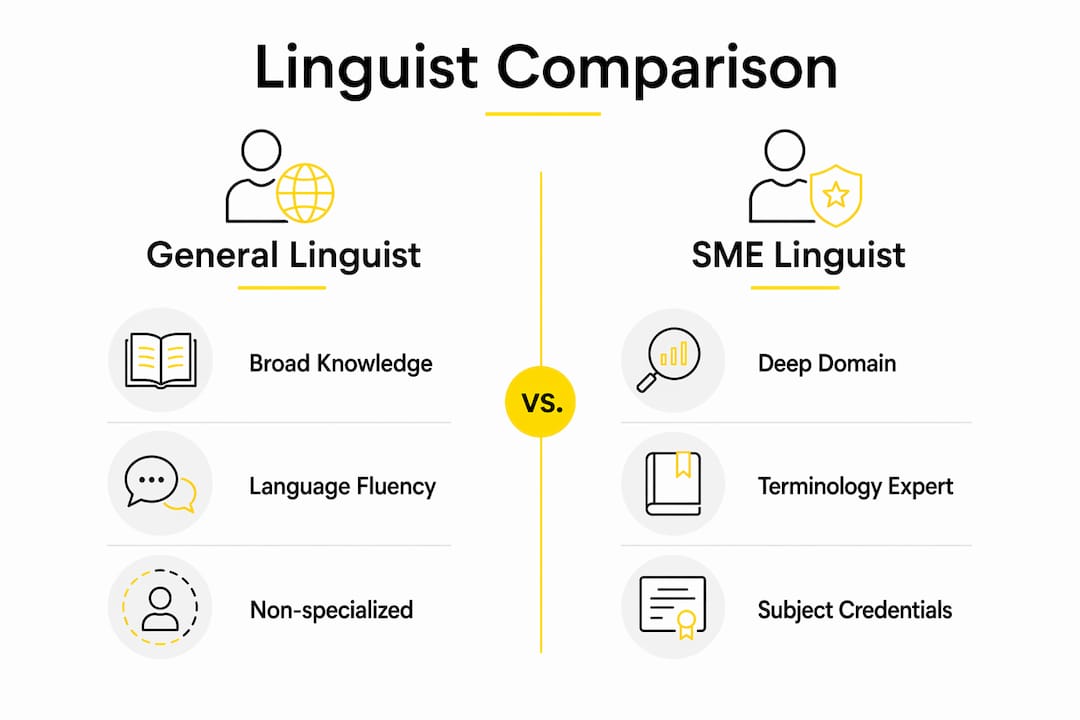
The distinction between a general linguist and an SME linguist is not a matter of language proficiency. Both may be equally fluent. The difference is domain authority and the ability to evaluate whether a translation is technically correct, not just grammatically acceptable.
Technical translation requires SMEs to ensure correct terminology and higher-quality specialized content. A general translator working on a clinical trial protocol may produce fluent output that is nonetheless clinically incorrect. An SME linguist with a background in clinical research will catch that error because they understand what the source text is actually specifying.
The table below maps the core differences across four dimensions:
Dimension | General Linguist | SME Linguist |
Domain knowledge | Broad, non-specialized | Deep expertise in a specific field (medical, legal, engineering) |
Terminology accuracy | Relies on dictionaries and glossaries | Validates terminology against domain standards and regulatory requirements |
Compliance awareness | Limited | Understands sector-specific regulations such as MDR, HIPAA, and ISO standards |
Error detection scope | Grammatical and stylistic | Technical, regulatory, and contextual |
SMEs add value by shaping terminology guidance, catching subtle mistakes, and ensuring context-appropriate translations rather than generic patterns. That last point is where general translators most frequently fall short. A generic pattern may be linguistically correct and still be wrong in a regulated context because it does not reflect the specific meaning the source document intends.
The qualifications for an SME linguist typically include a degree or professional credential in the subject domain, a recognized translation qualification such as those offered by the Chartered Institute of Linguists (CIOL) or the American Translators Association (ATA), and documented experience in the relevant sector. Neither credential alone is sufficient.
How should organizations engage and leverage SME linguists?
Organizations that treat SME linguists as interchangeable reviewers at the end of a translation pipeline consistently underperform on quality and compliance metrics. The role requires structured integration from the project outset.
Follow this sequence to get consistent results:
Define the domain scope first. Identify the specific subject area and regulatory framework before selecting an SME linguist. A Life Sciences SME linguist qualified for pharmaceutical labeling may not be the right fit for medical device software localization under MDR.
Involve the SME in asset preparation. Have the SME linguist review and validate Translation Memories and Term Bases before the AI generation step. This is where SME feedback improves upstream AI model tuning and terminology governance.
Assign the SME to the review stage with a defined checklist. The checklist should cover technical accuracy, regulatory terminology, and any sector-specific style requirements. Unstructured review produces inconsistent results.
Document SME decisions for audit purposes. Every terminology decision and correction should be logged in the Term Base. That log becomes part of the compliance record for regulated content.
Run QA against ISO 17100 and ISO 18587 after SME review. QA at this stage catches process gaps, not just linguistic errors.
Pro Tip: Avoid assigning SME linguists to projects outside their documented domain. A legal SME linguist reviewing a pharmaceutical regulatory submission introduces the same risk as using a general translator. Domain specificity is the entire point of the role.
The machine translation risks that most frequently surface in regulated sectors, including incorrect negation handling and false cognates in technical terminology, are exactly the errors SME linguists are trained to catch. Building that catch into the workflow, rather than relying on post-publication correction, is the operationally sound approach.
What fails when SME linguists are absent?
The consequences of omitting SME linguists from specialized translation are well documented. In regulated industries, specialized translation overseen by SMEs reduces risks associated with compliance failures during localization. The inverse is equally true: without SME oversight, compliance failures become more likely and harder to detect before they cause harm.
The most common failure modes fall into three categories. First, terminology drift: without an SME validating the Term Base, AI and general translators introduce synonyms that are technically incorrect in the target regulatory context. Second, negation errors: legacy machine translation and some neural MT engines mishandle negation in safety-critical instructions, producing output that means the opposite of the source. Third, contextual misalignment: a phrase that is accurate in a general medical context may be incorrect in the specific context of a clinical trial protocol or a device labeling requirement.
Localization SMEs help define what “good” translation means in context and distinguish harmless versus trust-eroding mistakes. That distinction is not abstract. A harmless error in a marketing brochure is a very different risk profile from the same error in a drug interaction warning. SME linguists make that judgment call. General translators and AI systems without SME oversight do not.
The mitigation is straightforward: build SME review into the workflow as a mandatory step, not an optional quality check. For regulated content, treat SME sign-off as a compliance control, not a translation preference.
Where does Adverbum fit in the SME linguist ecosystem?
Adverbum operates a network of 3,500+ subject-matter expert linguists, including medical professionals, engineers, and legal scholars, integrated into a proprietary AI+HUMAN hybrid translation workflow. The workflow follows the four-step sequence: asset integration, LLM generation constrained by client terminology, certified SME review, and QA aligned to ISO 17100 and ISO 18587.
The benefits of proprietary AI translation in regulated fields depend directly on SME integration at the terminology governance and review stages. Adverbum’s LangOps System is hosted on EU servers under ISO 27001 certification, with no reliance on outsourced public cloud tooling for core processing. That architecture matters for clients in Life Sciences, Legal, Finance, and Defense who operate under GDPR, HIPAA, or MDR constraints.
For organizations that need audit-ready translation with documented SME oversight, Adverbum’s model provides the compliance controls, terminology governance, and sector-specific expertise that general translation vendors and consumer-grade neural MT tools cannot match.
Key takeaways
A subject-matter expert linguist is the single most important quality control point in any regulated or high-stakes translation workflow, because domain expertise and linguistic skill must operate together to catch errors that neither AI nor general translators can reliably identify.
Point | Details |
Definition of the role | An SME linguist combines deep domain expertise with advanced linguistic skills for specialized translation. |
Role in AI+HUMAN workflows | SME linguists govern terminology, annotate AI outputs, and review translations before QA. |
Key differentiator from general linguists | SME linguists validate technical and regulatory accuracy, not just grammatical correctness. |
Engagement best practice | Involve SME linguists in asset preparation before AI generation, not only at the review stage. |
Risk of omission | Without SME oversight, terminology drift, negation errors, and contextual misalignment increase compliance exposure. |
The uncomfortable truth about SME linguists in 2026
Most organizations I have seen treat SME linguist involvement as a cost line to minimize. They assign one reviewer to the final stage, give that person a tight deadline, and call it “expert review.” That is not how the role works, and the compliance incidents that follow are predictable.
The real value of an SME linguist is not in catching errors at the end. It is in preventing them from entering the workflow at all. When an SME linguist validates a Term Base before the first AI generation run, the downstream error rate drops substantially. When that same expert is rushed through a final review of a 200-page regulatory submission, they catch some errors and miss others. The workflow design determines the outcome, not the individual’s competence.
The other pattern I find consistently underestimated is the feedback loop. Human expertise in localization is increasingly about curating data, defining rules, and providing oversight rather than replacing human linguists with AI. That framing is correct, but most organizations have not restructured their SME linguist roles to reflect it. They still treat SMEs as translators who happen to know the subject. The organizations that treat SMEs as data curators and terminology architects get better AI output from the first run. The others spend that time on corrections.
My advice is direct: if your SME linguist is only involved after the AI generates output, you are using the role incorrectly. Restructure the engagement so that SME input shapes the translation assets before generation begins. The quality difference is not marginal.
Work with SME linguists who know your sector
Adverbum has delivered AI+HUMAN hybrid translation for regulated industries for over 25 years. The 3,500+ SME linguists in Adverbum’s network include medical professionals, legal scholars, and engineers who operate within a documented, ISO-aligned QA process. Every project runs through the full four-step workflow: asset integration, LLM generation, certified SME review, and ISO 17100 and ISO 18587 aligned QA. If your organization needs multilingual translation services with documented SME oversight and data sovereignty controls, or wants to explore multilingual SEO built on the same quality framework, Adverbum is the right fit for regulated, audit-ready content.
FAQ
What is a subject-matter expert linguist?
A subject-matter expert linguist is a professional who holds deep expertise in a specialized domain, such as medicine, law, or engineering, combined with advanced language and translation skills. The role is distinct from a general translator because it requires the ability to evaluate technical and regulatory accuracy, not just linguistic fluency.
How does an SME linguist differ from a general translator?
A general translator focuses on linguistic accuracy and fluency. An SME linguist also evaluates whether the translation is technically correct and compliant with sector-specific standards, such as MDR for medical devices or HIPAA for healthcare documentation.
What qualifications does an SME linguist need?
SME linguists typically hold a degree or professional credential in their subject domain alongside a recognized translation qualification from bodies such as the American Translators Association or the Chartered Institute of Linguists. Documented sector experience is also required.
Why are SME linguists critical in regulated industries?
In regulated industries, translation errors in safety instructions, labeling, or legal documents can trigger compliance failures, product recalls, or litigation. SME oversight in regulated translation reduces those risks by ensuring terminology and contextual accuracy at every stage of the workflow.
What does an SME linguist earn in the u.s.?
The average annual salary for a subject-matter expert in the U.S. is $102,075 as of November 2025. That figure reflects the market’s recognition of the specialized knowledge and compliance value these professionals provide.
Recommended
