


Translation Turnaround for Compliance Leads: Plan 2,000–2,500 wpd
- 6 minutes ago
- 6 min read

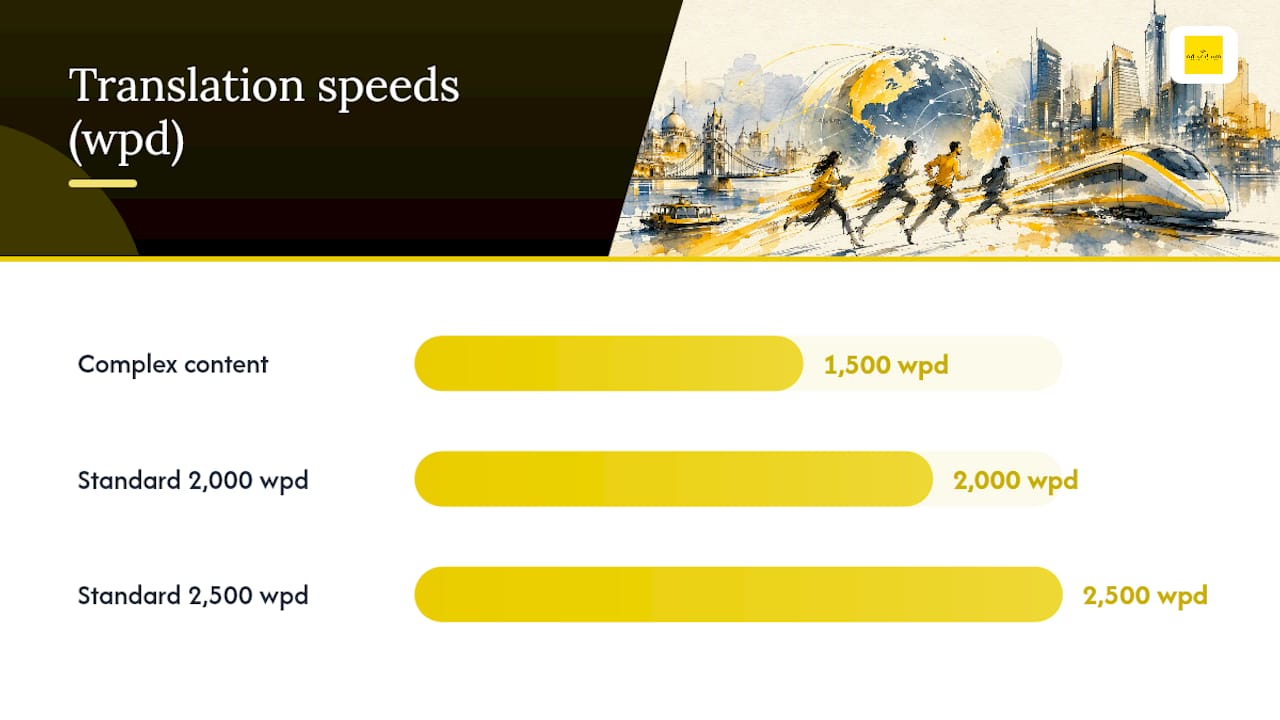
Plan on 2,000 to 2,500 words per business day for standard content, and roughly 1,500 words per day once you add legal, medical, or technical complexity, per industry benchmarks. Rush options exist, down to same-day for short files, at a premium. The biggest variable is not speed but review: a qualified second-linguist check, the kind ISO 17100 requires, typically adds 30 to 50% to total delivery time.
Table of Contents
How Long Does Translation Take by Word Count?
Turnaround scales with volume, but not in a straight line. Short documents move fast because a single linguist can own the whole file start to finish. Once a project crosses into multi-translator territory, coordination and QA scheduling start eating into the calendar gains you’d expect from adding people.
The ranges below reflect standard industry delivery windows for general business content. Legal, medical, and technical material typically requires extra time because terminology research and domain-specific phrasing slow per-day output. Certified translations that require a signed affidavit or notarization generally add extra administrative time beyond the standard window.
Word Count | Standard Turnaround | Rush Turnaround | Team Structure |
— | Same day to 24 hours | Same day (surcharge) | Single translator |
— | 1–2 business days | Same day to 24 hours | Single translator |
1,500–3,000 | 2–3 business days | 24–48 hours | Single translator |
3,000–5,000 | 3–4 business days | 48–72 hours | Single or dual translator |
5,000–10,000 | Several business days | Rush availability limited | Multi-translator team |
10,000+ | Staged delivery, by agreement | Rarely available; staged only | Multi-translator team required |
Anything above 10,000 words with a single hard deadline is a red flag. At that volume, a provider quoting one flat delivery date without a staging plan is usually not providing a realistic estimate.
What Factors Change Translation Turnaround Time?
Five variables explain almost every deviation from the benchmark table above.
Length and complexity. Terminology-dense text, think pharmaceutical labeling or patent claims, slows per-day throughput well below the 2,000 to 2,500 word standard.
Language pair rarity. Common pairs like Spanish to English draw from a deep linguist pool; niche pairs (Icelandic to Korean, for instance) can add days just to confirm availability.
File format and DTP needs. A scanned PDF or a heavily designed InDesign file needs prep and desktop publishing work before translation even starts.
Quality steps built into the process. An ISO 17100-aligned second-linguist review, plus client review rounds, extends the timeline but catches errors a single pass misses.
Client-supplied assets. A ready translation memory and term base speeds up repeated or similar content because fuzzy matching flags partial matches that don’t need full retranslation.
What Are Rush Translation Options and What Do They Cost?
Most providers define rush tiers around three thresholds: same-day (usually capped near 1,000 to 1,500 words), 24 hour delivery (up to roughly 3,000 words), and 48 to 72 hour turnaround for larger files that still need to move faster than standard. Beyond those ceilings, even expedited service usually becomes staged delivery rather than a single faster date.
Surcharges cluster around a few predictable triggers:
Same-day or weekend/holiday delivery, which pulls linguists off their normal schedule
Multi-translator coordination on projects over roughly 3,000 to 5,000 words, since splitting a file requires extra QA to keep terminology consistent
Certification or notarization, which adds administrative steps regardless of translation speed
Format conversion, when source files arrive as scans or non-editable PDFs
When Does the Turnaround Clock Actually Start and Stop?
The clock starts once a provider has reviewed the file and formally assigned it to a linguist, not the moment you hit send. It stops at delivery of the final editable target file, or the signed certification statement for certified work, per standard timeline definitions.
Delays cluster on both sides. Clients cause them with late reference materials, non-final source text that changes mid-project, or slow turnaround on review comments. Providers cause them through linguist availability gaps or backed-up QA scheduling. That’s not overhead to eliminate. It’s the mechanism that catches the errors a rushed single pass would miss.
How Do You Schedule a Multilingual Project?
Sequencing determines whether your deadline is realistic before a single word gets translated.
Prepare clean source files first. Finalize the text, supply your translation memory and term base, and mark any strings that should stay untranslated (product codes, legal citations).
Build in a client review buffer. Budget real calendar days for your team to review drafts, not “whenever someone gets to it.”
Add a vendor translation and SME review buffer. This is where the 30 to 50% review-time addition lives; don’t compress it out of the schedule.
Reserve time for final QA and packaging. Formatting checks and file handoff take longer than most schedules assume.
Decide batch versus parallel early. A 12,000 word manual for five languages can run in parallel across language teams; a single 12,000 word file in one language usually needs sequential staging instead.
Pro Tip: Before you commit to a single delivery date, ask the vendor to confirm the specific linguist’s availability for your language pair and subject matter, not just a generic capacity statement. “We can do it” and “this specific person is free next week” are different promises.
What Quality Risks Come From Compressing Timelines?
Cutting review time to hit a deadline creates specific, predictable failure modes: terminology drift across a document, missed SME checks on regulated claims, layout errors that slip through skipped QA, and, in the worst cases, noncompliant regulatory language reaching a filing.
The mitigations are narrower than most teams expect:
Run SME spot-checks on critical sections even when full review isn’t possible
Keep ISO-aligned QA steps rather than dropping them for speed
Limit rush treatment to noncritical, low-risk sections of a document
Enforce translation memory and glossary use so speed doesn’t cost terminology consistency
The math on this is blunt: at 1,500 words per day for complex content versus 2,000 to 2,500 for standard text, a 10,000 word regulated document already needs 6 to 7 days of translation alone before any review step. Add the 30 to 50% review-time premium, and skipping it doesn’t just save time, it removes the control most likely to catch a critical error before it ships.
Where AI+HUMAN Hybrid Workflows Shorten Delivery Time
AD VERBUM runs an AI+HUMAN hybrid workflow in a fixed sequence: asset integration of the client’s translation memory and term base, generation through a proprietary LLM-based system constrained by that terminology, review by a certified subject-matter expert for technical accuracy, and QA aligned to ISO 17100 and ISO 18587.
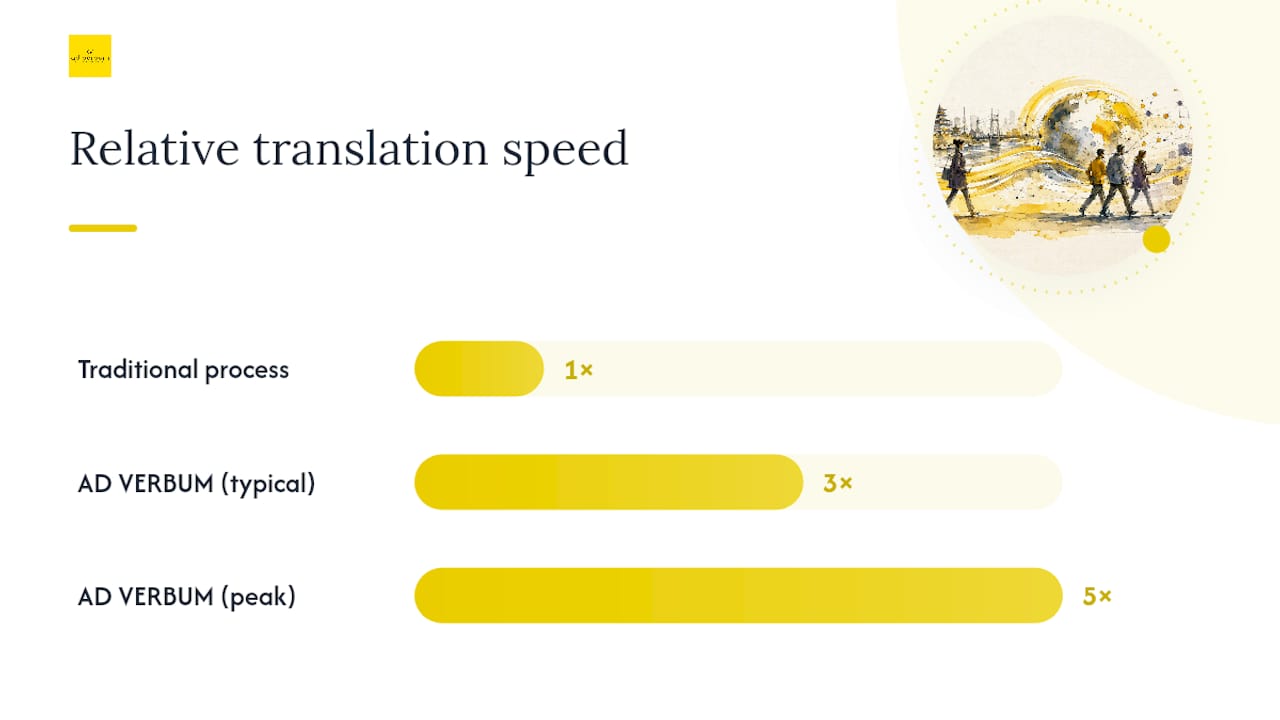
AD VERBUM states this workflow runs 3x to 5x faster than traditional translation processes. That figure applies specifically to translation memory-rich, repeatable content where subject-matter oversight is already built into the process, not to every project type.
The governance layer is what lets procurement teams accept a compressed timeline for sensitive material:
Terminology enforcement at generation, not just at final QA
EU-hosted infrastructure with no reliance on outsourced public cloud tooling for core processing
Alignment to GDPR, HIPAA, and MDR for regulated content categories
Pro Tip: Ask any AI-assisted provider where the human review sits in the sequence. If subject-matter review happens before generation instead of after, the human is checking the source, not the output, and that’s a different control entirely.
Two Worked Examples: Small and Large Projects
Example A, ~1,200 words of marketing copy: standard delivery runs 1 to 2 business days. Expedited to 24 hours is available, but you sacrifice the buffer for a second stylistic pass, so tone consistency checks get lighter.
Example B, ~15,000 word technical manual: this needs a multi-translator team with staged delivery, typically the first section within 4 to 5 days and full delivery across 8 to 10 business days. SME review is scheduled per section, not at the end, so errors surface early rather than in one final crunch. Rush surcharges here cluster around coordination fees, not the base per-word rate.
What Should Project Leads Actually Plan For?
Before signing a statement of work, confirm translation memory access, the exact review scope, weekend coverage, and certification requirements in writing. For regulated content needing an audit trail and terminology governance, AD VERBUM’s hybrid approach fits the brief better than a speed-only vendor.
— Eric Brown
Get a Turnaround Estimate for Your Next Project
An AI+HUMAN hybrid workflow can provide regulated content teams with a documented review trail and integrated terminology governance throughout the process. If your project involves legal, medical, financial, defense, or manufacturing documentation, that combination of speed and audit-readiness matters more than shaving another day off the calendar.
Some linguist networks cover 150+ languages and regional variants, supported by certified subject-matter experts and QA aligned to recognized ISO standards. For urgent legal-document handling across borders, partner resources like professional Italian-English translation services show how staged, expert-reviewed delivery works in practice for time-sensitive filings. If you’re scoping a multilingual rollout and need a realistic delivery window instead of an optimistic guess, contact AD VERBUM for a project-specific quote.
Sources
Recommended

