


Stop Vendor Lock In: Translation Memory Ownership for Regulated Teams

Contractual assignment, not creation, determines who owns a translation memory in practice, as explained in If the LLM is your engine, you don’t own your product - Gainable Blog. Copyright law and database rules rarely resolve the question cleanly on their own. If your contracts are silent on delivery and permitted use, request explicit TM ownership and export language in every statement of work before the project starts.
Table of Contents
What Is Translation Memory Ownership and What Does a TM Contain?
A translation memory is a bilingual database of aligned source and target segments, typically stored in TMX format or a vendor’s proprietary working file. Translation memory ownership refers to the legal and contractual right to possess, export, reuse, and license that database, separate from the right to use any single translation inside it.
Not all TMs are the same asset. Three types show up repeatedly in contracts:
Project TMs, built and scoped to a single engagement.
Master or client TMs, aggregated across many projects and often treated as a long-term terminology and quality asset.
Vendor production TMs, built internally by a language service provider and blended across multiple clients unless segregation is contractually required.
TMs also carry metadata: segment timestamps, linguist identifiers, source document context, and sometimes personal data pulled straight from the source content. That metadata is part of what a client is negotiating for when they ask “who owns TM” in a given engagement, and it’s often the piece that gets left out of the handover.
Does Copyright Law Actually Settle TM Ownership?
Not by itself. Translations qualify as protected derivative works under long-standing international copyright convention, which is why a translator’s specific wording carries its own copyright interest even when the underlying source document belongs to someone else.
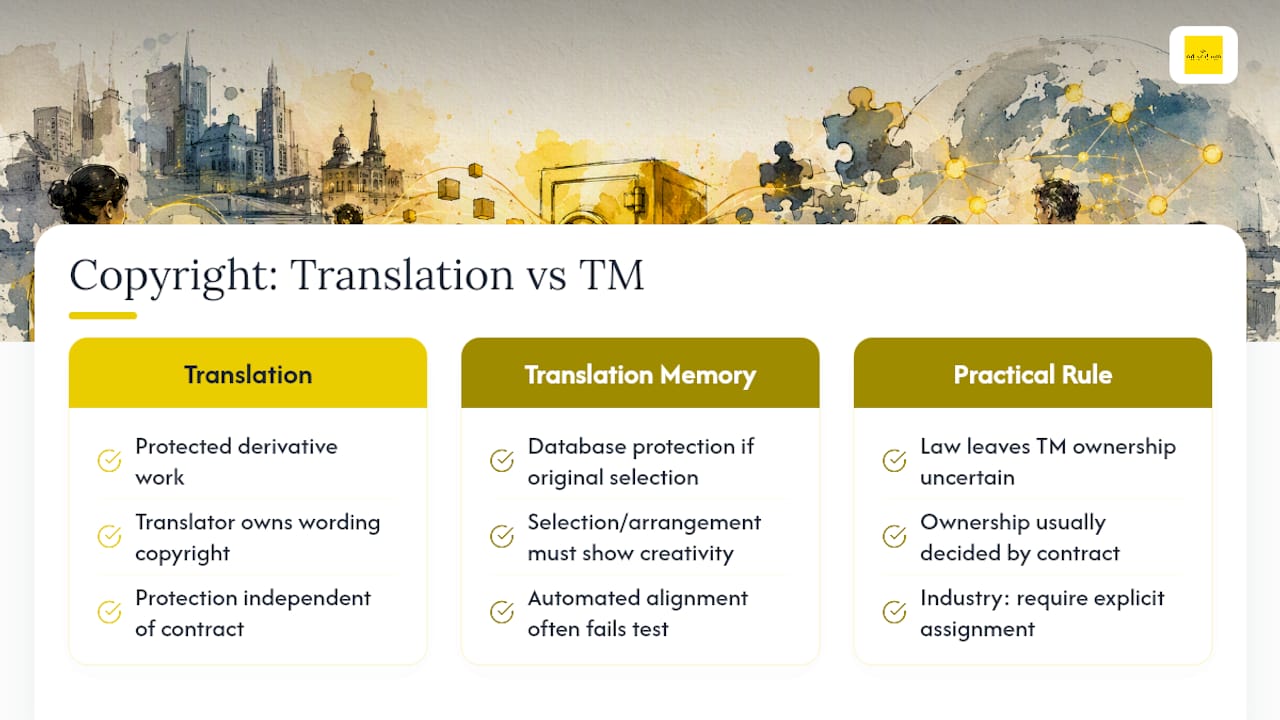
A translation memory is a different question. Whether a TM counts as a protected database depends on whether its selection or arrangement reflects genuine creative choice. The European Union’s Directive 96/9/EC on the legal protection of databases sets the test the European Court of Justice has applied: protection attaches only when selection or arrangement is an original expression of the author’s intellectual creation, not a mechanical byproduct of aligning segments during translation.
That test creates a real gap. Academic analysis of TM copyright concludes that translator creativity protects the individual segments, but the TM’s structure, being largely automated by CAT tool alignment, often fails to clear the originality threshold on its own, according to a 2009 review of translation memory copyright issues.
The gap in the law: neither the EU database directive nor derivative-work doctrine guarantees a client owns the TM built during their project. Ownership almost always comes down to what the contract says, not what the statute implies.
Practitioner guidance from language industry associations reaches the same conclusion from the operational side: because the legal position is unsettled, explicit contractual assignment of TM ownership is the only reliable way to avoid a dispute, according to ELIA’s guidance on copyright and translation tools. Law informs the negotiation. It does not replace the clause.
Client-Owned, Vendor-Owned, or Shared: Which TM Model Fits?
Three models dominate real contracts, and each carries a different tradeoff between control and convenience.
Client-owned TM. The client holds full rights to the segments, can export them anytime, and can audit or migrate them to a new provider. The cost is on the client’s side: cleanup, deduplication, and quality maintenance become the client’s responsibility once the vendor relationship ends.
Vendor-owned TM. The vendor retains the database, reuses segments across projects for efficiency, and may blend content with other clients’ work unless barred from doing so. The client risk is lock-in: switching providers can mean starting the linguistic asset from zero.
Shared or licensed TM. The vendor exports a scoped, sanitized TMX file to the client under a limited-use license, keeping its own production copy for internal reuse. This model suits ongoing relationships where both sides want continuity without full handover.
Choosing among these depends on update cadence, audit exposure, and how sticky the vendor relationship needs to be. A regulated manufacturer facing periodic compliance audits generally needs client ownership or, at minimum, a full sanitized export on a fixed schedule. A marketing team running short, low-stakes campaigns may accept vendor ownership in exchange for lower per-word rates.
When Does a Translation Memory Contain Personal Data Under GDPR?
TM content frequently includes personal data: names, patient identifiers in clinical documents, contract counterparties, or customer complaint text pulled directly from source files. Once that happens, the TM stops being purely a linguistic asset and becomes a data processing record subject to GDPR obligations, according to Baker McKenzie’s analysis of language data ownership.

Roles matter here. The client is usually the controller of the underlying content; the LSP is typically the processor; a CAT tool or cloud platform operator can be a sub-processor with its own obligations. Contracts need to state each party’s role rather than assume it.
Required controls include:
A documented lawful basis for retaining personal data inside the TM.
Defined retention schedules and a process for deletion requests.
Access logs showing who touched which segments and when.
Transparency language covering how translation memory data flows between vendor, sub-vendors, and platform operators.
Pro Tip: Ask vendors whether personal data is anonymized before it enters the production TM, or only at export time. Anonymizing at ingestion is far cheaper to prove during an audit than anonymizing after the fact.
What Contract Clauses Actually Secure TM Ownership?
Ownership language needs precision, not boilerplate. Six areas cover most disputes:
Assignment timing. State whether ownership transfers on delivery or on final payment. Ambiguity here is one of the most common sources of post-project disputes.
Deliverable scope. Specify TMX export, full metadata, and whether the deliverable is the project TM alone or the accumulated master TM.
Permitted uses. Explicitly address internal reuse, AI or machine learning model training, sublicensing to third parties, and analytics. Silence gets read as permission by some vendors and prohibition by others.
Export process and SLA. Define the acceptance criteria for a valid export, any cleanup fees, and a firm turnaround time for handover.
Data protection terms. Cover processor obligations, breach notification timelines, and mandatory deletion on termination.
Liability and indemnity. Assign responsibility for unauthorized reuse of TM content, including reuse across other clients’ projects.
Pro Tip: Freelance linguists working under a standard services agreement typically assign work-product rights to the hiring party by contract, not by default. If that assignment clause is missing, the freelancer may retain rights to the TM they built, even if the client paid for the project.
What Steps Protect TM Portability Before, During, and After a Project?
Portability isn’t an accident. It’s the result of specific actions taken at three points in the project lifecycle.
Before the project starts:
Write TM delivery into the statement of work, not a side email.
Define scope: project-only TM or contribution to a master TM.
Request a sample export and the metadata specification in advance.
During the project:
Keep project-scoped TMs segregated from other client work where contamination risk exists.
Track provenance, including which subcontractors or freelancers touched which segments.
Run periodic TM hygiene, translation memory cleanup to remove duplicate, obsolete, or mistranslated segments before they compound across future projects.
After the project closes:
Request the full TMX export and confirm it opens cleanly in a standard CAT environment.
Validate segment count and metadata against what the contract specified.
Confirm deletion of retained copies, or formal retention, according to the data protection clause.
Practical vendor guidance frames this as four questions worth asking any provider: who owns the language assets, can they be exported in a machine-readable format, who has access to them, and how is AI processing of that data governed, according to TextUnited’s analysis of translation data ownership.
How Do TM Ownership Disputes Play Out in Practice?
A regulated medical device manufacturer that wrote TM delivery directly into its SOW received a full TMX export with metadata at project close, avoiding a costly re-translation when it switched providers two years later. Industry guidance for device manufacturers confirms this outcome is the exception, not the rule, when TM delivery isn’t a written requirement, according to a GTS Blog guide for medical device manufacturers.
A finance client assumed TM delivery was standard, only to discover an exclusion clause in the vendor’s master services agreement. Remediation required a renegotiated addendum and a one-time export fee.
A freelancer built a specialized legal TM under a contract with no explicit assignment clause. The agency had to draft a retroactive work-product agreement before it could safely reuse the asset on future matters.
What Are the Most Common TM Ownership Disputes and How Do You Avoid Them?
Four failure patterns recur across industries:
Vendor lock-in. Proprietary formats or refusal to export block migration. Mitigate with mandatory TMX export rights and pre-agreed acceptance tests.
Translation memory contamination from mixed-client TMs, where segments from one account leak into another’s production database. Mitigate with project-scoped TMs, sanitized exports, and clearly priced cleansing fees.
Privacy exposure from retained personal data with no deletion path. Mitigate with anonymization at ingestion and enforceable retention schedules.
Missing provenance. No record of who created or edited which segment. Mitigate with mandatory metadata and audit logs on every deliverable.
Pro Tip: If a vendor can’t produce a sample TMX export during due diligence, treat that as a red flag on translation memory governance, not a formality to skip.
Where AD VERBUM Fits for Regulated TM Governance
AD VERBUM in manages client TMs and term bases during the asset integration step of its AI+HUMAN hybrid LangOps System, before any generation begins, so terminology and prior linguistic decisions carry forward rather than reset. That workflow runs on EU-hosted infrastructure under ISO 27001 and ISO 42001 certification, aligned to GDPR and HIPAA. For clients where auditability, regulatory traceability, and strict terminology governance are contractual requirements, not preferences, that combination of asset integration and certified oversight is the deciding factor.
— Eric Brown
How to Request TM Delivery and Governance Terms
Getting translation memory ownership right starts with the request, not the dispute. Ask any provider to confirm three things in writing before signing: full TMX export rights, complete metadata delivery, and a defined SLA for handover timing.
Integration of TM and term base into the initial step of an AI+HUMAN hybrid workflow ensures the governance conversation occurs before translation starts rather than after a contract dispute. For regulated buyers in sectors like life sciences, legal, finance, defense, or manufacturing, terminology control and export rights should be part of the engagement scope from the start, supported by ISO 17100 and ISO 18587 aligned QA. If your current provider can’t confirm export format, metadata scope, or deletion terms on request, that’s the conversation to have next. Review AD VERBUM’s multilingual SEO and localization services or reach out through the services overview to request a quote that specifies TM ownership and handover terms up front.
Sources
This article is general information, not a substitute for advice from a qualified lawyer. Consult a qualified legal professional about your own circumstances before acting on anything here.
FAQ
What Is the Purpose of a Translation Memory?
A translation memory stores previously translated segments so linguists can reuse them, improving consistency and cutting turnaround time on future content that repeats similar phrasing.
Who Legally Owns a Translation Memory by Default?
There is no universal default; ownership follows whatever the contract states, and in its absence, may depend on unresolved copyright and database law questions that courts have not settled consistently.
Can a Translation Memory Contain Personal Data?
Yes. Source content such as patient records, contracts, or customer correspondence can carry personal data into the TM, triggering GDPR controller and processor obligations for both client and vendor.
What File Format Should I Require for TM Export?
Request TMX, the standard interchange format supported across virtually all CAT tools, to guarantee the exported memory is usable outside your current vendor’s platform.
Does AD VERBUM Support Client TM Ownership and Export?
AD VERBUM in integrates client-supplied TMs and term bases at the start of its AI+HUMAN hybrid workflow and operates under ISO and GDPR-aligned controls suited to clients who require export rights and audit traceability.
Recommended

