Terminology Management Best Practices: 2026 Guide

Prioritize a shortlist of 30–50 high-impact terms and lock those entries into a shared termbase before localization begins. That single action prevents the most common and costly consistency failures. Here are five prioritized steps you can execute within the next 30 days:
Build a critical term shortlist. Identify 30–50 high-risk, high-impact terms: product names, regulatory designations, safety-critical phrases, and brand-controlled vocabulary. These are the terms where a wrong translation creates legal exposure or user confusion. Outcome: immediate consistency baseline with manageable scope.
Establish a single source of truth. Load those terms into a centralized termbase with minimum required fields: definition, context/source sentence, status (approved/deprecated/candidate), author, date, and product applicability. A spreadsheet that exports to TBX/CSV is acceptable at the start. Outcome: one authoritative reference that every translator and content author pulls from.
Integrate into CAT and LLM workflows. Connect the termbase to your CAT tool or LLM prompt before any translation project begins. Microsoft Learn’s globalization guidance is explicit: stabilize source terms early and translate terms first to reduce downstream cost and inconsistency. Outcome: automated term suggestions at the point of translation, fewer post-edit corrections.
Assign ownership and a QA gate. Name one person as terminology owner and require their sign-off before any new term enters the approved list. Add a terminology check to your QA checklist. Outcome: no orphaned terms, no silent changes.
Schedule post-project reviews and change control. After every project, the owner reviews flagged terms, updates entries, and logs changes with a date and rationale. Outcome: a living termbase that improves with each project rather than drifting into obsolescence.
Table of Contents
What are the best practices for terminology management?
Terminology management is the systematic process of creating, collecting, maintaining, and enforcing a standardized set of domain-specific terms across all organizational content. The key word is concept-based: a well-managed termbase organizes knowledge around concepts, not around word forms.
The distinction between a termbase and a simple glossary matters more than most teams realize. A glossary is a flat word list, often a spreadsheet with a source term and a target equivalent. A termbase is a structured knowledge base where each entry represents a concept and carries the metadata needed to govern it: definition, context sentence, subject field, status, author, date, product scope, and cross-references to related or forbidden terms. That structure is what makes terminology management concept-oriented and ISO-aligned, and it is what allows a termbase to be machine-actionable rather than just human-readable.
For regulated industries, this is not a theoretical preference; see how UAE Marriage Certificate Translation ensures legal validity in document translation. When a regulatory submission uses “adverse event” in one section and “adverse reaction” in another, the inconsistency can trigger a review request. The termbase entry for that concept, with its definition and approved status, is the documented basis for the choice.
Minimum required fields per entry: canonical term, definition, context/source sentence, subject field, status (approved/candidate/deprecated), author, date created, date modified, product or document applicability, and forbidden synonyms. Each field serves a governance function, not just a display function.
Why consistent terminology reduces cost, risk, and rework
Consistent terminology directly reduces translation cost, accelerates delivery, and supports regulatory traceability. The mechanism is straightforward: when translators encounter a term they have already translated and approved, they reuse the existing translation. When they encounter an ambiguous or undefined term, they stop, research, ask, and sometimes guess.
Practitioner research indicates translators may spend roughly 30%–60% of their time on terminology tasks in specialized texts, and that managed terminology produces measurable quality improvements.
That figure is not a rounding error.
The downstream impacts are concrete:
Translation cost: Consistent approved terms increase CAT tool match rates and reduce post-edit effort, directly lowering per-word cost.
Time-to-market: Fewer terminology queries during translation and fewer correction cycles after review compress project timelines.
Regulatory risk: In life sciences, legal, and defense contexts, inconsistent terminology in submitted documents creates traceability gaps. An auditable termbase with change logs is a defensible record.
Brand and UX trust: Users who encounter the same product name spelled three different ways across a UI, a manual, and a support article lose confidence. Terminology consistency is a quality signal that readers notice even when they cannot name it.
What are the core components of a terminology program?
A terminology program has five structural components. Each one has a specific function; missing any of them creates a predictable failure mode.
1. Concept model and entry structure. Each entry represents one concept. The entry structure defines which fields are required, which are optional, and what controlled vocabulary applies to each field (for example, a closed picklist for “status” rather than a free-text field). Well-designed termbases require careful data-category design — granularity and elementarily — to be reusable and machine-actionable.
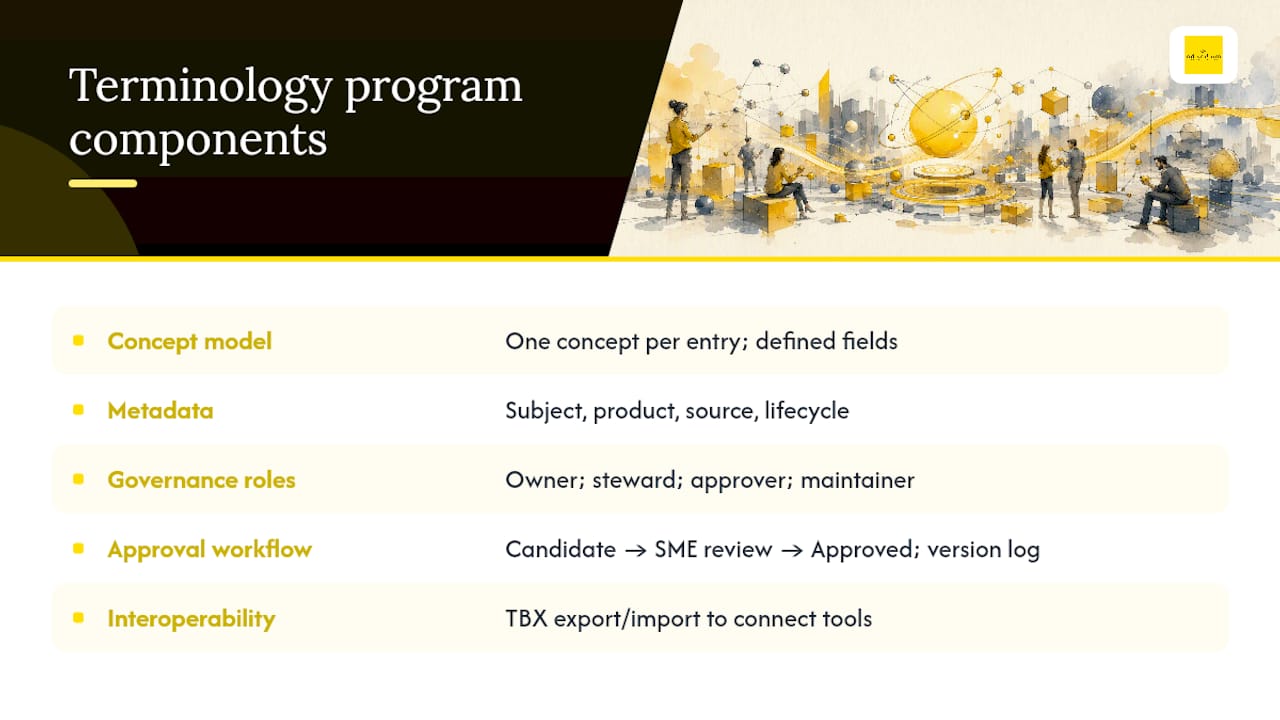
2. Metadata and data categories. Beyond the term and definition, entries need subject field, product scope, source reference, and lifecycle status. These fields are what allow you to filter the termbase by project, domain, or regulatory submission and extract only the relevant subset.
3. Governance roles. Every program needs at least four roles: owner (accountable for the program), steward (day-to-day maintenance), approver (subject-matter expert who validates definitions and usage), and maintainer (the person who enters and updates records). In small teams, one person may hold multiple roles, but the functions must be explicitly assigned.
4. Approval workflow and change control. New terms follow a defined path: candidate → SME review → approved. Changes to approved terms require a documented rationale and a version log. This is the audit trail that regulated programs need.
5. Technical interoperability. The termbase must support TBX (TermBase eXchange, ISO 30042) export and import. TBX is the interchange format that allows your termbase to connect to CAT tools, LLM prompts, and QA checkers. Without it, your termbase is an island.
Pro Tip: Start with closed picklists for high-risk fields like “status” and “subject field.” Free-text fields in those positions generate noise that slows adoption and makes automated filtering unreliable. Lock the vocabulary early.
How to implement terminology management step by step
The most effective rollout starts narrow and expands. Experienced teams avoid finalizing a full glossary before translation begins; they prioritize a critical list of 30–50 high-risk terms, then expand incrementally based on post-project findings.
Phase 1: Discovery (Days 1–14)
Run automated term extraction on your top 5–10 source documents using a CAT tool or extraction utility.
Filter the candidate list with a subject-matter expert (SME) and a localization lead. Flag terms with regulatory, safety, or brand implications first.
Interview product owners and legal/compliance stakeholders to identify terms where inconsistency has caused problems before.
Produce a shortlist of 30–50 critical terms with draft definitions.
Phase 2: Validate and populate (Days 15–21)
Send draft entries to SMEs for definition review and approval. Use a simple review template: term, definition, context sentence, forbidden synonyms, status.
Load approved entries into the termbase with all required metadata fields populated.
Mark remaining candidates as “under review” — do not leave them as free-text notes.
Phase 3: Lock, distribute, and integrate (Days 22–30)
Export the approved termbase to TBX and load it into your CAT tool or LLM prompt configuration before any translation project starts.
Brief translators and content authors on the termbase location, how to query it, and how to flag a missing or incorrect term.
Add a terminology check to the project QA checklist: pre-translation lock, in-editor suggestions active, post-edit review of flagged terms.
Phase 4: Post-project review (ongoing)
After each project, the terminology owner reviews all flagged terms, client corrections, and translator queries.
Update entries, log changes with date and rationale, and promote validated candidates to approved status.
Schedule a full termbase audit every 6–12 months, or before any major regulatory submission.
For regulated content, every change to an approved term must carry a timestamp, author, and rationale. This is the change-control log that supports traceability to regulatory submissions. Stabilizing source terms early in the product lifecycle reduces cost and compliance risk; the implementation checklist above is designed to get you to that stable baseline within 30 days.

How to choose terminology management software
Prioritize interoperability, CAT and LLM integration, and audit capability. Everything else is secondary.
Must-have features:
TBX import/export. Non-negotiable for any program that connects to translation tools or external partners. Without TBX, your termbase cannot be used by CAT tools, LLM systems, or QA checkers reliably.
API or native CAT integration. The termbase must surface inside the translator’s or author’s editor. A termbase that requires a separate browser tab gets ignored.
Role-based access control. Translators should be able to query and flag; only designated approvers should be able to edit approved entries.
Versioning and audit trail. Every change to an approved entry must be logged with author, date, and reason. This is the compliance record.
Term-status workflows. Candidate, under review, approved, deprecated — these statuses must be enforced by the system, not just noted in a field.
Metadata picklists. Closed-vocabulary fields for subject, product, and status prevent data quality degradation over time.
Search and context examples. Translators need to find terms quickly and see them in context. Full-text search and example sentences are baseline requirements.
Selection red flags: no API, no TBX export, no audit trail, or proprietary data formats that prevent migration. A termbase you cannot export is a liability, not an asset.
A spreadsheet that exports to TBX/CSV is a legitimate starting point for small programs. Long-term, any program handling regulated content needs an integrated solution with API access and auditability. For technical translation workflows, the integration between termbase and translation environment is where most of the consistency gains actually occur.
Pro Tip: Require TBX export and automated change notifications as non-negotiable criteria in any vendor evaluation. If a tool cannot notify stakeholders when an approved term changes, your translators will work from stale data without knowing it.
How to measure success and run QA on terminology
Focus on three metric categories: adoption, quality, and cycle time. These give you a complete picture of whether the program is working and where to intervene.
KPI | Measurement method | Target threshold |
Term match rate | % of project segments where a termbase hit was available and used | 85%+ for mature programs |
Terminology error rate | Terminology-related corrections per 1,000 words in client review | Below 2 per 1,000 words |
Translator acceptance rate | % of in-editor term suggestions accepted without modification | 70%+ indicates good termbase quality |
Post-edit effort reduction | Comparison of post-edit time per word before and after termbase integration | Measurable reduction after 3 projects |
Time to update | Average days from flagged term to approved entry in termbase | Under 5 business days |
The QA process has four checkpoints. First, lock the termbase before translation begins — no changes during an active project. Second, confirm in-editor term suggestions are active in the CAT tool or LLM configuration. Third, run a post-edit review that specifically checks flagged terms and client corrections against termbase entries. Fourth, complete the glossary update loop: every correction that reveals a termbase gap or error triggers an update request, which the owner processes within the agreed SLA.
For compliance-focused translation programs, the audit trail from these QA checkpoints is part of the deliverable, not just an internal record.
Common failure modes and how to avoid them
The most common failures in terminology programs are poor ownership, stale termbases, over-large unvalidated glossaries, and lack of workflow integration. Each has a specific fix.
No named owner. Terms accumulate without governance, statuses go stale, and no one is accountable for corrections. Fix: assign a named terminology owner before the program launches, not after the first crisis.
Stale termbase. Approved terms reflect a product version from two years ago. Translators stop trusting the termbase and start ignoring it. Fix: mandatory post-project review after every project, with a logged update or a documented decision not to update.
Over-large unvalidated glossary. A 2,000-term glossary where 1,800 entries have no definition, no status, and no source reference is worse than no glossary. It creates false confidence and wastes translator time. Fix: start with the critical 30–50 list and expand only as validated entries are added.
No workflow integration. The termbase exists in a SharePoint folder. Translators never see it during translation. Fix: connect the termbase to the CAT tool or LLM prompt before any project starts. A termbase that is not surfaced in the editor is not being used. See examples of terminology enforcement in translation for practical integration patterns across regulated sectors.
No change control for regulated content. An approved term changes without a logged rationale. In a regulatory submission, that gap is a traceability failure. Fix: require a documented change request for any modification to an approved entry, with author, date, and reason.
Terminology drift in AI workflows. When LLM-generated content or AI translation is part of the workflow, an unconnected termbase allows the model to introduce variant terms silently. Fix: inject termbase entries directly into the LLM prompt or system instruction before generation.
Pro Tip: During regulatory submission cycles, freeze the critical terms list. No changes to approved entries for the scope of terms covered in the submission until the review period closes. Log the freeze date and the scope. This is the single most defensible control for audit purposes.
Where AD VERBUM fits for compliance-driven terminology enforcement
AD VERBUM is the right choice when you need EU-hosted, audit-capable AI+HUMAN hybrid translation with enforced termbase integration and ISO-aligned QA — specifically for regulated content where terminology errors carry legal, safety, or compliance consequences.
AD VERBUM’s workflow begins with asset integration: client Translation Memories and Term Bases are ingested first, before any generation occurs. The proprietary LLM-based LangOps System then produces target-language output constrained by that terminology and style guidance. A certified subject-matter expert reviews for technical accuracy, regulatory compliance, and contextual nuance. QA is aligned to ISO 17100 and ISO 18587, and to sector requirements such as MDR where applicable. Every step produces an auditable record. Full workflow details are documented here.
The decision criteria that favor AD VERBUM over generic NMT or consumer SaaS translation engines:
Regulatory risk: Content for FDA submissions, CE marking, legal contracts, or defense documentation where a terminology error has direct compliance consequences.
EU data sovereignty: Content that cannot be processed on public cloud infrastructure. AD VERBUM’s LangOps System runs on private EU-hosted servers, ISO 27001 and ISO 42001 certified.
Domain-specific SME review: AD VERBUM’s network of 3,500+ subject-matter expert linguists includes medical professionals, engineers, and legal scholars. Generic NMT has no equivalent control.
Speed with governance: AD VERBUM delivers 3x to 5x faster than traditional translation workflows (AD VERBUM stated figure) without removing the SME review and QA gate.
TBX and TM integration: Client termbases and translation memories are integrated at the asset-ingestion stage, not applied as a post-edit filter.
For legal and contract translation specifically, the combination of enforced termbase, SME review, and ISO-aligned QA addresses the traceability requirements that generic translation tools cannot meet. AD VERBUM holds ISO 9001, ISO 17100, ISO 18587, ISO 13485, ISO 27001, ISO 42001, and AQAP2110 (NATO), all independently audited by Bureau Veritas.
What the right terminology program looks like in practice
Effective terminology management requires a prioritized critical-term list, a concept-based termbase with full metadata, a named owner, mandatory post-project reviews, and workflow integration that surfaces terms at the point of translation or content creation.
Point | Details |
Start with 30–50 critical terms | Prioritize high-risk, high-impact terms first; expand incrementally after each validated project. |
Use concept-based entries | Each entry needs definition, context, status, author, date, and product scope — not just a word pair. |
Assign a named owner | Ownership is the single most important governance control; no owner means no maintenance. |
Integrate before translation begins | Connect the termbase to your CAT tool or LLM prompt before any project starts, not after. |
AD VERBUM for regulated workflows | AD VERBUM enforces client termbases in an AI+HUMAN hybrid translation workflow with ISO-aligned QA and EU-hosted data sovereignty. |
The part most teams get wrong about terminology programs
The conventional advice on terminology management focuses heavily on tooling: which termbase software to buy, which CAT tool to use, whether to invest in automated term extraction. That framing puts the emphasis in the wrong place.
The highest-impact control is process, not software. A mandatory post-project review and a single maintained source-of-truth termbase with a visible approval trail will outperform sophisticated software that nobody maintains. The teams that get the most out of their terminology programs are not the ones with the most elaborate tools. They are the ones where a named person is accountable, where post-project updates are non-negotiable, and where the termbase is connected to the translation environment before work starts.
The second thing most guides understate is the compliance dimension. For teams in life sciences, legal, or defense, terminology management is not a quality-of-life improvement. It is a traceability requirement. When a regulatory body asks why a specific term was used in a submission, the answer needs to be documented: approved entry, definition, source reference, approval date. A spreadsheet with no metadata and no change log does not answer that question.
The third gap is AI workflow integration. As LLM-generated content and AI translation become standard in localization pipelines, an unconnected termbase is a liability. The model will generate plausible-sounding variants of your approved terms, and without enforcement at the prompt level, those variants will reach reviewers and sometimes reach publication. Injecting termbase entries into the LLM system instruction before generation is now a baseline control, not an advanced feature.
Start small, assign ownership, connect the termbase to the workflow, and review after every project. The rest follows from those four decisions.
AD VERBUM handles terminology enforcement for regulated translation programs
Regulated content teams working across 150+ languages need more than a termbase file and a translation vendor. They need a workflow where terminology enforcement is built into the translation process itself, not bolted on as a post-edit check.
AD VERBUM’s AI+HUMAN hybrid translation workflow ingests your existing termbase and Translation Memory before any generation occurs. The proprietary LangOps System applies your approved terminology at the LLM generation stage, a certified SME reviews for accuracy and compliance, and QA is aligned to ISO 17100 and ISO 18587. Every project produces an auditable record. For teams in life sciences, legal, finance, and defense, that combination of enforced terminology, SME oversight, and ISO-aligned QA is the difference between a translation that passes regulatory review and one that requires a correction cycle.
If your program handles regulated documentation and you need terminology governance that holds up under audit, review AD VERBUM’s full services and request a project quote.
Sources
Recommended