


Terminology Enforcement Guide for Regulated Industries

Lock and propagate your approved term base into the translation pipeline, enforce it at every delivery gate, and record a signed approval trail before any localized file leaves the workflow. That single action closes the most common audit gap in multilingual regulated documentation.
TL;DR
Terminology enforcement in translation means governing which words appear in localized output, not just which words appear in source documents.
Every enforcement decision must produce an auditable record: who approved the term, when, and in which target language.
Uncontrolled machine translation output in regulated content is a compliance risk, not a cost-saving measure.
Immediate action checklist (paste into a change-control ticket or kickoff memo):
Lock the approved term base and assign a version identifier.
Integrate the term base and translation memory into the active translation management system.
Configure pre-translation enforcement filters and forced glossary mapping.
Assign a certified subject-matter expert for sign-off before delivery.
Table of Contents
What does “terminology enforcement” actually mean in translation?
Terminology enforcement in translation and localization is the set of governance controls, tooling configurations, and QA procedures that guarantee only approved wording appears in localized deliverables. It covers term bases (TBs), enforced glossaries, translation memory ™ integration, approval workflows, and audit trails. It does not cover statutory enforcement actions, regulatory penalty frameworks, or legal definitions of compliance terms — those are a separate discipline with a different audience.
The scope matters because regulators and auditors treat a localized label, IFU, or clinical report as a controlled document. ISO 17100:2015 sets requirements for core translation processes and is the baseline standard most US-regulated organizations reference when evaluating translation service providers (TSPs). ISO 18587:2017 adds requirements for full human post-editing of machine translation output, including post-editor competence — critical when any AI-generated segment enters a regulated document. Alignment to both standards is what converts a linguistic preference into an auditable risk control.
How to build an auditable terminology enforcement workflow
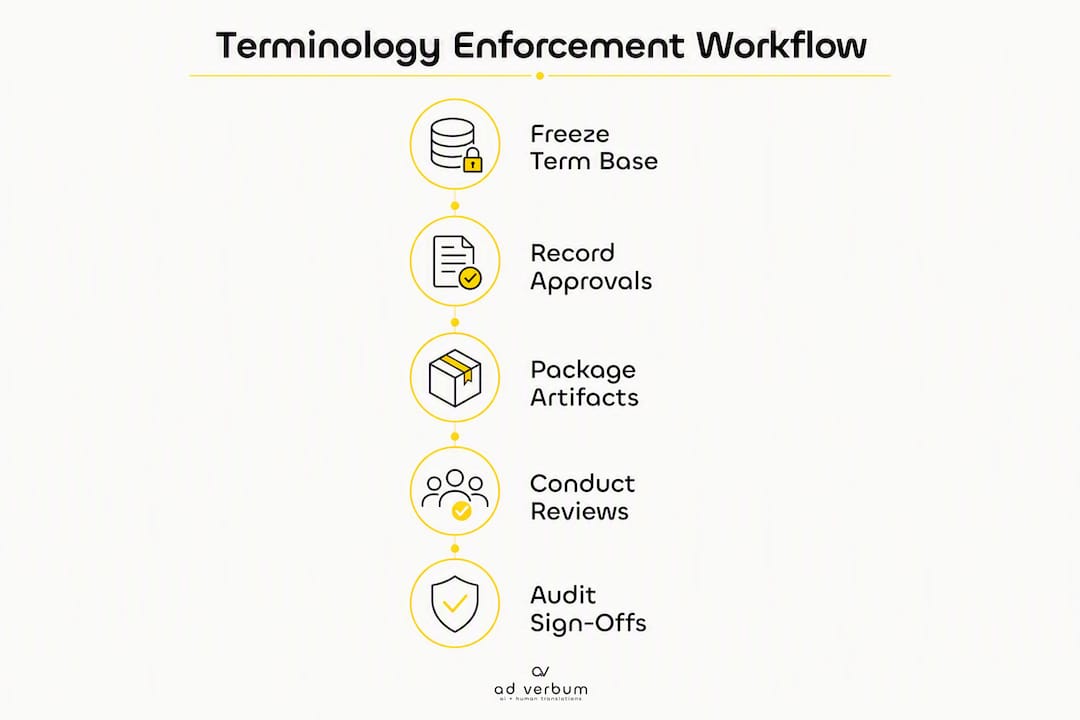
The workflow runs in one direction: asset onboarding → TB/TM lock → enforcement configuration → LLM-guided generation → SME review → QA → sign-off → distribution with audit trail. Every step produces a timestamped record.
Step-by-step:
ISO-aligned QA — QA runs against ISO 17100 and ISO 18587 criteria, plus sector requirements such as MDR where applicable.
Audit controls matrix:
Step | Evidence to record | Who | Timestamp required |
TB lock | Version ID, approver name | Terminology manager | Yes |
TM lock | TM export with segment count | Localization engineer | Yes |
LLM generation | Prompt template reference, TB version used | System log | Yes |
SME review | Sign-off document with name and role | SME linguist | Yes |
QA pass | QA checklist, error category counts | QA reviewer | Yes |
Final delivery | Versioned file, leverage report | Project manager | Yes |
Pro Tip: Package context artifacts — screenshots, source document sections, and prior approved translations — alongside isolated terms when submitting to SME review. Reviewers who see the term in context catch contextual errors that isolated term lists miss entirely.
Which tools and integrations make enforcement enforceable?
The minimum asset set is: a locked term base, a versioned translation memory, a style guide, and source-context artifacts. Without all four, enforcement is advisory, not auditable.
Integration touchpoints to configure:
TMS connectors to the TB and TM (bidirectional sync, not read-only)
CMS webhooks that trigger pre-translation filters before content enters the pipeline
Pre- and post-edit hooks for AI+HUMAN hybrid translation workflows
Webhook logging for every TB query and forced-substitution event
Required metadata per term base entry:
Field | Purpose |
Term ID | Unique identifier for audit reference |
Approved source string | Canonical source-language term |
Approved target variant(s) | One or more approved translations per locale |
Approval date | Change-control timestamp |
Approver name and role | Accountability record |
Audit reference | Links to change-control ticket or regulatory submission |
Technical configuration checklist:
TB locking enabled; no write access without change-control approval
TM leverage thresholds set (e.g., 100% matches enforced; fuzzy matches flagged for SME review)
LLM prompt templates reference the locked TB version by ID
All forced-substitution events logged with timestamp and segment reference
Pre-translation QA filter blocks segments containing unapproved variants
Protecting source content and TB exports during transfer is also a data-governance concern. Practical data-leakage prevention for regulated industries applies directly to TB and TM file handling, especially when assets move between internal systems and external TSPs.

How do you choose the right process, tool, or vendor?
The top-level choice is between in-house governance, vendor-managed enforcement, or a hybrid. Most regulated organizations in pharma, medical device, and defense lack the internal linguist network to cover 10+ languages with SME-level review, which pushes the decision toward vendor-managed or hybrid.
Must-have controls for US-regulated sectors:
ISO 17100 and ISO 18587 certification (not just alignment)
HIPAA-aligned data handling where protected health information is involved
Independent third-party audit evidence (Bureau Veritas or equivalent)
TB/TM integration APIs with full logging
Documented SME review process with named approvers
Rollback procedure for term changes with re-validation evidence
RFP questions to ask every vendor:
How do you lock and propagate term changes across active projects?
How are approvals recorded and retrievable for audit?
What is your rollback process when a term change affects in-flight deliverables?
Where is source content processed, and who has access?
Two enforcement scenarios auditors actually examine
Scenario 1: Pharma label localization. A US pharmaceutical company localizes a drug label into six EU languages. The approved source term is “adverse reaction.” The TB locks the approved target variants per locale. The LLM-based system generates output using only those variants. An SME pharmacist reviews the French output and flags a contextual nuance in the dosage section. The correction is logged, the TB entry is updated with a new version ID, and the final file is delivered with a TM leverage report and SME sign-off. The audit evidence package includes: TB export (CSV with version ID), TM leverage report, SME sign-off document, change-control ticket, and versioned final file.
Scenario 2: Medical device IFU. A device manufacturer translates an Instructions for Use document under MDR. The term “contraindication” must appear consistently across multiple languages. Pre-translation filters block any segment where an unapproved variant appears. Post-edit QA confirms zero unapproved variants in the final output. Artifacts submitted to the notified body include: TB export, QA checklist with error counts, SME sign-off, and the versioned IFU file.
What causes terminology enforcement to fail?
Terminology drift is the most common failure mode, and it typically surfaces during a regulatory inspection rather than during QA. An auditor finds two different target-language terms for the same source concept across documents submitted in the same dossier.
Failure → mitigation pairs:
Drift across projects: TB not locked or not integrated → enforce TB lock at project setup; run periodic TM sampling against the current TB to catch divergence early.
Uncontrolled MT output: Open MT used without TB gating → gate all MT/LLM output with forced glossary mapping and pre-translation filters before any segment reaches a reviewer.
Approval gaps: Sign-off not recorded or not linked to the correct TB version → require a named approver and TB version ID on every delivery record.
Term change propagation failures: A term update applied to new projects but not to in-flight ones → apply a phased propagation policy: emergency stop for safety-critical documents, batch propagation for others, then re-run TM leverage QA with timestamped exports.
Escalation playbook: When a terminology error is discovered post-delivery, the corrective action record must include: the incorrect term and its source, the approved replacement, the TB version updated, the localized files recalled or corrected, and the re-validation evidence. The regulatory owner signs the corrective action ticket.
Pro Tip: Set a quarterly TM sampling review: pull 50 random segments per language pair and check them against the current TB. This catches drift before it reaches a submission.
When is AD VERBUM the right choice?
AD VERBUM fits when the combination of regulated content, audit requirements, data sovereignty constraints, and multi-language scale exceeds what in-house tooling or a general-purpose TSP can reliably deliver.
Decision conditions that favor AD VERBUM:
Content is regulated (pharma, medical device, biotech, finance, defense) and requires ISO-aligned QA
Audit evidence is required at delivery (TB exports, SME sign-off, QA checklists, versioned files)
Data sovereignty matters: source content cannot transit public cloud infrastructure
SME-level review is required (medical professionals, engineers, legal scholars)
Scale covers multiple languages simultaneously, with consistent terminology across all of them
Capability summary:
Proprietary LangOps System: LLM-based AI+HUMAN hybrid translation with TB and TM integration, hosted on EU servers
a large network of subject-matter expert linguists across life sciences, legal, finance, defense, and manufacturing
Certifications: ISO 9001, ISO 17100, ISO 18587, ISO 13485, ISO 27001, ISO 42001, ISO 14001, AQAP2110, independently audited by Bureau Veritas
Supports 150+ languages including regional variants
GDPR, HIPAA, and MDR aligned
When in-house tooling is sufficient — a single-language, low-volume program with a stable TB and an internal SME — a vendor-managed solution adds overhead without proportional benefit. The case for AD VERBUM strengthens as language count, regulatory exposure, and audit frequency increase.
Key Takeaways
Terminology enforcement in regulated translation is an auditable governance control, not a style preference: lock the term base, integrate it into the pipeline, and record every approval.
Point | Details |
Lock assets before translation starts | Freeze the TB and TM with version IDs before any segment enters the pipeline. |
Audit trail is mandatory | Every delivery must include TB export, TM leverage report, SME sign-off, and versioned file. |
Gated AI output reduces drift | Forced glossary mapping and pre-translation filters prevent unapproved variants from reaching reviewers. |
ISO 17100 and ISO 18587 are the baseline | Procurement criteria for regulated US sectors must include both certifications plus independent audit evidence. |
AD VERBUM fits regulated, multi-language programs | ISO-certified, Bureau Veritas-audited, with a large network of SME linguists and EU-hosted data sovereignty. |
A practitioner’s perspective on where enforcement actually breaks down
The enforcement gap in most regulated organizations is not the term base itself. It is the distance between the TB and the translation pipeline. Teams spend months building a meticulous glossary, then route urgent projects through a general-purpose MT engine because the deadline is tight. The TB sits in a shared drive. The MT output goes to a reviewer who does not have access to it. The localized file ships.
What makes this pattern so persistent is that it looks like a resource problem when it is actually a configuration problem. The fix is not more reviewers or a bigger glossary. It is a single integration: the TB must be a live input to the translation system, not a reference document. Once that connection is enforced at the system level, the TB becomes a control, not a suggestion.
The second thing most guides understate is the value of the SME sign-off as an audit artifact. Regulators do not just want to see that a term was approved. They want to see who approved it, in what role, on what date, and against which version of the source document. A sign-off that lacks any of those four fields is not audit-ready, regardless of how accurate the translation is. Build the sign-off template before the first project, not after the first inspection.
AD VERBUM’s terminology enforcement offer
Regulated translation programs that need ISO-certified, audit-ready delivery across multiple languages can request a scoped compliance pilot from AD VERBUM. The pilot covers one product family, up to three target languages, and produces a complete evidence package: TB export, TM leverage report, SME sign-off, QA checklist, and versioned localized files.
What AD VERBUM delivers in a pilot:
TB and TM integration into the LangOps System with forced glossary enforcement
AI+HUMAN hybrid translation with certified SME review per target language
ISO 17100 and ISO 18587 aligned QA, with MDR or HIPAA scope where applicable
Full audit evidence package ready for regulatory submission or internal audit
Teams ready to run a compliant pilot or request a quote can review AD VERBUM’s translation capabilities or contact the team directly at adverbum.com/contact.
Useful sources and further reading
AD VERBUM internal resources:
Terminology enforcement workflow for translation: 2026 guide — detailed workflow configurations and tooling setup
7 examples of terminology enforcement in translation — scenario walkthroughs with audit artifact lists
How to ensure translation compliance for technical documents — QA checklists and compliance procedures
Regulated translation: definition, standards, and compliance guide — standards alignment reference
AD VERBUM certifications and audit evidence — ISO certificates and Bureau Veritas audit references
Standards references:
ISO 17100:2015 — requirements for translation services; cite in procurement criteria and QA alignment claims
ISO 18587:2017 — requirements for post-editing of machine translation output; cite for AI+HUMAN hybrid translation QA
ISO/AWI 17100 — in-progress update to translation services requirements; relevant for forward-looking procurement criteria
Audit evidence to collect and retain:
Recommended