


30–90 Day Audit Ready Plan for Term Base Management in Regulated Teams

Term base management is the discipline of creating, governing, and maintaining a structured terminology database, or termbase, so every translator, reviewer, and tool uses the same approved word for the same concept. Done right, it cuts revision cycles, gives auditors a paper trail, and keeps multilingual content consistent across markets. The industry standard for exchanging that data is TBX under ISO 30042, and specialist providers like AD VERBUM build their AI+HUMAN hybrid workflows around exactly this kind of governed terminology.
Table of Contents
The Data Model: Fields a High-Impact Termbase Actually Needs
Governance: The Workflow That Stops Terminology From Drifting
Where AD VERBUM Fits: Specialist Support vs. Building In-House
Best Practices for Termbase Quality Assurance and Validation
The Role of Term Base Management in Multilingual Content Consistency
What Is a Termbase, and When Do You Need One?
A termbase is a concept-oriented database. Each entry represents one idea, not one word, and carries the metadata needed to translate that idea correctly every time: the term itself, its definition, usage context, approval status, and the person accountable for it. That structure is what separates a termbase from a glossary, which is usually a flat list of word pairs with no status field, no owner, and no audit trail.
A typical entry includes:
The canonical term and its definition
Usage context (industry, register, document type)
Approval status (approved, deprecated, candidate)
Owner and subject-matter reviewer
Approved variants and explicitly disallowed alternatives
You need a termbase, not a spreadsheet glossary, once translator volume, recurring clients, or compliance obligations grow past what one person can track from memory. Termbase notes that most organizations start with a glossary and graduate to a termbase when concurrent translators, repeat projects, or regulatory review enter the picture. If your content touches Life Sciences, Legal, Finance, Defense, or Manufacturing documentation, that threshold often arrives earlier than many teams anticipate.
The Data Model: Fields a High-Impact Termbase Actually Needs
A termbase earns its keep only when its fields support both human decision-making and machine automation. Skimping on metadata is the single most common reason termbases decay into unreliable spreadsheets within a year.
At minimum, each entry should ideally carry relevant metadata including:
Canonical concept and definition — plain-language, unambiguous, tied to one specific meaning
Approved variants by locale — regional spelling or register differences that are still correct
Disallowed alternatives with context — terms translators might reasonably guess but that are wrong for this client or domain
Provenance metadata — author, current owner, entry status, unique ID, creation date, last modification date, and next scheduled review date
That last group is what makes a termbase audit-ready rather than just useful. TerminOrgs’ Terminology Starter Guide frames these status and metadata fields as the mechanism that lets a termbase serve as a single source of truth for QA teams, legal reviewers, and compliance auditors. Without an owner field, a disputed term has no one accountable for resolving it. Without a review date, entries go stale silently.
Governance: The Workflow That Stops Terminology From Drifting
Terminology drifts the moment more than one person can add or edit entries without oversight. A structured change-request flow is what keeps a termbase trustworthy over time.
Proposal. A translator, reviewer, or client stakeholder flags a term problem and submits a proposed change with rationale.
Evidence check. A subject-matter reviewer verifies the proposal against source documentation, regulatory language, or client style guides.
Decision. The term owner or approver accepts, rejects, or modifies the proposal, recording the reasoning.
Record and notify. The termbase is updated, the change log captures who approved what and when, and affected teams get notified before their next deliverable.
Roles matter as much as steps. A workable model assigns a proposer (anyone on the project), an SME reviewer (someone with domain authority), an owner or approver (accountable for the final call), a local reviewer (for regional variants), and a maintainer (who runs the mechanics of updates and exports). Practical governance research on entity drift shows that a small, tightly owned termbase with visible exceptions scales faster and drifts less than an attempt to build an exhaustive terminology encyclopedia up front.
Local exceptions should never be silent. Record the reason, the scope it applies to, the named owner, and a review date, so a one-off regional preference doesn’t quietly become an unreviewed permanent rule. Most regulated teams run a full termbase review quarterly, with high-risk entries checked sooner.
Pro Tip: Use a minimal-friction change-request form, even a shared document with five fields, rather than a formal ticketing system. Governance that takes ten minutes gets used; governance that takes an hour gets bypassed.
TBX, ISO 30042, and When to Insist on Standard Formats
TBX (TermBase eXchange) is the industry-standard XML format for moving termbase data between systems, and it’s governed by ISO 30042. If a translation memory system, CAT tool, or vendor can’t import or export TBX, integrating your termbase into a broader toolchain becomes a manual, error-prone exercise.
Two flavors matter in practice:
TBX-Core carries the full metamodel, useful for complex regulated terminology with extensive metadata
TBX-Basic is a lighter subset that many teams use to get compatibility without importing every optional data category, according to comparative guidance on termbase structures
Insist on TBX delivery when you’re switching vendors, running multi-vendor projects, or operating under audit requirements where terminology traceability matters. A simpler CSV or Excel export is fine for a small, single-vendor glossary with no compliance exposure.
Compatibility check: before trusting any TBX exchange, run an export, validate the file structure, then import it into the destination system and confirm entry counts and field mapping match. Skipping this test is how termbases silently lose fields during migration.
A Step-by-Step Checklist to Stand Up a Termbase
Start small. Select 20 to 40 high-impact terms, the ones that cause the most rework or carry the most regulatory risk, and name an owner for each.
Populate required metadata. Fill in definition, context, status, approved variants, and disallowed alternatives before importing anything into your TMS.
Export in TBX if required. If a client or downstream vendor needs standard interchange, generate and validate the TBX file before delivery.
Integrate with TM and CAT tools. Connect the termbase to your translation memory and CAT environment so terminology surfaces during actual translation work, not just in a reference document.
Set SLAs for change requests. Define how fast a proposed term change gets reviewed and decided, typically within one to five business days depending on risk level.
Measure impact. Track QA flags and revision cycles tied to terminology before and after rollout to confirm the termbase is actually reducing errors.
Enforcing Terminology Inside Translation Toolchains
A termbase only delivers value once it’s active inside the tools translators actually use. In most CAT environments, termbase entries surface as lookups and auto-suggestions while a linguist types, and disallowed terms trigger QA flags automatically during the check pass.
In AI+HUMAN hybrid workflows, the termbase constrains generation before a human ever sees the draft: the system ingests approved terminology first, generates output within those boundaries, and only then routes the draft to a subject-matter expert for review. That sequencing catches terminology errors earlier and cheaper than catching them in a final QA pass.
For regulated reviews, the pieces that matter most are:
A logged, timestamped audit trail of every terminology change and who approved it
Sample acceptance tests that confirm the termbase correctly blocks disallowed terms
Evidence packages, change logs, entry status, and reviewer sign-off, that can be handed to a compliance auditor without reconstruction work
Failure Modes and How to Mitigate Them
Three failure patterns account for most termbase decay.
Entity drift happens when local teams quietly adopt unapproved variants. Mitigate it with scheduled reviews and a policy that any local exception needs a named owner, a documented reason, and a review date, not a silent workaround.
Duplicate entries accumulate when multiple contributors add near-identical concepts without checking existing entries first. A quarterly deduplication pass, cross-referencing by concept ID rather than by term string, catches most of these.
Stale entries occur when a term is approved once and never revisited, even after the underlying product, regulation, or client style guide changes. Flag entries for retirement automatically once they pass their review date without action, and consider automated similarity checks to surface likely-duplicate candidates for human confirmation.
Pro Tip: Tag every entry with its last-reviewed date visibly in the termbase interface, not just in a hidden metadata field. Reviewers act on what they can see.
Where AD VERBUM Fits: Specialist Support vs. Building In-House
Building and maintaining termbase governance in-house works when volume is moderate and risk exposure is low. Vendor engagement becomes the stronger option once content touches regulated categories, requires an audit trail for external review, involves sensitive data with sovereignty constraints, or needs ongoing subject-matter expert oversight that an internal team can’t staff.
A specialist AI+HUMAN hybrid workflow ingests a client’s existing Translation Memories and Term Bases first, then generates target-language output constrained by that terminology before a certified subject-matter expert reviews it for technical accuracy and regulatory fit. Quality assurance aligns to ISO 17100 and ISO 18587, with sector-specific requirements layered in where relevant, such as MDR for medical device content.
Expect deliverables that include enforced terminology throughout the translated output, TBX export where interoperability is required, a documented audit trail, and SME sign-off, the evidence package a compliance director needs, without reconstructing it after delivery.
Summary: What to Do in the Next 30 to 90 Days
Governance discipline beats scale. Pick your 20 riskiest terms, name owners, and run one clean export-import test before you build anything bigger.
Identify the 20 highest-risk terms in your active content and assign a named owner to each
Run a TBX export and import test, plus a CAT integration QA pass, to confirm your toolchain actually enforces what you approve
Put a lightweight change-request flow in place and schedule your first formal review cycle
Action | Timeframe | Owner Type |
Identify high-risk terms | Week 1-2 | Content or localization lead |
TBX export/import test | Week 2-4 | Terminology maintainer |
First review cycle scheduled | Within 90 days | SME reviewer + approver |
Security and Access Control in Term Base Management
Termbase content is not always low-sensitivity reference material. In regulated sectors, term entries can embed proprietary product names, unreleased regulatory language, or contractual terminology that competitors or unauthorized parties should never see before public release.
Access control starts with role separation. Not everyone who uses a termbase needs edit rights: translators typically need to read and lookup access, SME reviewers need comment and proposal rights, and only named owners or approvers should have final write access. Logging every change, who made it, when, and what the previous value was, turns your termbase into an audit artifact rather than just a working document.
Hosting location matters too, particularly for clients under GDPR or HIPAA obligations. A termbase hosted on infrastructure without clear data residency guarantees creates exposure the moment client terminology includes protected health information or unreleased financial terms. A proprietary LangOps System runs on EU-hosted infrastructure specifically to avoid dependence on outsourced public cloud tooling for core processing, an architecture choice aimed at teams that can’t accept ambiguity about where sensitive terminology data lives.
Version control adds a second layer of protection. If an entry is edited incorrectly, or if a bad actor gains temporary access, the ability to roll back to a prior verified state matters as much as preventing the access in the first place. Pair that with periodic access reviews, quarterly at minimum for regulated projects, to catch accounts that still have write access after a role change or offboarding.
None of this replaces a broader information security program; it sits inside one. A termbase with no access controls is simply another unmanaged data store, regardless of how well its terminology fields are structured.
Best Practices for Termbase Quality Assurance and Validation
Quality assurance for a termbase operates on two levels: checking the entries themselves, and checking whether the termbase is actually being followed during translation.
At the entry level, validation should catch structural problems before they reach translators. That means checking for duplicate concept IDs, entries missing required fields like status or owner, and conflicting approved terms for the same concept across different product lines. A quarterly structural audit, even a simple spreadsheet export reviewed by the maintainer, catches most of these before they cause downstream errors.
At the usage level, QA needs to confirm the termbase is actually shaping output. This is where automated terminology checks inside CAT tools earn their place: they flag any translated segment that uses a disallowed term or misses an approved one, giving reviewers a concrete list rather than relying on manual spot checks. ISO 30042’s TBX standard supports this kind of automated checking by giving termbase data a consistent, machine-readable structure that QA tools can parse reliably across systems.
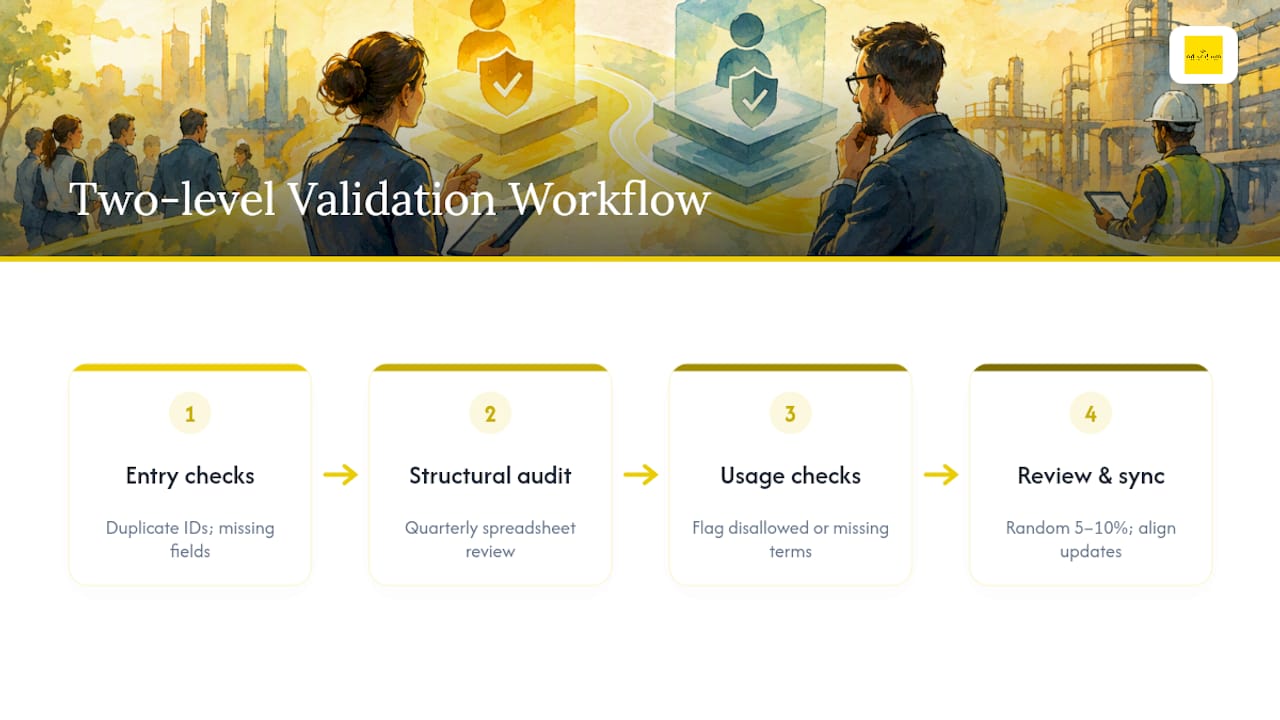
Sample-based validation works well for high-volume projects: pull a random 5 to 10 percent of translated segments per project and manually confirm terminology compliance against the termbase. Track the error rate over time. A rising rate usually means either the termbase has gaps that need filling or the change-request process has slowed down and translators are guessing.
Finally, validation should include the termbase’s own accuracy against source truth, not just translator compliance with it. If a regulatory term changes upstream, an outdated termbase entry will pass every internal QA check while still being wrong. Tying termbase review cycles to known regulatory or product update schedules closes that gap.
The Role of Term Base Management in Multilingual Content Consistency
Consistency across languages is not a stylistic nicety in regulated content. It’s a functional requirement, and it’s the primary reason term base management exists as a discipline rather than an afterthought.
Consider a medical device manual translated into 15 languages for a multi-market launch. If the term for a specific component drifts between languages, or even between two documents in the same language, a technician or regulator reading the translated instructions faces genuine ambiguity about what part is being referenced. That’s not a quality complaint; it’s a safety and compliance issue. A governed termbase eliminates that ambiguity by forcing every translator, human or AI-assisted, to draw from the same approved concept entry regardless of which language they’re working into.
The consistency benefit compounds across content types. Marketing copy, technical documentation, legal contracts, and regulatory submissions for the same product often get translated by different teams, sometimes different vendors entirely, at different points in a product’s lifecycle. Without a shared termbase, each team independently decides how to render key terms, and the result is a fragmented brand and regulatory voice across a company’s multilingual footprint. With a shared termbase feeding every workflow, terminology stays aligned even when the people doing the translation never talk to each other directly.
This is also where termbase integration with translation memory pays off beyond terminology alone. A TM stores full segments that have been previously translated and approved; a termbase governs the specific terms within those segments. Used together, they reinforce each other: a TM match that uses outdated terminology gets flagged for update rather than reused blindly, keeping consistency current rather than frozen at whatever state the TM was in when it was built.
Training and Adoption Strategies for Termbase Tools
A termbase with perfect data and zero adoption delivers zero value. Getting translators, reviewers, and project managers to actually use it consistently is a change-management problem as much as a technical one.
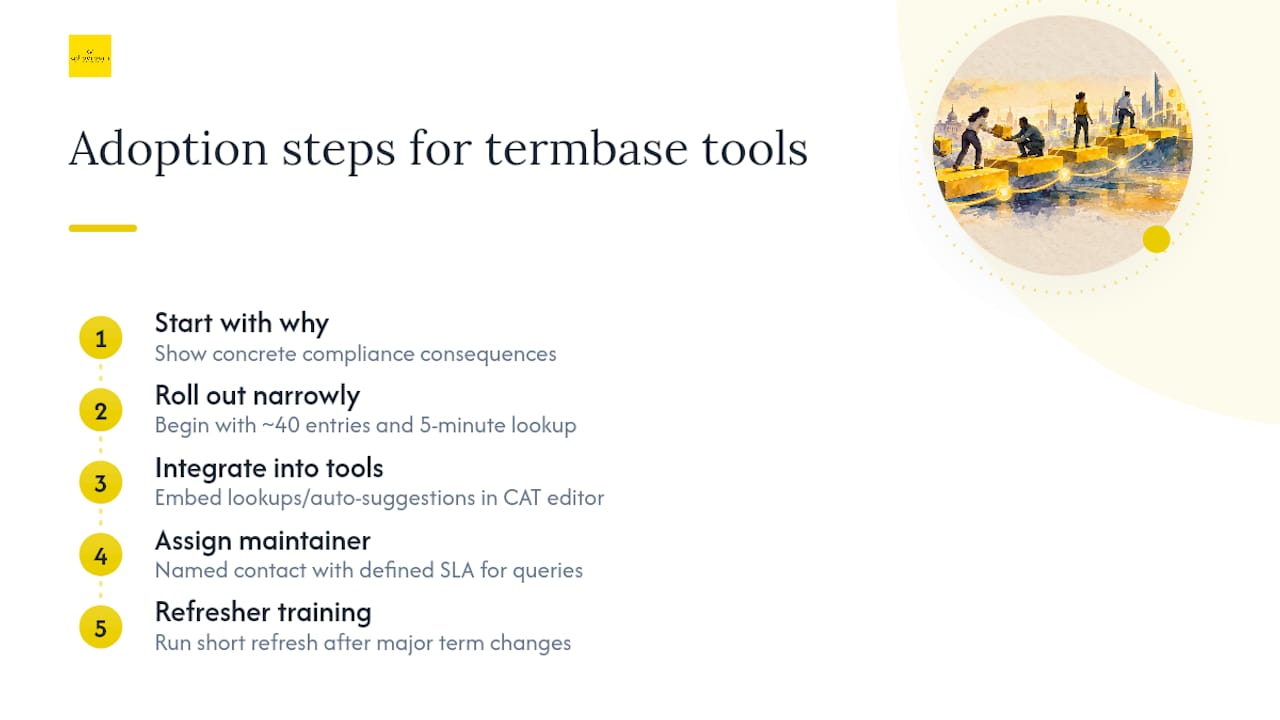
Start training with the “why,” not the interface. Translators who understand that a disallowed term caused a specific past compliance issue engage differently than translators handed a list of rules with no context. Framing termbase discipline around real consequences, a mistranslated dosage instruction, a contract clause that shifted liability, makes the governance feel necessary rather than bureaucratic.
Keep the initial rollout narrow. Introducing a termbase alongside 40 well-chosen entries and a five-minute lookup workflow gets adopted. Introducing 2,000 entries and a complex approval hierarchy on day one gets ignored. Expand scope only after the core habit, checking the termbase before guessing a term, becomes routine.
Build the termbase into the tools people already use rather than asking them to check a separate reference. If lookups and auto-suggestions appear directly inside the CAT editor during translation, adoption happens by default. If the termbase lives in a separate system that requires switching windows, usage drops off within weeks regardless of how good the initial training was.
Assign a visible point of contact for questions and change proposals. Adoption stalls when translators hit an ambiguous case and have no clear path to resolution; they either guess or ignore the termbase entirely. A named maintainer who responds to proposals within a defined SLA keeps the feedback loop alive and signals that the termbase is a living resource, not a static document nobody maintains.
Finally, revisit training when the termbase itself changes significantly, not just at onboarding. A major terminology overhaul after a product rebrand or regulatory shift needs its own short refresher, not a silent update that translators discover mid-project.
A Practitioner’s Note on Governance Discipline
The lesson that surprises new terminology managers most: the termbase itself is rarely the hard part. The discipline to keep reviewing it is. Most failures trace back to a change-request process nobody enforced, not to a missing field.
— Eric Brown
How AD VERBUM Supports Term Base Management
AD VERBUM is the alternative to building terminology governance from scratch, or trusting it to a generic translation vendor with no structured workflow behind it. AD VERBUM’s translation services run on AI+HUMAN hybrid translation: your Translation Memories and Term Bases are ingested first, the proprietary LLM-based LangOps System generates output constrained by that terminology, and a certified subject-matter expert reviews the result before it reaches you.

That workflow includes terminology enforcement throughout the translation, QA aligned to ISO 17100 and ISO 18587, and TBX delivery when your systems require standard interchange. For teams in Life Sciences, Legal, Finance, Defense, or Manufacturing, an initial assessment maps your existing termbase, or helps you build one, against the audit and compliance requirements your content actually faces. Review the full service catalog or get in touch to scope a termbase integration for your next multilingual project.
Sources
FAQ
What Is a Term Base?
A term base is a concept-oriented database of approved terminology, storing each term with its definition, context, approval status, and owner. It differs from a simple word list because it tracks metadata that supports governance and auditability, as described in the Wikipedia entry on termbases.
What Is the Difference Between a Termbase and a Glossary?
A glossary is typically a flat word list with no status field or ownership tracking, while a termbase includes structured metadata like approval status, context, and provenance. Teams generally move from a glossary to a termbase once translator volume, recurring projects, or compliance needs grow past what informal tracking can handle.
What Are the Four Main Types of Translation?
The categories most practitioners recognize are literary, technical, legal, and administrative translation, though some frameworks add medical or financial as distinct categories given their regulatory weight. Regulated technical and legal translation is where structured term base management matters most, since terminology errors carry compliance consequences.
What Are CAT and MT Tools?
CAT (computer-assisted translation) tools are software environments where human translators work, using features like translation memory and termbase lookups to maintain consistency. MT (machine translation) generates output automatically without a human in the loop during generation; AD VERBUM’s AI+HUMAN hybrid approach differs from plain MT by combining LLM-based generation with mandatory subject-matter expert review before delivery.
How Often Should a Termbase Be Reviewed?
Most regulated teams run a full review quarterly, with high-risk or frequently disputed entries checked sooner. The right cadence depends on how often source regulations, product names, or client style guides change, and any local exception should carry its own review date rather than waiting for the next full cycle.
Recommended
