


Software Localization for Regulated Industries: What Compliance Requires

Software localization for regulated industries succeeds only when it delivers four things simultaneously: regulatory traceability, controlled terminology, secure workflows, and documented quality assurance. Miss any one of these and a translated string stops being a convenience feature and becomes a liability, whether it sits inside a medical device interface, a banking disclosure, or a defense procurement portal.
The four pillars work together, not separately:
Regulatory traceability — every change to translated content is logged, timestamped, and attributable to a named reviewer.
Terminology governance — approved terms stay locked and consistent across every release and every language.
Secure workflow — translation happens inside a controlled system, not on unmanaged local files.
ISO-aligned QA — quality checks map to recognized standards like ISO 17100, not ad hoc proofreading.
Compliance snapshot: A significant share of U.S. residents speak a language other than English at home, which is one reason regulated communications, from HIPAA notices to device labeling, increasingly require formal localization programs rather than informal translation. AD VERBUM structures its process around this exact set of controls.
Key Takeaways
Compliant software localization for regulated industries depends on locked terminology, immutable audit trails, zero-trust security controls, and ISO-aligned SME review working together, not any single control alone.
Point | Details |
Traceability is non-negotiable | Every translated string needs a logged version, reviewer identity, and approval date for audit readiness. |
Lock terminology early | Term Bases and Translation Memories must be version-controlled with formal change-control sign-off. |
Disable offline exports | Require in-platform editing to preserve UI context and reduce data exposure from unmanaged devices. |
Segment content by risk | Safety-critical strings need SME review and screenshot verification; low-risk UI text can move faster. |
AD VERBUM maps to this framework | Its AI+HUMAN hybrid workflow follows asset ingestion, LLM generation, SME review, and ISO-aligned QA sign-off. |
Table of Contents
How Should Teams Handle Strings, UI Previews, and File Formats?
Why Does Terminology Governance Matter More Than Translation Speed?
How Does AI+HUMAN Hybrid Translation Fit an Audit-Ready QA Pipeline?
How Do You Evaluate a Localization Vendor or TMS for Compliance Work?
What Do Compliant and Non-Compliant Localization Look Like in Practice?
What Are the Highest-Risk Failure Modes in Regulated Localization?
Risk Management Strategies for Localization Errors in Regulated Sectors
How Are Localized Software Products Audited and Certified for Compliance?
How Do You Manage Version Control for Continuously Updated Regulated Software?
How Does Cultural Adaptation Interact With Regulatory Compliance?
How Does Localization Affect Cybersecurity and Data Privacy Compliance?
Get Compliance-Ready Localization Without Building It In-House
What Counts as Software Localization in a Regulated Sector?
Software localization for regulated industries covers any user-facing or regulator-facing text embedded in or attached to a software product operating under legal, medical, financial, or defense oversight. That includes UI strings, error messages, in-app help content, embedded labeling, instructions for use (IFUs), consent screens, and any text that gets referenced in a regulatory submission.
It does not include general marketing copy translation, and this guide does not constitute legal or regulatory advice for any specific filing.
Typical regulated artifacts include:
A glucose monitor’s on-screen dosing instructions, which fall under medical device labeling rules.
A banking app’s fraud disclosure language, which must match jurisdiction-specific financial disclosure requirements.
Clinical trial data-capture screens used across multi-country trial sites.
Defense logistics software interfaces subject to NATO or government procurement standards.
Anything a regulator, auditor, or end patient could reasonably rely on for a safety or compliance decision belongs in scope. Internal engineering comments and non-published test strings generally do not.
What Do Auditors Actually Expect From Localized Software?
Auditors and regulatory reviewers expect a documented chain of custody for every translated string that ends up in a regulated product. That means an immutable log showing what changed, when, who translated it, who approved it, and against which source-language version.
For medical device submissions, that trail often needs to align with 21 CFR Part 11 style expectations around electronic records: signed approvals, version-locked terminology, and audit trails that show role-based sign-off rather than informal email approvals. Finance disclosures carry a parallel but distinct burden, where a mistranslated risk statement or fee disclosure can trigger regulatory scrutiny independent of any software bug.
A defensible localization audit trail generally needs to show:
The source string, its version identifier, and the date it was locked for translation.
The identity and credentials of the linguist or subject-matter expert who translated or reviewed it.
The approval chain, including any legal, medical, or compliance sign-off before release.
The QA method applied, mapped to a named standard such as ISO 17100 or ISO 18587.
A timestamped record of any post-release correction or terminology change.
Structuring sign-offs this way turns audit prep from a scramble into a query. When a regulator asks for evidence on a specific string in a specific release, the answer should be retrievable in minutes, not reconstructed from scattered spreadsheets and translator email threads.
How Should Teams Handle Strings, UI Previews, and File Formats?
Regulated software localization runs on structured file formats, primarily XLIFF, JSON resource files, and platform-specific resource bundles (.strings, .resx, .po). Each format carries its own risk profile: JSON files with nested keys are easy to break structurally, while XLIFF exchanged offline as loose files loses the surrounding UI context a translator needs to get tone and length right.
Live UI previews and screenshot-based contextual review matter more than most teams initially assume. A term that is accurate in isolation can still break a button layout or truncate mid-sentence on a smaller screen. Functional and visual checks at this stage catch problems that a pure text review misses entirely.
Watch for these common technical failure points:
Placeholders ({0}, %s) getting reordered or dropped during translation, breaking dynamic content.
Pluralization rules in languages with more than two plural forms (Arabic, Polish, Russian) rendering incorrectly.
Embedded markup or HTML tags getting mistranslated as literal text instead of formatting instructions.
Text expansion in languages like German or Finnish overflowing fixed-width UI elements.
Integrating localization into the development pipeline through connectors, webhooks, or automated sync reduces the lag between a source string change and its translated counterpart reaching QA.
Pro Tip: Never approve a string for release based on the translated text alone. Require a screenshot or live-render check for any string tied to dosing, dosage frequency, warnings, or financial figures, even when the translation itself looks clean.
Why Does Terminology Governance Matter More Than Translation Speed?
Meaning drift, not translation errors, causes most compliance incidents in regulated localization. A term translated correctly in one release can be rendered differently in the next if the translation memory isn’t enforced, and that inconsistency is exactly what regulators flag during review.

Term Bases (TBs) and Translation Memories (TMs) exist to prevent this. A locked TB defines exactly how a regulated term, “adverse event,” “cooling-off period,” “authorized dealer,” gets rendered in each target language, and that decision does not change without a formal review. Centralizing terminology and enforcing locked terms reduces the risk of safety-critical mistranslation across releases.
A workable governance structure includes:
A versioned glossary with a change log, not a static spreadsheet that gets silently edited.
A formal change-control step: proposed terminology changes require sign-off before they enter the live TB.
Credentialed subject-matter experts, medical linguists, financial translators, defense-cleared reviewers, attached to specific term categories rather than general linguistic staff.
Reuse of approved TM segments across releases so previously validated language doesn’t get retranslated inconsistently.
Learn more about structuring term base enforcement for regulated technical content.
What Security Controls Does a Localization Workflow Need?
Localization workflows expose sensitive strings, product specifications, clinical data, financial figures, to external linguists working outside the client’s own network perimeter. Outsourced localization introduces unique threats because contributors often work from unmanaged devices with varying security postures across different jurisdictions.
Zero-trust design principles address this directly rather than relying on contractual trust alone.
Enforce SAML/SSO with strong two-factor authentication for every linguist and reviewer accessing the platform.
Apply role-based access control (RBAC) so a linguist sees only the project scope assigned, not the full content repository.
Disable offline file exports; require translation and review inside the platform editor to preserve context and prevent sensitive files from sitting on personal devices.
Use API token rotation, IP allowlisting, session timeouts, and a panic-lock option to cut access instantly if a device or credential is compromised.
Decide data residency deliberately: private hosting or EU-hosted processing matters when GDPR, HIPAA, or defense data-sovereignty rules apply to the underlying content.
Applying zero-trust principles to localization work, limiting offline exports, enforcing strict RBAC, requiring strong authentication, measurably lowers the threat surface created by external linguist access. This is the core argument behind treating translation platforms as a security perimeter, not just a productivity tool.
Data residency decisions matter most when the content itself is regulated, protected health information under HIPAA, or export-controlled defense specifications, rather than for general marketing text where geography is a lesser concern.
How Does AI+HUMAN Hybrid Translation Fit an Audit-Ready QA Pipeline?
A validated localization pipeline for regulated software follows a fixed sequence, and skipping a step is usually where audit findings originate.
Asset ingestion. Client Translation Memories and Term Bases load first, so nothing gets translated outside the approved terminology baseline.
LLM-assisted generation. A constrained language model produces draft target-language output bound by the locked TB and style guidance, not a freeform machine translation pass.
Certified SME review. A subject-matter expert, medical, legal, financial, or defense-credentialed, reviews the draft for regulatory accuracy and contextual nuance. In-country or certified reviewers are required when the target market has its own regulatory body (a national medicines agency, for example); general linguistic reviewers suffice for lower-risk UI text.
ISO-aligned QA and sign-off. Quality checks map to ISO 17100 and ISO 18587, with functional UI testing against defined acceptance criteria before release.
Retain the draft, the SME’s review notes, the QA checklist, and the final sign-off as a single evidence package per release. That package is what gets pulled during an audit request, not a reconstructed email trail.
Pro Tip: Treat SME review sign-off the same way you treat code review approval, no merge to production without it, and no exceptions for “minor” UI copy changes.
How Do You Evaluate a Localization Vendor or TMS for Compliance Work?
A short checklist separates vendors built for regulated work from general-purpose translation shops.
Confirm certifications: ISO 17100, ISO 18587, ISO 27001, and ISO 13485 where medical devices are involved.
Verify native TM/TB integration, not a bolt-on import feature.
Request a sample audit log to see what evidence the platform actually generates.
Ask about the subject-matter expert network: credentials, sector specialization, and vetting process.
Clarify data residency: where is content processed and stored, and under what jurisdiction.
Get a documented incident response and breach notification timeline in writing.
Questions worth asking directly:
“Show me a sample audit trail for a past regulated project.”
“What is your process when a locked term needs to change mid-project?”
“What is your contractual breach notification window?”
Red flags: no audit trail capability, offline-only file workflows, and no verifiable SME credentialing process. Governance setup typically adds upfront time to a first engagement, expect several weeks for TB/TM onboarding, but pays back on every subsequent release.
What Do Compliant and Non-Compliant Localization Look Like in Practice?
A medical device manufacturer using locked term bases, in-context UI review, and a full audit trail caught a mistranslated dosage unit during QA, before release, because the screenshot-based review flagged a truncated warning label. The fix took an afternoon.
A separate case involved a finance client whose translator worked from an offline XLIFF export. Stripped of surrounding UI context, “hold” (as in account hold) was rendered as a generic pause instruction rather than the regulated financial term, and the error reached production before a customer complaint surfaced it.
Mitigation: disable offline exports; require in-platform editing.
Mitigation: attach screenshots to every string touching financial or medical meaning.
Mitigation: require SME sign-off before any release, not just before submission.
What Are the Highest-Risk Failure Modes in Regulated Localization?
Terminology drift across releases. Mitigation: lock the TB and require change-control approval for any edit.
Data leakage via offline files. Mitigation: disable offline XLIFF export and mandate in-platform editing.
Missing audit evidence when a regulator requests it. Mitigation: generate audit logs automatically as a workflow byproduct, not a manual report.
Insufficient SME validation on safety-critical strings. Mitigation: require credentialed sign-off before any regulated string reaches production.
Pro Tip: If resources are constrained, fix audit-trail gaps first. It’s the control regulators ask for by name during a review, and the one most often missing entirely.
When Does AD VERBUM Fit a Regulated Localization Program?
AD VERBUM fits when content is regulated, audit evidence is required, and data sovereignty matters, medical device labeling, financial disclosures, defense documentation, or clinical software interfaces.
The AD VERBUM AI+HUMAN hybrid translation workflow follows the same sequence outlined above: TM/TB ingestion, constrained LLM generation, certified SME review, and then QA aligned to ISO 17100 and ISO 18587.
Certifications include ISO 27001, ISO 13485 for medical devices, and AQAP2110 for defense work, independently audited by Bureau Veritas.
Infrastructure runs on EU-hosted servers with no reliance on outsourced public cloud tooling, relevant when GDPR or HIPAA scoping applies.
Risk Management Strategies for Localization Errors in Regulated Sectors
Localization errors in regulated software rarely stay contained to a single string. A mistranslated warning label or a dropped negation in a dosage instruction can trigger a product recall, a regulatory inquiry, or patient harm, depending on the sector. Risk management here means building controls that catch errors before release, not auditing them after the fact.
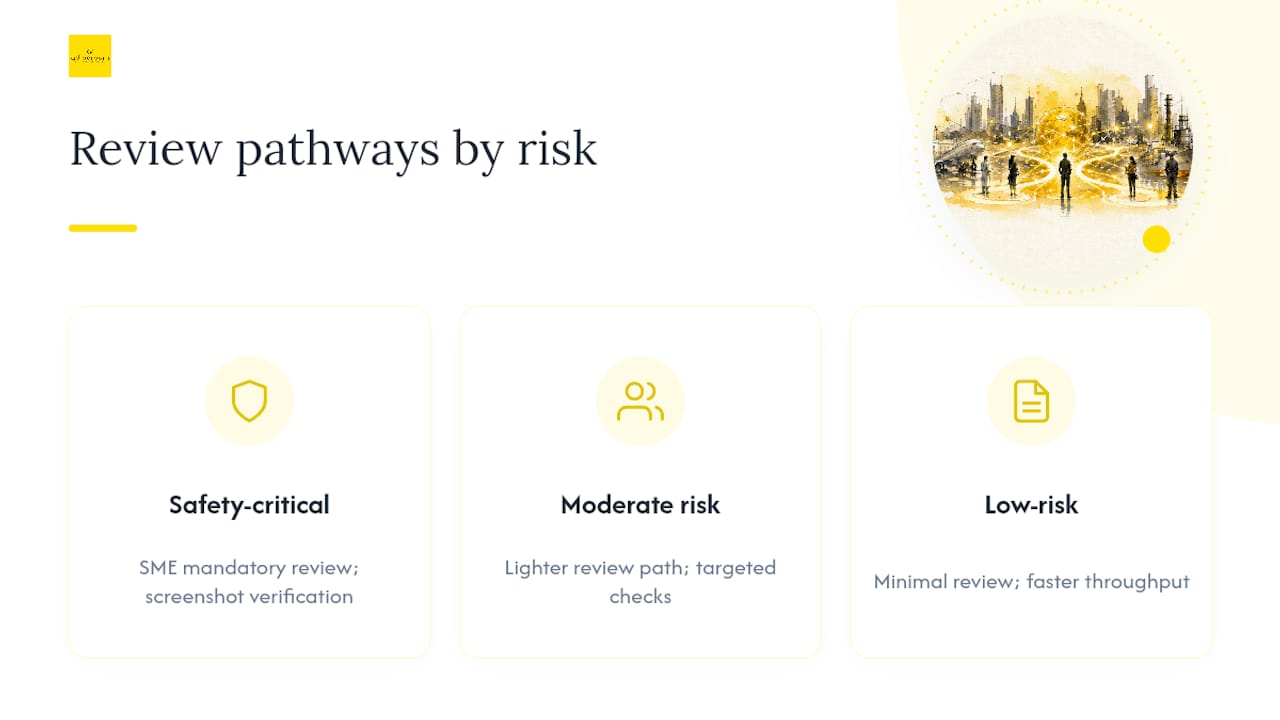
The most effective mitigation is segmenting content by risk tier before translation even starts. Safety-critical strings, dosing instructions, warning labels, financial risk disclosures, get mandatory SME review and screenshot-based verification. Lower-risk UI copy (menu labels, generic navigation text) can move through a lighter review path. Treating every string with identical rigor wastes review capacity on low-risk text while safety-critical strings compete for the same attention.
A second lever is negation and quantifier testing. Errors involving “not,” “except,” and numeric thresholds are disproportionately common in regulated translation because these words carry legal weight but are easy to drop or invert during rapid translation. Building a specific QA check for negation handling, separate from general grammar review, catches errors that standard proofreading misses.
Finally, build a rollback plan. If a translated string ships with an error, the team needs a predefined process to pull it, notify affected users where required, and log the correction as its own audit event. Waiting to improvise this process during an actual incident costs time regulators won’t extend.
How Are Localized Software Products Audited and Certified for Compliance?
Certification and audit for localized regulated software typically happens on two tracks: the certification of the localization provider’s own quality management system, and the audit of the specific product release for regulatory submission.
On the provider side, certifications like ISO 17100 (translation services quality), ISO 18587 (post-editing of machine translation), and ISO 13485 (medical device quality systems) get issued after third-party audit, typically by an accredited body such as Bureau Veritas. These certifications confirm the provider’s process meets a defined standard, they don’t certify any individual translated string.
On the product side, the regulator or internal compliance team audits the actual release. For medical devices, this often means checking that translated labeling matches the source-language version approved in the original submission, with evidence that any deviation went through change control. For financial products, auditors typically check that disclosure language meets jurisdiction-specific wording requirements, not just accurate translation.
The practical connection between the two tracks: a provider’s ISO certification gives auditors confidence in the process, but it doesn’t replace the release-specific evidence package, the audit trail, SME sign-off, and QA checklist, that a regulator will request for a specific product version. Teams that treat provider certification as sufficient on its own, without maintaining release-level documentation, tend to struggle when a regulator asks for evidence tied to a specific string in a specific release rather than a general process description.
How Do You Manage Version Control for Continuously Updated Regulated Software?
Continuous localization, where source strings update frequently through agile development cycles, creates a version control problem that traditional batch translation never had to solve. Every source-string change needs a corresponding translation update, and every translation update needs to trace back to the exact source version it was translated against.
The core mechanism is version-locking at the string level, not just the file level. Each translatable string carries its own version identifier tied to the source-language change that triggered it. When a developer edits a source string, the localization system flags every target-language version as outdated rather than assuming the existing translation still applies.
Automated sync through connectors and webhooks reduces the lag between a source change and translated content reaching review, but speed without governance creates its own risk: a string can get auto-translated and pushed to a staging environment before SME review completes. The fix is a gate, not a slowdown, translations sync automatically for review, but nothing marked “regulated” or “safety-critical” advances to production without a logged sign-off.
Rollback capability matters as much as forward sync. If a translated string introduces an error post-release, the team needs to revert to the prior validated version instantly while the correction goes through review, not leave a known error live while a fix is drafted. Maintaining a full version history, not just the current live string, for every regulated release is what makes that rollback possible and gives auditors a complete change record on request.
How Does Cultural Adaptation Interact With Regulatory Compliance?
Cultural adaptation and regulatory compliance sometimes pull in the same direction and sometimes pull against each other, and regulated localization teams need to know which is happening in a given case.
Where they align: a warning label translated with correct regional units (metric versus imperial dosing, local date formats, currency symbols) is both culturally appropriate and regulatorily accurate. Getting the date format wrong on a clinical trial consent form isn’t just a cultural misstep, it can invalidate the document’s legal standing in that jurisdiction.
Where they can conflict: some markets have local conventions around directness, formality, or risk language that differ from the source market’s regulatory phrasing. A financial disclosure written in blunt, legally precise English might read as unnecessarily alarming or oddly informal when adapted too loosely for another market’s cultural register. The correct approach is rarely a free adaptation, regulated text usually needs to preserve exact legal meaning first, then adapt tone and formality within whatever range the regulation permits.
This is precisely where credentialed subject-matter experts earn their role over generalist translators. A qualified legal or medical linguist working in the target market understands both the cultural register readers expect and the regulatory boundary they can’t cross to get there. Partner resources focused on jurisdiction-specific legal translation, such as guidance on certified legal translation workflows, illustrate how tightly cultural and regulatory adaptation intertwine in cross-border legal documentation.
How Does Localization Affect Cybersecurity and Data Privacy Compliance?
Localization workflows touch data privacy compliance the moment source content includes protected health information, financial account details, or personally identifiable information, because that content now exists in additional copies, additional languages, and additional systems (the TMS, the SME’s review environment, backup storage).
Every additional copy is an additional exposure point. A HIPAA-covered entity that shares patient-facing content for translation is extending its data processing chain, and that chain needs the same access controls, encryption, and data-handling agreements as any other processor relationship. GDPR and HIPAA obligations don’t pause because content is temporarily inside a translation workflow.
The specific privacy risk in localization is less about the translation itself and more about where the content sits while being translated. Unmanaged linguist devices, personal email threads used to send files, and downloaded offline copies are the actual failure points, not the translation quality. This is why disabling offline exports and requiring in-platform editing functions as a privacy control, not just a security one: it keeps protected content inside a governed environment with logged access, rather than scattered across devices with no oversight.
Data residency decisions compound this. Processing regulated data on servers outside the jurisdiction that governs it can trigger cross-border transfer restrictions under GDPR or create HIPAA business associate agreement complications. Confirming exactly where a localization provider processes and stores content, not just whether they claim compliance, is a due-diligence step compliance teams should not skip.
Why the “Fast Translation” Instinct Undermines Compliance
The biggest misconception in regulated software localization is treating speed and compliance as a trade-off you negotiate project by project. They aren’t in tension nearly as often as procurement teams assume. Most compliance failures in this space trace back to skipped governance steps, no locked terminology, no SME sign-off, no audit trail, rather than to translation quality itself. A grammatically perfect translation with no evidence trail is functionally useless to an auditor.
The conventional advice, “get a certified translator,” undersells the problem. Certification addresses linguistic competence, not regulatory traceability. A perfectly competent medical translator working outside a governed TMS, on an offline file, with no locked term base, still creates an audit gap regardless of how accurate the individual sentence is.
Prioritize the boring infrastructure first: locked term bases, immutable audit logs, and in-platform editing. These controls feel unglamorous next to translation quality debates, but they are what actually gets checked when a regulator opens a file. Get the evidence trail right, and translation quality becomes a QA problem you can solve. Get it wrong, and no amount of linguistic skill fixes a missing sign-off.
Get Compliance-Ready Localization Without Building It In-House
Building the infrastructure described above, locked term bases, zero-trust TMS controls, SME credentialing, ISO-aligned QA, from scratch takes most internal teams months and a dedicated governance budget most product teams don’t have. AD VERBUM runs this exact stack today: AI+HUMAN hybrid translation constrained by your Translation Memories and Term Bases, reviewed by subject-matter experts across Life Sciences, Legal, Finance, Defense, and Manufacturing, with EU-hosted infrastructure built for GDPR and HIPAA-aligned data handling.
The workflow runs significantly faster than traditional translation cycles while keeping certified human review at every regulated string, backed by ISO 17100, ISO 18587, ISO 27001, and ISO 13485 certification, independently audited by Bureau Veritas. If your team is evaluating a localization partner for a regulated release, start with a scoped services review or explore multilingual content support for your next global launch and request a quote against your specific compliance requirements.
Frequently Asked Questions
What is software localization for regulated industries? It is the adaptation of software interfaces, embedded content, and related documentation into target languages under governance controls that satisfy sector-specific regulatory, audit, and data protection requirements, rather than general-purpose translation.
Which ISO standards matter most for medical software localization? ISO 17100 governs translation service quality, ISO 18587 covers post-editing of machine-translated content, and ISO 13485 applies specifically to medical device quality management systems.
How is secure software localization different from standard translation security? Secure localization applies zero-trust principles, strong authentication, role-based access, disabled offline exports, directly to the translation platform itself, since linguists often work outside the client’s own network perimeter.
What triggers a localization compliance audit in regulated sectors? A regulatory submission review, a routine internal compliance check, or a customer complaint tied to a translated string typically triggers an audit, at which point teams need to produce a complete evidence trail for that specific content.
Can machine translation alone satisfy regulated software adaptation requirements? No. Machine translation output generally requires certified subject-matter expert review and ISO-aligned QA before it satisfies regulatory traceability and accuracy requirements for regulated content.
Sources
Recommended

