


3 Vendor Controls That Make Rare Language Pharma Translation Audit Ready

Yes, rare language translation for pharma is feasible, but only with ISO-aligned workflows that pair certified subject-matter linguists with documented QA and audit trails. Ad hoc machine translation or unvetted freelance vendors will not survive an FDA or EMA inspection. Before signing any vendor, confirm three things in the proposal: named linguist qualifications for that specific language pair, documented terminology governance, and a QA process producing an audit trail. One option is built around exactly those conditions.
Table of Contents
What Counts as a Rare Language in Pharma Translation
“Rare” in this context does not mean obscure in the abstract. It means low-resource: language pairs with limited digital corpora, few certified medical linguists, and no standardized clinical terminology base. A trial site in rural Ethiopia needing Tigrinya, or a device labeling requirement for Quechua in Peru, both fall into this category even though millions of people speak these languages. The scarcity is professional, not demographic. Long-tail dialects and regional variants compound the problem: a linguist certified in standard Amharic may still lack fluency in a specific regional variant used at a trial site.
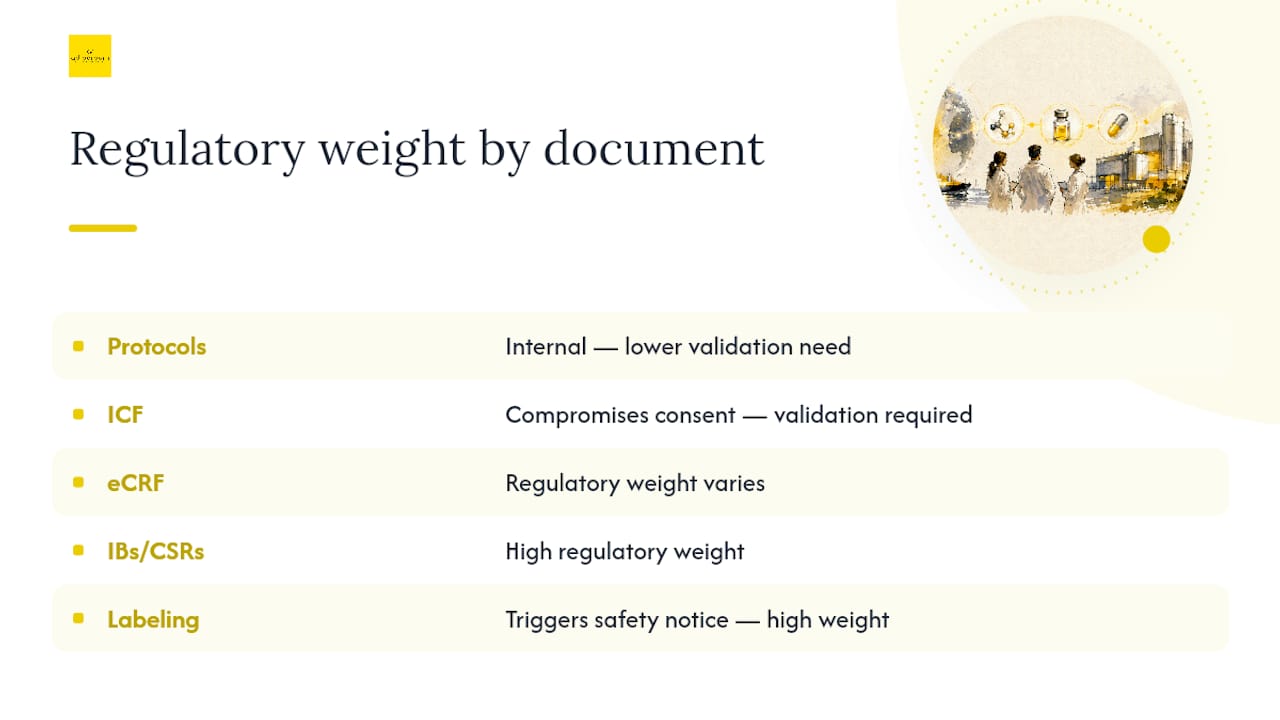
Scope determines controls. Protocols, informed consent forms (ICFs), electronic case report forms (eCRFs), investigator brochures (IBs), clinical study reports (CSRs), labeling, and safety reports each carry different regulatory weight. An ICF translation error can compromise patient consent validity. A labeling error can trigger a field safety notice. Linguistic validation, meaning back-translation plus reconciliation, and cognitive debriefing with target-population representatives, become mandatory whenever the material is patient-facing rather than internal.
What Regulatory Evidence Do You Need for Rare-Language Submissions?
Regulators do not evaluate translation quality directly. They evaluate whether your quality system produced traceable evidence that the translation is fit for purpose. That distinction shapes everything you should demand from a vendor.
eCTD submissions require translated content to sit in the correct module with consistent metadata: source language, target language, translator identity, and review status. A translated IB or CSR appendix that lacks this metadata creates a query during review, and queries slow approval timelines. Specialist providers describe ISO-aligned workflows and eCTD packaging as baseline, not premium, service.
GxP expectations extend to the translation process itself. Translation memory and terminology assets are considered regulated content once they feed submission documents, which means version control, change control, and validated handling apply the same way they would to any other controlled document. A vendor who cannot show you a change log for a term base update is not operating under a GxP-compatible system.
Request these artifacts before you sign a contract:
Translator and reviewer CVs showing subject-matter credentials in the relevant therapeutic area
QA logs documenting error rates, review cycles, and resolution
Signed in-country reviewer statements confirming linguistic and cultural accuracy
Attestations of process compliance tied to a named ISO standard
Version-controlled terminology records showing when and why terms changed
If a vendor cannot produce these on request, that absence is itself a finding worth escalating internally before procurement moves forward.
How Do You Handle Consent Forms and Labeling in Rare Languages?
Informed consent and protocol language carry the highest patient-safety stakes in the entire translation scope, and rare languages amplify the risk because there is often no established precedent translation to reference.
Back-translate every ICF. An independent linguist translates the target-language version back into the source language, and a reconciliation step flags discrepancies before the ethics committee sees the document.
Run cognitive debriefing with representative patients or site staff. A handful of target-population readers walk through the consent form aloud, and their comprehension gaps get corrected before finalization. Providers working in low-resource languages treat this step as more valuable than rushing straight to full-dossier translation.
Map labeling terms to standardized systems. Dosage notation, units of measure, International Nonproprietary Names (INNs), and MedDRA terms all need controlled mapping so a rare-language label does not drift from the approved reference text.
Build in readability testing for any patient-facing labeling, particularly where literacy levels vary across the target population.
Pro Tip: Set separate service-level agreements for pharmacovigilance reporting versus routine documentation. A safety signal in a rare language cannot wait for the same review cycle as a marketing insert, so your contract should specify an expedited SLA (often 24 to 48 hours) for adverse event narratives, with the same SME review standard, not a lighter one.
Speed and safety pull in opposite directions here. The fix is not cutting review steps. It is pre-qualifying a smaller, faster-responding linguist pool specifically for pharmacovigilance so expedited work still gets full SME sign-off.
Which Quality Certifications Actually Matter?
Certifications only mean something if you can trace them to specific deliverables. ISO 17100 governs the translation process itself: qualified translators, a second-linguist revision step, and project record-keeping. ISO 18587 governs post-editing of machine-generated output, which matters if any part of the workflow touches MT or LLM-generated drafts. Neither standard, on its own, addresses medical device or information security risk, which is why ISO 13485 (medical devices) and ISO 27001 (information security) matter as additional layers for pharma-specific engagements. AD VERBUM’s own guidance on ISO 17100 in practice breaks down how these standards translate into procurement checkpoints.
The workflow that satisfies auditors follows a consistent shape: terminology and translation memory assets get integrated first, any AI-assisted drafting runs under controlled prompts and terminology constraints, a certified subject-matter expert reviews for technical and regulatory accuracy, and a documented QA step closes the loop.

Pro Tip: Ask every candidate vendor for a sample QA report before contracting, not after. Auditors expect traceable evidence, including signed reviewer reports, change logs, and version-controlled glossaries — not just a certificate number on a cover page.
What separates an audit-ready deliverable from a merely translated document:
A QA report tied to the specific document, not a generic company-wide certificate
Reviewer signatures with named credentials, not “internal review complete”
A change log showing terminology decisions and who approved them
Output packaged in eCTD-ready format with consistent file naming and metadata
How Do You Vet a Rare-Language Vendor Before Signing?
Sourcing options split three ways: in-country freelance linguists, specialist language service providers (LSPs) with rare-language panels, and community or academic organizations tied to a specific language group. In-country freelancers often have the deepest cultural fluency but weaker process infrastructure. Specialist LSPs, including providers that maintain panels of work-authorized rare-language linguists, tend to offer more consistent QA but at a premium for tiered review. Community organizations can be valuable for dialect-specific validation but rarely scale to full regulatory documentation on their own.
Before signing anyone, run this sequence:
Request a paid sample translation test using real (or representative) clinical text, not marketing copy.
Verify subject-matter experience specifically in your therapeutic area, not general medical translation.
Ask for a security posture summary: data residency, access controls, and breach notification terms.
Request two references from prior regulated pharma engagements, ideally involving eCTD submission.
Confirm proof of linguist qualifications, including certification body and years of relevant practice.
Contract terms worth insisting on:
Audit rights allowing your quality team to inspect QA records on request
Explicit data handling terms covering storage location and retention period
Defined SLAs separated by document risk tier, as noted above for pharmacovigilance
Deliverable format specifications matching your eCTD or submission system requirements
A dispute resolution clause covering rework at no additional cost for documented quality failures
Rate structures for rare-language pharma work typically run above standard per-word rates once you add certified review and validation steps; premium tiers with senior-review and in-country validation should be the default for anything patient-facing, not an upsell you decline to save budget.
How AD VERBUM’s AI+HUMAN Hybrid Workflow Applies to Rare-Language Pharma Work
AD VERBUM runs a documented four-step sequence for every AI+HUMAN hybrid translation project: asset integration, where client translation memories and term bases load first; LLM generation, where the proprietary LangOps System produces a draft constrained by that terminology; certified subject-matter expert review for technical and regulatory accuracy; and a final QA step aligned to ISO 17100 and ISO 18587.
That sequence maps directly to the audit evidence discussed above. Certifications include ISO 9001, ISO 17100, ISO 18587, ISO 13485, ISO 27001, and ISO 42001, independently audited by Bureau Veritas, alongside GDPR and HIPAA alignment. Data processing runs on EU-hosted infrastructure without reliance on outsourced public cloud tooling for core translation work.
Selection criterion | Why it matters for rare-language pharma work |
Regulated content requiring eCTD packaging | Deliverables need consistent metadata and file structure |
Audit requirements from FDA/EMA inspection | ISO-aligned QA logs must be reproducible on request |
Terminology governance across many document types | TM/TB integration keeps INN and MedDRA mapping consistent |
Sensitive patient or trial data | EU-hosted infrastructure with ISO 27001 controls applies |
SME oversight for safety-critical text | Certified SME review sits after every AI-generated draft |
What Teams Get Wrong About Rare-Language Pharma Translation
The most common mistake is skipping cognitive debriefing because it feels like an extra cost on a tight timeline. Teams that skip it usually discover the comprehension gap after the ethics committee flags it, which costs more time than the debriefing would have. The second mistake is treating terminology governance as optional for a “small” rare-language project. A single unmapped INN or inconsistent dosage unit propagates into every downstream document once it enters the term base.
The third mistake is writing a contract scope that only covers translation volume, with no language for rework, audit rights, or SLA tiers by risk level. When a safety report needs expedited handling six months into the engagement, an undefined scope becomes a negotiation, not a service call.
A short pilot, one document type, one language pair, full QA evidence attached, tells you more about a vendor’s actual process than any sales deck. Choose the vendor whose evidence trail survives an audit, not the one with the lowest per-word rate.
— Eric Brown
Requesting a Pilot Translation From AD VERBUM
The company works with regulated submissions, clinical trial documentation, and pharmacovigilance reporting across many languages, including regional variants that most general-purpose LSPs do not staff for.
A request for quote should specify the language pair, document type, expected volume, and any existing translation memory or term base you want integrated from the start. During a pilot, the provider supplies the full AI+HUMAN hybrid deliverable: asset-integrated draft, certified SME review, and QA documentation aligned to ISO 17100 and ISO 18587, enabling evaluation of audit-readiness before larger engagement. Beyond translation, the same certified workflow extends to interpretation for site visits and regulatory meetings where a rare language is spoken. Visit the services page to scope a pilot request or start a conversation about your specific language pair and document set.
Sources
FAQ
What Is the Rarest Language Supported in Machine Translation Tools?
Consumer machine translation tools like Google Translate support widely spoken languages best and struggle with low-resource languages that have limited digital text available for training. Providers of rare and indigenous language services note that machine translation alone is insufficient for many of these languages because training data machine translation alone is insufficient for many of these languages because training data is too thin to catch safety-critical errors reliably.
What Is the Highest-Paying Translation Specialization?
Certified medical and pharmaceutical translation, particularly for rare language pairs requiring subject-matter expertise, commands premium rates compared to general translation work. Rates rise further when the project requires tiered review with senior translator sign-off, which is standard for regulated pharma documentation.
Which Translation Approach Works Best for Medical Documents?
The most reliable approach pairs certified subject-matter expert linguists with a documented QA process, whether that process uses AI-assisted drafting or fully human translation. AD VERBUM’s AI+HUMAN hybrid model applies certified SME review after every generated draft, following an asset integration, generation, review, and QA sequence aligned to ISO 17100 and ISO 18587.
Which Languages Are Hardest to Translate for Pharma Projects?
Languages with limited digital corpora, few certified medical linguists, and no standardized clinical terminology base, often regional dialects or long-tail variants of larger languages, present the greatest translation difficulty. These pairs typically require in-country validation and cognitive debriefing rather than standard review alone.
Do Rare-Language Pharma Translations Cost More Than Standard Languages?
Yes, rare-language pharma translation typically costs more per word than mainstream language pairs because of scarce qualified linguists and mandatory validation steps like back-translation and cognitive debriefing. Current AD VERBUM pricing is available by request through the services page.
Recommended

