


Private AI in Localization: Ensuring Compliance and Data Control
- Feb 11
- 7 min read

Managing sensitive language data in medical and legal documents challenges even the best Compliance Officers across Northern Europe. The push for secure localization means every translation decision carries potential privacy and regulatory consequences. By shifting toward private AI in localization, organizations gain control over digital content adaptation while balancing data sovereignty, accuracy, and strict regulatory compliance. This overview clarifies how specialized AI models, secure environments, and human oversight support risk management without sacrificing precision in regulated industries.
Table of Contents
Key Takeaways
Point | Details |
Private AI enhances data security | Utilizing private AI in localization ensures strict compliance with data protection regulations such as GDPR and HIPAA, safeguarding sensitive information. |
Hybrid workflows improve translation quality | Integrating AI with human oversight in translation processes mitigates risks and enhances accuracy, particularly in regulated industries. |
Industry-specific solutions are essential | Private AI frameworks are vital for sectors like healthcare and finance, where data confidentiality and compliance are paramount. |
Comprehensive audits are crucial | Conducting thorough data sovereignty and compliance audits is essential before implementing private AI to identify risks and establish governance frameworks. |
Defining private AI in localization
Private AI in localization represents a sophisticated approach to language transformation that prioritizes data sovereignty and precision. By utilizing specialized AI models within controlled, secure environments, organizations can now adapt digital content while maintaining strict data privacy and regulatory compliance.
The core characteristics of private AI in localization include:
Deployment of AI models within proprietary, internal systems
Strict data access and governance controls
Protection of sensitive linguistic assets
Compliance with regional data protection regulations
Customizable terminology and style management
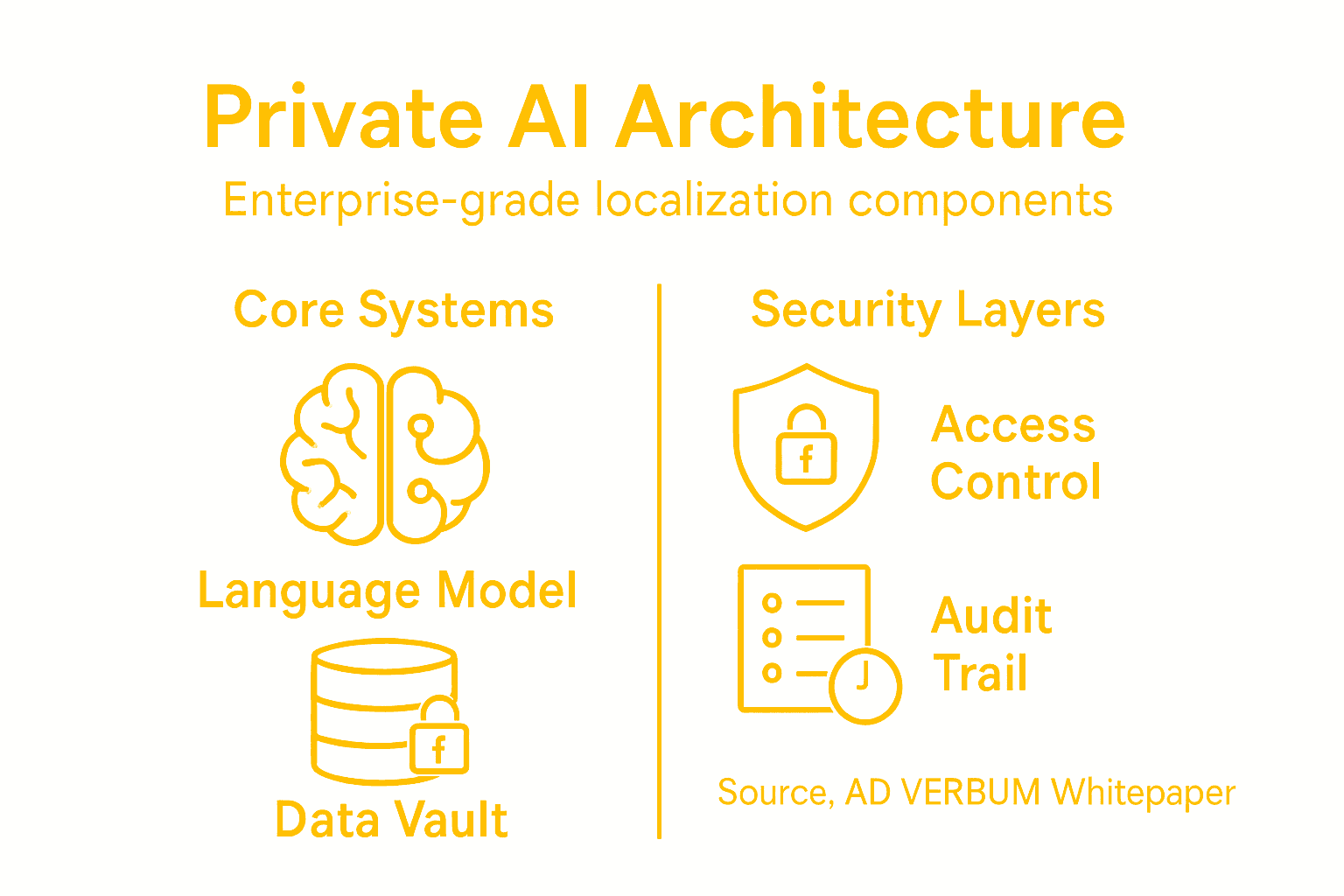
Unlike public cloud translation services, private AI localization integrates specialized language models designed specifically for regulated industries like healthcare, legal, and manufacturing. These models leverage sophisticated machine learning techniques to understand complex linguistic nuances while maintaining rigorous security protocols.
The technical architecture of private AI localization involves creating isolated, enterprise-grade language processing environments where sensitive content remains completely protected. Organizations can implement granular access controls, ensuring that only authorized personnel interact with linguistic data and translation workflows.
Pro tip: Conduct a comprehensive data sovereignty audit before implementing private AI localization to identify potential compliance risks and establish clear governance frameworks.
Types of AI translation solutions compared
AI translation solutions have evolved into sophisticated frameworks that range from fully automated approaches to complex hybrid methodologies. Machine translation workflows represent a spectrum of technological capabilities designed to address diverse linguistic challenges across industries.
The primary types of AI translation solutions include:
Fully Automated Machine Translation (MT)
High-volume processing capabilities
Rapid turnaround for repetitive content
Limited contextual understanding
Neural Machine Translation (NMT)
Advanced language pattern recognition
Improved grammatical accuracy
Better semantic comprehension
Hybrid Human-AI Translation
AI-generated initial drafts
Human expert post-editing
Highest quality and cultural accuracy
Enterprise-grade solutions prioritize human-in-the-loop translation approaches that balance machine efficiency with human linguistic expertise. These sophisticated workflows integrate artificial intelligence for initial draft generation while maintaining critical human oversight to ensure nuanced, culturally appropriate translations.
The selection of an appropriate AI translation solution depends on specific organizational requirements, including content complexity, regulatory constraints, and linguistic precision needed. Regulated industries like healthcare, legal, and finance typically require more robust hybrid approaches that guarantee absolute linguistic and contextual accuracy.
Here’s a quick comparison of key AI translation solution types and their best-fit business scenarios:
Solution Type | Best For | Limitation |
Fully Automated MT | Bulk content, low-risk data | Lacks contextual nuance |
Neural Machine Translation | Technical documents, fast updates | May miss cultural details |
Hybrid Human-AI Translation | Critical, regulated materials | Requires expert workforce |
Pro tip: Evaluate your translation workflow by conducting a comprehensive linguistic risk assessment that maps your content’s complexity against available AI translation methodologies.
How private AI ensures compliance and data sovereignty
Private AI represents a sophisticated approach to managing linguistic and technological compliance across regulated industries. Data sovereignty principles form the critical foundation for protecting sensitive information while enabling advanced language processing capabilities.
Key mechanisms for ensuring compliance and data sovereignty include:
Localized Data Processing
Restricting data movement across jurisdictional boundaries
Maintaining complete control over information storage
Preventing unauthorized external access
Cryptographic Governance
Implementing advanced encryption protocols
Creating transparent access management systems
Establishing auditable computational environments
Regulatory Alignment
Adhering to GDPR and EU AI Act requirements
Developing jurisdiction-specific computational frameworks
Ensuring transparent AI decision-making processes
Decentralized identity and access control form the cornerstone of robust private AI systems. These advanced frameworks integrate sophisticated policy-compliant computation methods that go beyond traditional data protection strategies, enabling organizations to maintain granular control over sensitive linguistic and technical resources.

Enterprise-grade private AI solutions implement multilayered security protocols that transform data sovereignty from a theoretical concept into a practical, enforceable operational standard. By localizing AI infrastructure and implementing strict governance mechanisms, organizations can simultaneously protect sensitive information and leverage advanced linguistic processing capabilities.
Pro tip: Develop a comprehensive data sovereignty mapping that identifies all potential regulatory intersections before implementing your private AI translation infrastructure.
Hybrid AI+human workflows for risk reduction
Hybrid AI+human workflows represent a sophisticated strategy for mitigating risks in complex translation environments. Human-AI collaborative models create synergistic approaches that leverage computational power while maintaining critical human oversight and contextual understanding.
Key risk reduction strategies in hybrid workflows include:
Contextual Validation
Human experts review AI-generated translations
Verify cultural and technical accuracy
Identify potential contextual misunderstandings
Error Detection Mechanisms
Implement multi-stage review processes
Create feedback loops for continuous improvement
Establish clear escalation protocols for complex translations
Domain-Specific Quality Control
Assign subject matter experts to specialized content
Develop sector-specific review frameworks
Maintain rigorous compliance standards
The hybrid workflow integrates AI’s computational efficiency with human intuition, creating a robust risk management framework. By strategically allocating tasks based on individual strengths, organizations can minimize translation errors, reduce bias, and maintain high-quality linguistic outputs across complex, regulated environments.
Enterprise-level implementations focus on creating transparent, auditable processes that balance technological innovation with human expertise. This approach allows organizations to leverage AI’s capabilities while maintaining the nuanced understanding that only human professionals can provide.
Pro tip: Develop a comprehensive skills matrix that clearly defines human and AI roles in your translation workflow to maximize efficiency and minimize potential risks.
When private AI is best for regulated industries
Private AI deployment represents a critical strategic approach for industries with stringent data protection requirements. Private AI clusters enable comprehensive security for organizations operating in high-stakes environments where data confidentiality is paramount.
Key industries where private AI becomes essential include:
Healthcare
Protect patient medical records
Ensure HIPAA compliance
Maintain strict data privacy standards
Financial Services
Safeguard sensitive financial information
Meet PCI-DSS regulatory requirements
Prevent unauthorized data access
Government and Legal Sectors
Protect classified and confidential documents
Maintain strict information governance
Ensure complete audit trails
Enterprise-grade private AI provides dedicated infrastructure that allows organizations to implement granular access controls, maintain full model ownership, and create transparent, auditable AI processes. This approach ensures that sensitive information remains completely protected while enabling advanced computational capabilities.
Dedicated AI infrastructure supports comprehensive risk management by providing isolated processing environments that meet the most stringent regulatory requirements. Organizations can leverage AI’s transformative potential without compromising their fundamental data sovereignty principles.
The following table summarizes how private AI addresses industry-specific compliance needs:
Industry | Primary Compliance Focus | Private AI Advantage |
Healthcare | Patient data privacy | Enforces medical confidentiality |
Financial | Transaction security | Ensures strict access controls |
Government | Classified document safety | Maintains auditability |
Pro tip: Conduct a comprehensive compliance gap analysis before implementing private AI to identify potential regulatory risks and design robust governance frameworks.
Elevate Your Localization with AD VERBUM’s Private AI Expertise
The challenges highlighted in “Private AI in Localization Ensuing Compliance and Data Control” call for a solution that guarantees data sovereignty, strict regulatory compliance, and unmatched linguistic precision. If you deal with regulated content, are navigating complex compliance landscapes such as GDPR and HIPAA, or require airtight terminology governance, AD VERBUM’s Specialized AI Translation offers a tailored answer. Our proprietary LLM-based AI, hosted exclusively on secure EU servers, operates within an AI+HUMAN hybrid translation workflow ensuring every word respects your exact terminology and industry standards.
Partner with over 25 years of Northern European expertise combined with a network of 3,500+ experts to experience translations that meet ISO 9001, ISO 17100, ISO 13485, and additional critical standards. This approach dramatically reduces risk by placing subject-matter experts in the review loop, boosting content accuracy and compliance.
Explore how our solution transforms regulatory challenges into opportunities for faster, safer, and more precise localization. To learn how our private AI infrastructure safeguards sensitive data while accelerating your workflow, start a conversation today.
Protect your data with EU-hosted AI solutions
Contact AD VERBUM to secure your regulated translation needs
Take charge of your multilingual compliance and data sovereignty now by partnering with AD VERBUM. Visit us at https://adverbum.com/contact for a consultation tailored to your industry’s most demanding translation requirements.
Frequently Asked Questions
What is private AI in localization?
Private AI in localization is a sophisticated approach to language transformation that emphasizes data sovereignty and precision. It involves using specialized AI models within controlled environments to ensure data privacy and regulatory compliance while adapting digital content.
How does private AI ensure compliance and data sovereignty?
Private AI ensures compliance and data sovereignty through localized data processing, cryptographic governance, and regulatory alignment, allowing organizations to maintain control over sensitive information while adhering to regional data protection regulations.
What are the different types of AI translation solutions?
The primary types of AI translation solutions include Fully Automated Machine Translation (MT), Neural Machine Translation (NMT), and Hybrid Human-AI Translation. Each type has its advantages and limitations depending on organizational requirements and the complexity of content.
When is private AI most beneficial for regulated industries?
Private AI is particularly beneficial in regulated industries like healthcare, financial services, and government sectors, where stringent data protection requirements are critical. It provides dedicated infrastructure to enforce compliance with regulations and protect sensitive information.
Recommended

