


Precision in Regulated Translation: Risk vs. Compliance

One overlooked translation error can trigger costly recalls or legal disputes, especially for European pharma, legal, or medical device firms handling American submissions. In regulated industries, a single mistranslated phrase can violate compliance guidelines and expose companies to severe risk. This guide clarifies what truly sets precision regulated translation apart and how advanced workflows protect operational integrity in an environment where accuracy is non-negotiable.
Table of Contents
Key Takeaways
Point | Details |
Precision is Critical | Regulated translation requires high accuracy, cultural nuances, and strict compliance with industry standards. |
AI+HUMAN Workflows Enhance Quality | Combining AI capabilities with human expertise significantly improves translation accuracy and meets regulatory demands. |
Understand Technology Options | Familiarize yourself with translation technologies like RBMT, NMT, and hybrid methods to choose the right fit for your industry. |
Mitigate Risks Effectively | Implement robust verification processes to address potential legal and operational risks associated with imprecise translations. |
Precision in Regulated Translation Defined
In the complex landscape of global communication, precision in regulated translation represents far more than simple word conversion. It is a sophisticated process of cultural and linguistic negotiation that demands extraordinary accuracy, particularly in high-stakes industries like pharmaceuticals, legal services, and medical devices.
Translation in regulated contexts is fundamentally about transferring meaning while preserving critical nuances. Intertextual translation research reveals that this process involves a delicate balance between source language culture and target language norms. The goal is not just linguistic accuracy, but comprehensive cultural and contextual alignment that meets stringent regulatory requirements.
The core elements of precision in regulated translation include:
Absolute terminology consistency
Cultural and contextual adaptation
Strict adherence to industry-specific compliance standards
Preservation of original document intent and technical specificity
Advanced translation methodologies now integrate sophisticated technologies to enhance accuracy. Innovative translation quality assessment models demonstrate how artificial intelligence and expert human review can dramatically improve translation reliability in regulated environments.
Pro Tip: When selecting a translation partner for regulated content, always verify their specific industry certifications and technological capabilities to ensure maximum precision and compliance.
Types of Translation Technologies Compared
The landscape of translation technologies has dramatically evolved, moving far beyond simple word-for-word conversion. Comprehensive translation technology research reveals a complex ecosystem of technologies, each with unique capabilities and limitations for handling multilingual communication.
Three primary translation technology categories dominate the current landscape:
Rule-Based Machine Translation (RBMT)
Relies on predefined linguistic rules
Highly structured but limited flexibility
Best for languages with consistent grammatical structures
Limited contextual understanding
Neural Machine Translation (NMT)
Uses artificial neural networks
Capable of learning and improving translations
Better contextual comprehension
More natural language rendering
Hybrid Translation Technologies
Combines multiple translation approaches
Integrates human expertise with machine learning
Offers enhanced accuracy and contextual precision
Adaptable across different industry requirements
Advanced translation technologies like those developed by AD VERBUM leverage AI translation security and innovation to create more sophisticated, context-aware translation solutions that go beyond traditional technological limitations.

Here’s a quick comparison of translation technology types and their ideal industry fit:
Technology Type | Key Advantage | Ideal Industry Use |
RBMT | Rule consistency | Legal agreements |
NMT | Contextual accuracy | Medical documentation |
Hybrid | Human oversight | Regulatory submissions |
Pro Tip: When evaluating translation technologies, prioritize solutions that offer robust security protocols, demonstrate consistent accuracy across multiple domains, and provide transparent quality assurance mechanisms.
Role of AI+HUMAN Workflow in Accuracy
Translation accuracy in regulated industries demands more than technological capabilities. AI integration with human expertise represents a sophisticated approach that combines machine efficiency with human nuance, creating a robust translation workflow that meets stringent compliance requirements.
The AI+HUMAN workflow fundamentally transforms translation processes through strategic collaboration:
AI Processing Stage
Rapid initial translation generation
Consistent terminology application
High-volume content processing
Baseline contextual understanding
Human Expert Review Stage
Comprehensive contextual validation
Cultural and legal nuance verification
Technical accuracy assessment
Ethical and regulatory compliance check
Professional translator research confirms that human translators remain critical in maintaining translation integrity. While AI efficiently processes large volumes of text, human experts provide essential refinement, ensuring translations capture subtle linguistic and cultural complexities that automated systems might miss.
The AD VERBUM approach integrates advanced AI technologies with a network of 3,500+ subject matter experts, creating a translation workflow that combines technological precision with human intellectual rigor.
Use this summary to understand how the AI+HUMAN workflow improves translation outcomes:
Workflow Stage | Main Contribution | Compliance Benefit |
AI Processing | Fast initial translation | Consistent terminology |
Human Expert Review | Contextual refinement | Regulatory requirement validation |
Pro Tip: Implement a structured review process where AI-generated translations receive systematic human validation, focusing on context, compliance, and technical accuracy.
Legal and Regulatory Requirements Explained
In regulated industries, translation is far more than linguistic conversion—it is a critical compliance mechanism with substantial legal implications. Translation workflows for regulatory compliance demonstrate the complex legal landscape that organizations must navigate when transferring critical documentation across linguistic boundaries.
Key legal and regulatory requirements for translation encompass several critical dimensions:
Data Protection and Privacy
GDPR compliance for European translations
HIPAA standards for medical documentation
Strict data sovereignty protocols
Secure handling of sensitive information
Industry-Specific Compliance Standards
Medical Device Regulation (MDR) requirements
Pharmaceutical translation accuracy protocols
Legal document authentication standards
Technical documentation precision guidelines
Precision Translation Frameworks demand rigorous verification processes. Specialized translation requirements mandate that every translated document must maintain:
Original document’s legal intent
Technical accuracy
Contextual integrity
Regulatory compliance
The AD VERBUM approach integrates comprehensive legal expertise with advanced technological infrastructure, ensuring translations meet the most stringent regulatory requirements across multiple international jurisdictions.
Pro Tip: Develop a comprehensive translation validation checklist that includes legal review, technical accuracy verification, and regulatory compliance assessment for each translated document.
Risks and Liabilities of Imprecise Translation
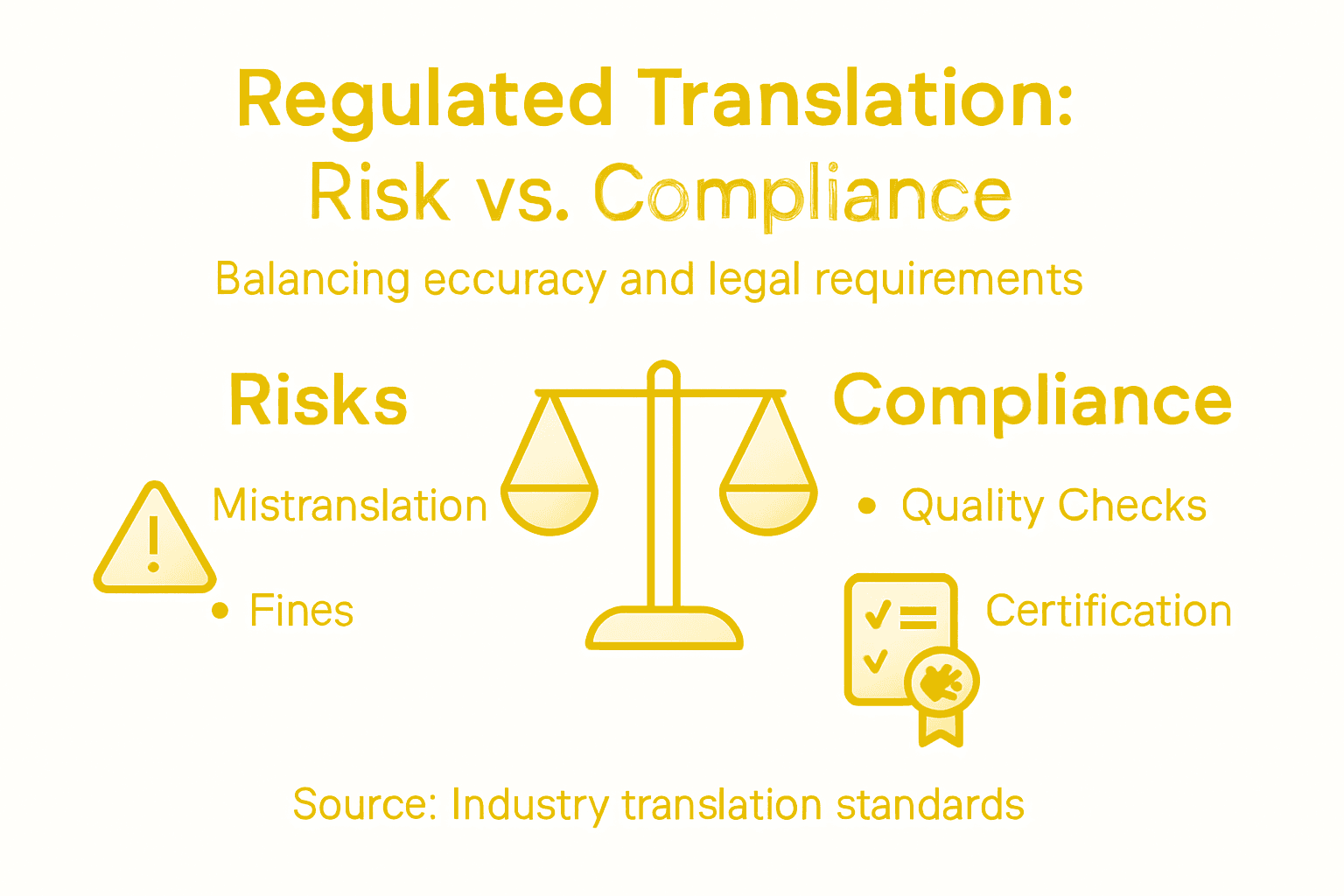
Imprecise translation is not merely a linguistic error—it represents a significant legal and operational risk for organizations operating in regulated industries. Legal risks in machine translation reveal potential consequences that extend far beyond simple miscommunication.
The primary risks of imprecise translation include:
Legal Consequences
Potential contract invalidation
Regulatory non-compliance penalties
Intellectual property misinterpretation
International litigation exposure
Operational Risks
Product safety documentation errors
Medical instruction mistranslations
Technical specification misunderstandings
Critical information distortion
Risk management strategies demonstrate that systematic translation validation is crucial. Organizations must implement robust verification processes that go beyond automated solutions, integrating human expertise to mitigate potential risks.
The AD VERBUM approach addresses these risks through a comprehensive AI+HUMAN workflow that combines technological precision with expert human validation, ensuring translations maintain absolute accuracy and compliance across multiple regulatory frameworks.
Pro Tip: Develop a multi-stage translation verification protocol that includes linguistic, technical, and legal review to systematically minimize translation-related risks.
Elevate Your Regulated Translations With AD VERBUM’s Precision AI+HUMAN Workflow
The article highlights the critical risks and compliance challenges organizations face when managing regulated translations in highly sensitive industries such as Pharmaceuticals, Legal, and Medical Devices. Precision in terminology, contextual accuracy, and absolute data security are non-negotiable to avoid costly liabilities or regulatory penalties. Key pain points include avoiding imprecise machine-generated errors, preventing data leakage, and ensuring strict adherence to industry-specific compliance frameworks like GDPR and MDR.
AD VERBUM directly addresses these challenges through its proprietary LLM-based AI+HUMAN translation ecosystem. Unlike standard public NMT or legacy MT tools, our technology enforces your approved terminology throughout every project while safeguarding your sensitive content within an ISO 27001 certified private cloud hosted solely on EU servers. Our network of over 3,500 subject matter experts meticulously reviews every translation to ensure full regulatory compliance and unparalleled contextual fidelity. This unique combination of advanced AI and expert human oversight delivers consistent, error-free, and rapid results for life-critical documentation.
Explore how to transform your regulated translation risks into guaranteed compliance solutions with AD VERBUM’s Specialized AI Translation. Discover the advantages of our AI+HUMAN workflow built exclusively for high-stakes industries. Safeguard your enterprise today by partnering with a leader that sets the standard in secure, precise, and compliant language services.
Frequently Asked Questions
What is precision in regulated translation?
Precision in regulated translation refers to the accurate transfer of meaning while preserving cultural nuances in highly regulated industries such as pharmaceuticals and legal services. It ensures compliance with industry standards and maintains the integrity of original documents.
Why is compliance critical in regulated translation?
Compliance is critical in regulated translation to ensure that all translated documents meet legal and regulatory requirements. Non-compliance can lead to legal consequences, financial penalties, and potential harm to public safety, especially in sectors like healthcare and legal services.
How does the AI+HUMAN workflow improve translation accuracy?
The AI+HUMAN workflow enhances translation accuracy by combining rapid machine translation with expert human review. AI processes large volumes of text efficiently, while human experts validate context, cultural nuances, and compliance, ensuring the highest levels of precision.
What are the risks of imprecise translation in regulated industries?
Imprecise translation poses significant risks, including legal consequences like contract invalidation and regulatory non-compliance, as well as operational risks such as errors in product safety documentation and technical specifications. These risks underscore the importance of rigorous translation verification processes.
Recommended
