Avoid audit failures: why NATOTerm is essential in NATO procurement
- Apr 2
- 8 min read

A single unauthorized term buried in an otherwise flawless procurement document can trigger a full NSQAO audit failure. Not a warning. Not a minor finding. A rejection that forces re-tender, corrective action, and in some cases, contractual penalties. NATO policy requires use of NATO-agreed terminology from NATOTerm in all NATO documents, including procurement documentation. For compliance officers and AQAP documentation managers at EU defense primes, this is not an abstract risk. It is a daily operational reality. This article explains what NSO-authorised terminology is, how audit failures happen, and what concrete steps you can take to prevent them.
Table of Contents
Key Takeaways
Point | Details |
NATOTerm is mandatory | All NATO procurement terminology must align with NATOTerm to pass audit. |
Terminology errors are costly | A single unauthorized term can trigger audit failure and contract risks. |
LSPs must validate terms | Language service providers are responsible for verifying all terminology against the official NATOTerm database. |
Audit-proofing needs process | Systematic QA and checks are essential to ensure fully compliant documentation. |
What is NSO-authorised terminology, and why does it matter?
The NATO Standardization Office (NSO) is the body responsible for managing NATO’s terminology program. It maintains NATOTerm, the only recognized database of NATO-agreed terms, definitions, and abbreviations. Every term in NATOTerm has been formally reviewed, approved, and assigned a status. If a term does not appear there with an approved status, it is not authorized for use in NATO procurement documentation, regardless of how linguistically accurate or technically precise it may seem.
The compliance chain works like this: a NATO contract references specific STANAG standards and quality requirements. Those quality requirements are governed by AQAP standards such as AQAP 2110, which are NATO quality assurance requirements that supplement ISO 9001. AQAP 2110 in particular applies to the design, development, and production of defense products and services, and it demands a documented, traceable quality management system. Terminology consistency is a direct audit checkpoint within that system. When a document uses a term that is linguistically equivalent but not NSO-authorised, it breaks the traceability chain. That is the root cause of most terminology-related audit failures.
The NATOTerm legal framework is not optional guidance. It is the normative reference. Auditors do not evaluate intent. They evaluate conformance.
“Linguistically correct” and “NSO-authorised” are not the same thing. A synonym, a regional variant, or a translated equivalent that has not been formally approved by the NSO is an unauthorized term, and unauthorized terms fail audits.
Core compliance pillars for terminology in NATO procurement documents:
Single source of truth. NATOTerm is the only recognized reference. No other glossary, style guide, or internal term base overrides it.
Status awareness. Terms in NATOTerm carry statuses such as agreed, promulgated, or under review. Only agreed and promulgated terms are audit-safe.
Definition fidelity. Term definitions must match NATOTerm exactly. Paraphrasing a definition, even accurately, creates a non-conformance.
AQAP 2110 compliance documentation. The audit trail must show that terminology was validated against NATOTerm at each QA checkpoint.
Language-specific validation. NATOTerm contains terms in multiple languages. Each language version must be validated independently, not inferred from the English source.
How unauthorized terminology triggers audit failures
Understanding the audit workflow helps you see exactly where terminology errors surface and why they are so damaging. NSQAO audits for procurement documentation typically follow a structured review process. Knowing each step lets you intercept problems before an auditor does.
Document intake and scope confirmation. The auditor identifies which STANAG references and AQAP requirements apply to the contract package.
Terminology screening. Documents are cross-checked against the current NATOTerm snapshot, either manually by a qualified reviewer or through automated QA tooling configured with NATOTerm data.
Non-conformance flagging. Any term that does not match an approved NATOTerm entry is flagged. This includes terms that are close synonyms, outdated approved terms that have since been revised, and translated equivalents without formal NSO approval.
Corrective action request (CAR) issuance. Each flagged term generates a CAR. Depending on the contract terms, multiple CARs can result in tender rejection or suspension of the contract.
Re-audit scheduling. After corrective action, the document set must be re-submitted and re-audited, adding weeks or months to the procurement timeline.
For defense LSPs, NATOTerm access is non-negotiable to avoid audit non-conformances under AQAP and NSO rules. The practical consequences extend beyond the immediate audit. Repeat audit cycles erode delivery timelines. Rejected tenders mean lost contract value. And in some cases, AQAP-related translation faults can expose the prime contractor to financial penalties under the original contract terms.

The most dangerous scenario is one that compliance teams rarely anticipate: a document that was compliant at the time of drafting becomes non-compliant because NATOTerm was updated and a previously approved term was revised or withdrawn. This is why point-in-time validation is not enough.
Pro Tip: Before submitting any procurement document package, validate all terminology against the current NATOTerm snapshot, not the version used during drafting. NATOTerm is a living database, and terminology errors in contracts often trace back to stale reference data.
NATOTerm access: The cornerstone of compliance for defense LSPs
For a language service provider working on NATO procurement documentation, NATOTerm access is not a nice-to-have capability. It is a baseline requirement. The NATO Standardization Office manages NATOTerm and the broader NATO terminology program, with access available via the NATOTerm portal. Every QA checkpoint in a compliant LSP workflow must reference this database directly.
The practical challenge is that NATOTerm contains thousands of entries across multiple languages and domains. Navigating it efficiently requires trained terminology managers who understand both the database structure and the AQAP audit requirements. An LSP that relies on general translation memory or internal glossaries without cross-referencing NATOTerm is operating outside the compliance boundary, regardless of how experienced its linguists are.
When a required term is not found in NATOTerm, the correct path is not to use the closest available equivalent. New terms require a formal proposal process submitted through the NATO Terminology Office (NTO). This process involves drafting a compliant definition, ensuring consistency with existing approved terms, and submitting via the official channel at terminology@nso.nato.int. Until a proposed term receives approved status, it cannot be used in audit-sensitive documentation.
Scenario | Compliant approach | Non-compliant approach |
Term exists in NATOTerm | Direct lookup and adoption | Using internal glossary equivalent |
Term not in NATOTerm | Formal NTO proposal submission | Using closest synonym or translation |
Term definition differs | Match NATOTerm definition exactly | Paraphrasing for clarity |
Term status is “under review” | Escalate and flag for QA hold | Treating it as approved |
NATOTerm-driven process for contract readiness:
Map all technical terms in the source document before translation begins.
Cross-reference each term against the current NATOTerm snapshot.
Flag any term not found in NATOTerm and initiate NTO proposal if needed.
Lock approved terms into the project Term Base before LLM-based generation begins.
Validate all target-language outputs against language-specific NATOTerm entries.
Document each validation step for the localization compliance oversight audit trail.
Review defense LSP requirements carefully before selecting a language partner for any STANAG-referenced contract.
Building audit-proof NATO procurement docs: Key steps and checklists
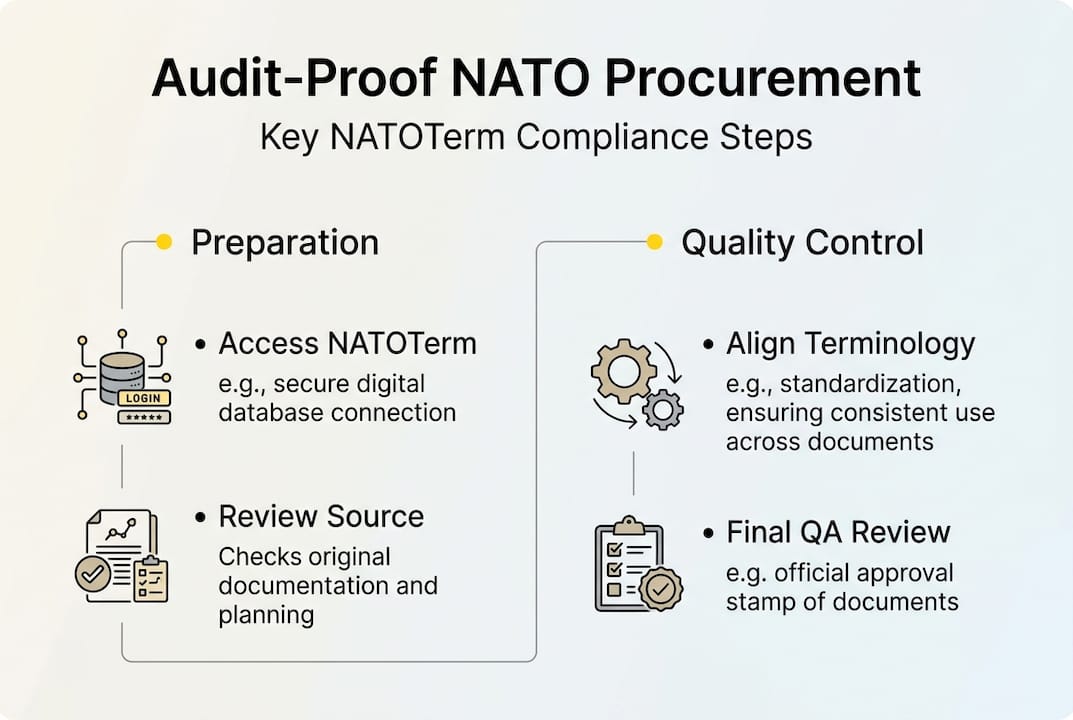
With NATOTerm access established and your LSP workflow aligned, the next layer is the document-level QA process. Every procurement document that references a STANAG or falls under AQAP 2110 scope needs a structured, recorded validation sequence.
QA step | Responsible party | Documentation required |
Source document terminology review | Terminology manager | Term extraction report |
NATOTerm cross-check | LSP QA lead | Validation log with term status |
Non-conformance resolution | Terminology manager + NTO | CAR record or NTO submission receipt |
Target-language validation | Subject-matter expert linguist | Bilingual term review sign-off |
Final QA sign-off | QA manager | ISO 17100-aligned QA certificate |
Checking documents against NATOTerm, proposing changes via terminology@nso.nato.int, and ensuring QA includes consistency with existing terms, one-sentence definitions, and no abbreviations in definitions are the three non-negotiable mechanics of a compliant process.
Essential checklist for audit-ready NATO procurement documentation:
Scope confirmation. Identify all STANAG references and applicable AQAP requirements at project start.
Term extraction. Extract all domain-specific terms from source documents before any translation work begins.
NATOTerm validation. Confirm each term’s approved status in the current NATOTerm database.
Definition matching. Verify that definitions used in the document match NATOTerm entries word for word.
Abbreviation check. Confirm no abbreviations appear inside term definitions, per NATOTerm QA rules.
Audit trail documentation. Record every validation step with timestamps, responsible parties, and NATOTerm version referenced.
Final cross-check. Run a full document scan before submission to catch any terms introduced during revision cycles.
Pro Tip: For large document sets, configure your QA tooling to automate NATOTerm matching at the segment level. Manual checks alone are not scalable across multi-volume procurement packages. Addressing the contract language challenges early in the project lifecycle saves significant rework cost downstream.
Our take: The untold cost of ignoring terminology discipline
Here is something the industry rarely says out loud: most terminology audit failures are not caused by ignorance. They are caused by process shortcuts that teams rationalize as acceptable risk. The assumption is that a near-equivalent term, or a term that was approved in a previous contract cycle, will pass again. It often does not.
We have seen EU defense primes in Germany, Poland, and Italy absorb significant re-tender costs because a handful of non-authorized terms appeared in contract packages that were otherwise technically sound. The financial exposure was not from the translation itself. It was from the downstream audit cycle, the legal review, and the reputational cost of a failed tender. That is not a translation problem. It is a governance problem.
The uncomfortable truth is that even sophisticated QA technology cannot compensate for a lax terminology process. Automation catches what it is configured to catch. If your Term Base is not anchored to the current NATOTerm snapshot, your automated checks are validating against the wrong reference. Cross-border audit risks compound this further when multi-language packages are involved.
Terminology discipline is not administrative overhead. It is competitive security. Primes that treat NATOTerm compliance as a core delivery standard win bids, pass audits on first submission, and build the kind of documented quality history that NSQAO auditors recognize.
Need help making your NATO documentation audit-proof?
AD VERBUM works with EU defense primes and their LSP supply chains to ensure 100% NATOTerm-aligned terminology across all NATO procurement documentation. Our AI+HUMAN hybrid workflow begins with client Term Base and Translation Memory ingestion, locks approved NATOTerm entries before any generation step, and delivers subject-matter expert review aligned to ISO 17100, ISO 18587, and AQAP 2110 quality requirements.

With ISO 27001-certified, EU-hosted infrastructure and a network of 3,500+ defense-specialized linguists, we provide the audit trail documentation that NSQAO compliance requires. If your organization needs an audit-readiness review of existing procurement documentation or a compliant localization workflow for an upcoming tender, explore our NATO localization services or connect with our defense translation expertise team directly.
Frequently asked questions
What happens if there is one unauthorized term in a NATO procurement document?
Even a single non-NSO-authorised term can trigger documentation audit failure, requiring costly corrective action and re-submission. NATO policy requires use of NATO-agreed terminology from NATOTerm in all NATO documents without exception.
How do you check if a term is authorized for NATO documents?
Cross-check the term directly in NATOTerm via the NSO portal. The NATO Standardization Office manages NATOTerm, and only entries with approved or promulgated status are considered audit-compliant.
Who is responsible for proposing new terminology if not found in NATOTerm?
The LSP or localization lead must formally propose new terms through the NATO Terminology Office. New terms require a formal proposal process via the NTO before they can be used in audit-sensitive documentation.
Are abbreviations allowed in NATO procurement document definitions?
No. Abbreviations are not permitted inside term definitions for NATO documents, per NATOTerm QA guidance. NATOTerm QA rules require one-sentence definitions with no abbreviations embedded in the definition text.
Can automated tools help enforce terminology compliance for audits?
Yes, QA tools configured with current NATOTerm data can automate term-level cross-checks across large document sets. However, automation only works when the underlying Term Base is anchored to the latest approved NATOTerm snapshot, and process discipline from trained terminology managers remains essential.
Recommended