


memoQ Server vs Cloud for Regulated US Translation Data

memoQ Server and memoQ cloud differ mainly in who hosts and operates the system. memoQ now sells both under the name memoQ TMS. In public cloud, memoQ runs the instance. In a hosted private deployment, the customer holds the license and memoQ runs the server. On-premises, the customer runs everything. Regulated teams should choose by data control, administrative access and audit needs.
Table of Contents
What is the direct answer for a US team with regulated documents?
Choose on-premises or private hosted deployment when the organization must control the server, the encryption keys or the network boundary. Choose public cloud when the team is small, needs fast setup and accepts a multi-tenant service. The decision rests on three controls: access control, audit trail and backup ownership.

The rest of this reference defines each option, lists the steps to decide, and names common failure modes. Statements about memoQ come from memoQ documentation. Statements about AD VERBUM come from company-provided information.
What do memoQ Server, memoQ cloud and memoQ TMS mean?
memoQ’s team products, including memoQ server, were collectively transformed into memoQ TMS, a customizable system for managing localization workflows and terminology. The word “server” therefore usually refers to a deployment model of memoQ TMS, not a separate product.
memoQ’s terms describe three delivery models:
Public cloud (SaaS). memoQ operates the instance for the customer’s exclusive use.
Private cloud (hosted). The customer owns the server license and controls the TMS. memoQ operates the dedicated virtual machine.
On-premises. The customer installs and operates the system in its own or controlled infrastructure.
In memoQ’s product naming, memoQ TMS cloud is a compact offering for smaller teams. Private cloud is aimed at enterprises and larger localization teams.
What is in scope here?
This text covers hosting, administration, security, backup and cost. It applies to document types such as clinical and device documentation, contracts, financial disclosures and technical manuals. It does not cover translator-side desktop licensing or a comparison with other CAT tools.
How do hosting and administration differ?
In the hosted model, the customer owns the server license and controls memoQ Server. memoQ operates and monitors the server computer and intervenes during downtime. Software updates are not automatic.
The hosting service runs the customer-licensed server on a dedicated Azure server managed by memoQ IT Services. Hosting support covers infrastructure. Server software support requires a valid, paid Support and Maintenance Agreement (SMA).
In public and private cloud, memoQ installs and maintains the instance. To change something on a cloud instance, the customer contacts memoQ support. In public cloud, users can restart or back up the TMS in their my memoQ account.
On-premises, the customer’s IT team owns installation, patching, monitoring and recovery. This gives the most control and the most workload.
Which features and admin controls differ?
A 2019 memoQ guide states that the then-current memoQ Cloud excluded Enterprise License Management, Terminal server support, Content Connectors, Folder Connections and Active Directory Integration. Plan contents have changed since 2019, so confirm the current feature list for each plan with memoQ before committing.
Across deployments, Server Administrator lets administrators manage users and groups and configure Windows single sign-on. The Resource Console shares and publishes resources such as translation memories and term bases.
The public-cloud plans are Starter, Essential, Professional and Premium. Starter has a 14-day free trial with one Project Manager and five Linguist licenses.
memoQ also offers implementation, migration assistance, integrations, workflow automation, technology audits, training and custom development. Machine-translation plugins and Git and file-system connectors are listed there too, with availability varying by plan or deployment.
How do security, data location and backups compare?
The 2019 memoQ data protection guide describes the model as follows. The cloud is multi-tenant and encrypts the whole virtual machine with one key. Hosted servers use dedicated virtual machines and separate file-system keys. On-premises, data separation can be configured and BitLocker enabled. memoQ conducts daily backups for cloud and hosted deployments.
These statements date from 2019. Request current security documentation, data center region and sub-processor details from memoQ before a regulated project starts.
Criterion | Public cloud | Private cloud (hosted) | On-premises |
Operator | memoQ | memoQ operates, customer holds license | Customer |
Tenancy | Multi-tenant per 2019 guide | Dedicated VM | Customer’s own infrastructure |
Backups | Daily by memoQ; users can back up in my memoQ | Daily by memoQ | Customer’s responsibility |
Updates | Handled by memoQ | Not automatic | Customer schedules |
Config changes | Through memoQ support | Customer controls TMS | Customer |
Typical fit | Small or ad hoc teams | Teams wanting dedicated managed servers | IT-capable organizations, off-site prohibited |
The fit row follows memoQ’s own positioning: cloud for smaller or ad hoc teams, hosted for dedicated managed Azure servers, and on-premises for organizations with IT expertise or policies against off-site deployment.
What does each option cost?
memoQ lists the Starter tier at €2,750 ($3,025) per year when billed annually. It includes one Project Manager license and five Linguist licenses. A 2024 memoQ offer document lists Starter at €185 per month billed annually or €199 per month billed monthly, with 10 GB storage and 24/7 support. The same document lists Essential from €750 per month billed annually, with up to five Project Manager licenses and 20 GB of public-cloud storage.
Professional and Enterprise plans start at 5 and 10 Project Manager licenses. Pricing is by personalized quote. Prices change, so confirm them on the memoQ pricing page.
Support costs differ by license type. Support and maintenance are included in an active subscription. SMA applies to perpetual licenses, which memoQ says it no longer offers. Customers using hosting must hold a valid, paid SMA.
On-premises adds infrastructure cost. For memoQ TMS 12.6, memoQ specifies 64-bit Windows Server (2016 required, 2022 or newer recommended), 16 GB RAM, SQL Server 2016 or newer, .NET Framework 4.8 or newer and 50 to 100 GB of data storage. For more than 10 users it recommends 32 GB or more of RAM. For heavy workloads or more than 20 users it recommends SSD or SAS storage in RAID-1 or RAID-5 with 1 TB or more. Add staff time, licensing for Windows Server and SQL Server, and a DNS name for internet access.
What steps should a regulated team follow to choose?
Classify the data. Owner: compliance or regulatory affairs. Control: a written data classification for each document type, such as patient data, trade secrets or privileged legal material.
Map obligations. Owner: legal and the security officer. Control: a list of contractual, HIPAA, GDPR or sector requirements that limit hosting location or processors. Mark unverified legal readings [VERIFY] until counsel confirms.
Define the access model. Owner: IT security. Control: single sign-on, user and group roles, and a review cycle for access rights.
Define audit evidence. Owner: quality manager. Control: an audit trail of who changed which translation memory, term base or project, and the QA records required by the quality system.
Assign backup and recovery. Owner: IT operations. Control: documented backup frequency, restore test and recovery time target.
Estimate team size and growth. Owner: localization manager. Control: counts of Project Managers, linguists and projects, compared with plan limits and storage caps.
Run a pilot. Owner: localization manager. Control: a trial on non-sensitive content, such as the Starter 14-day trial, before any regulated content moves.
Record the decision. Owner: procurement. Control: a vendor file with documentation received, approval date and review date.
What decision criteria separate the options?
Control of the server and keys. On-premises gives the most. Hosted gives a dedicated VM. Public cloud gives the least.
IT capacity. On-premises needs staff for patching, monitoring and restore tests. Cloud shifts that to memoQ.
Speed of setup. Cloud is fastest. A trial exists for the Starter plan.
Change flexibility. Cloud configuration changes go through memoQ support. Self-hosted changes are immediate.
Integration needs. Active Directory integration, connectors and custom code vary by plan and deployment. Verify each one in writing.
Team size. Small teams fit Starter or Essential. Larger teams need Professional, Premium or private cloud.
Cost profile. Cloud is a recurring subscription. On-premises adds hardware and staff costs.
What do real-world examples look like?
The following are illustrative scenarios, not case studies.
Scenario 1: a five-person marketing localization team. Content is non-sensitive and the team has no server staff. Public cloud Starter fits the team size and timeline. The control to keep is user role review.
Scenario 2: a US medical device manufacturer. Labeling and technical files include confidential design data. The security officer requires a dedicated environment and key separation. A hosted private cloud or on-premises deployment fits better. The control to keep is an audit trail tied to quality records.
Scenario 3: a law firm with privileged documents. Client contracts forbid third-party processors without approval. On-premises, or hosted deployment after written client consent, fits. The control to keep is access control by matter.

Scenario 4: a bank with an internal IT team. Policy prohibits off-site systems. On-premises is the only acceptable model. The control to keep is a tested restore procedure, because the bank owns backups.
What failure modes occur, and how are they mitigated?
Failure mode | Cause | Mitigation |
Storage cap reached in cloud | Projects and translation memories exceed plan storage | Track usage against the plan limit; archive finished projects. memoQ publishes guidance on storage limits |
Missing feature after purchase | Assumed Active Directory or connector support | Confirm each integration in writing for the exact plan |
Unpatched hosted server | Updates are not automatic in hosted model | Assign an owner and schedule for update requests |
Support gap | SMA lapsed on a hosted perpetual license | Track SMA status and renewal dates |
Failed restore | Backups never tested on-premises | Run scheduled restore tests and log results |
Over-broad access | Linguist accounts keep rights after projects end | Quarterly access review and group-based roles |
Outdated security assumptions | Reliance on 2019 documentation | Request current security documents from the vendor |
What is our perspective on the choice?
The hosting model is only one layer of risk. The translation workflow around it matters as much. Terminology governance, reviewer qualification and an auditable process decide whether a regulated document is defensible. Teams often spend months on server selection and little on who reviews the output.
We work in regulated sectors, so we treat data location, access control and traceable review as requirements from the start. We combine AI+HUMAN hybrid translation with subject-matter experts and work inside the client’s translation memories and term bases. A memoQ environment, whichever model the client chooses, is one more system to govern.
— Eric Brown
Where does AD VERBUM fit?
AD VERBUM is a language service provider with 25+ years of experience. It runs a proprietary LangOps System on EU-hosted infrastructure and uses AI+HUMAN hybrid translation with subject-matter experts in 150+ languages. It holds ISO 9001, 17100, 18587, 13485, 27001 and 42001 certifications, audited by Bureau Veritas. It integrates client translation memories and term bases, so a team can keep its own memoQ environment and outsource the language work.
See the AD VERBUM services for translation, localization and documentation.
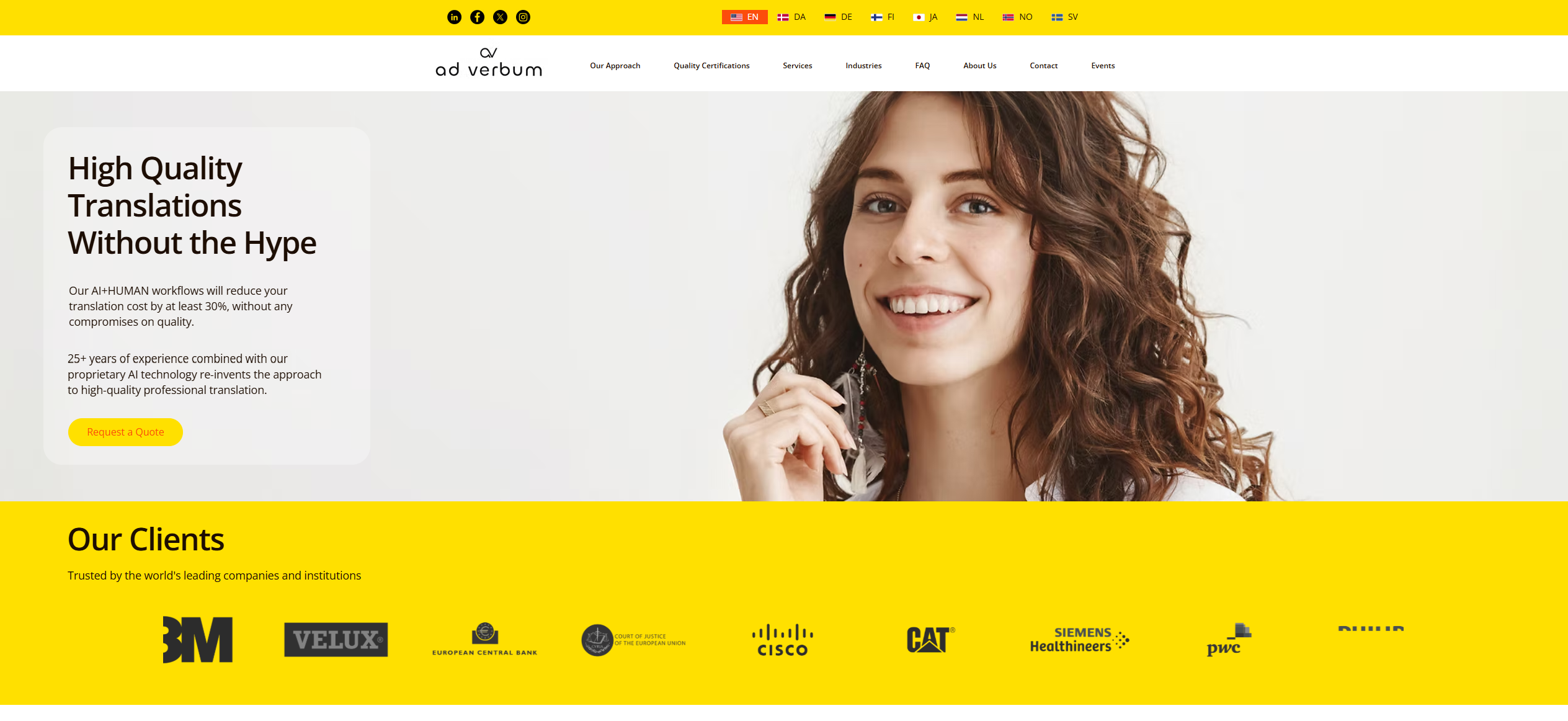
Teams that need regulated content translated without operating a server can scope a project with AD VERBUM. Pricing is by quote, per word, page or project scope. The AD VERBUM home page describes the approach and the sectors served.
Frequently asked questions
Is memoQ Server the same as memoQ TMS?
memoQ’s team solutions, including memoQ server, were consolidated into memoQ TMS. The name server now describes a deployment model: hosted or on-premises. Public cloud, private cloud and on-premises are all offered under memoQ TMS.
Who manages updates in each model?
In public and private cloud, memoQ installs and maintains the instance. In the hosted model, memoQ operates the server, but software updates are not automatic. On-premises, the customer’s IT team schedules and applies updates.
What does memoQ cloud cost?
memoQ lists the Starter plan at €2,750 ($3,025) per year when billed annually. Other plans are by quote. Confirm current figures on the memoQ pricing page.
Can regulated content go into public cloud?
It depends on the data category and the obligations that apply, such as HIPAA, GDPR or client contracts. Counsel and the security officer must confirm [VERIFY]. A multi-tenant cloud is the weakest fit when data separation or key control is required.
Key points
memoQ Server is now a deployment model of memoQ TMS.
Public cloud is operated by memoQ; private cloud is license-owned and memoQ-operated; on-premises is customer-operated.
Cloud configuration changes go through memoQ support.
Hosted servers do not update automatically.
Starter costs €2,750 ($3,025) per year billed annually; other plans are by quote.
On-premises needs Windows Server, SQL Server and staff for backup and restore.
Security documentation cited here dates from 2019 and needs current confirmation.
Classify data first, then choose the hosting model.
Sources