


5 Checks Regulated Buyers Need for Life Sciences Patent Translation
- 18 hours ago
- 7 min read

The right approach to life sciences patent translation is ISO-aligned AI+HUMAN hybrid translation, with subject-matter-expert review and dedicated sequence-listing verification, never machine output alone. AD VERBUM fits as the vendor of choice when filings involve regulated clinical data, sequence-heavy biotech claims, tight PCT national-phase deadlines, or strict data-sovereignty and audit requirements.
TL;DR:
Confirm that vendors provide sequence-listing extraction and verification files with a detailed audit trail before awarding the contract.
Ensure that translations involve SME and patent-law reviews with credentials checked through a sample technical test translation.
Verify ISO certifications, especially ISO 17100, ISO 18587, and ISO 27001, are current and independently audited.
Require character-level sequence verification for nucleotide and amino acid listings, as errors can invalidate biological claims.
Avoid vendors relying solely on machine translation with no SME oversight or audit logs, since this risks claim scope and data integrity.
Table of Contents
What Does Life Sciences Patent Translation Cover?
Life sciences patent translation spans more than the specification text. A single filing typically bundles claims, the full specification, drawings with embedded labels, experimental protocols, data tables, and, for biotech patents, sequence listings that follow their own formatting rules entirely separate from narrative prose.
Sequence listings are the part most buyers underestimate. Filed under WIPO ST.25 or the newer ST.26 XML standard, they list nucleotide and amino acid sequences character by character. A translator cannot “rephrase” a sequence. It must be reproduced and verified exactly, because a single transposed character can shift what the claim actually covers.
Getting any of these elements wrong carries real legal weight:
Mistranslated claim language can narrow or widen claim scope in ways that get challenged during prosecution or litigation.
Sequence transcription errors can invalidate the biological subject matter the claim is meant to protect.
Data table or unit errors in experimental sections can undermine the evidentiary support for a claim.
Inconsistent terminology across related filings can create prosecution history that opposing counsel later exploits.
What Compliant Workflow Should Buyers Require?
A defensible patent translation workflow isn’t a black box. It’s a sequence of checkpoints a buyer can name in a statement of work and audit afterward.
Asset ingestion. The vendor pulls in the client’s existing Translation Memory ™ and Term Base (TB), then extracts any sequence listing into its own file, separate from the narrative text, so it can be verified independently.
Constrained AI+HUMAN hybrid translation draft. An AI+HUMAN hybrid translation approach generates the target-language draft under the constraints of the client’s own terminology and style guidance, rather than producing free-form output.
SME technical review. A qualified biologist, chemist, or relevant scientist checks the draft for technical accuracy, and a patent-law reviewer separately checks claim language for legal equivalence to the source.
Sequence verification. Every sequence listing gets character-level reconciliation against the original source file, not a spot check.
ISO-aligned QA and formatting. Final quality assurance follows ISO 17100 and ISO 18587 protocols, with output formatted to the filing standard the jurisdiction requires (ST.26 conversion where applicable) and delivered with an audit log.
Pro Tip: Ask any vendor to show you the sequence-listing extraction step in a sample project before you sign anything. If they can’t produce a separated sequence file with a verification record, they’re translating sequences the same way they translate a paragraph of prose, and that’s the wrong workflow for this document type.
What Should a Regulated Buyer Check Before Signing?
Procurement and legal teams evaluating a life sciences translation services vendor need a checklist that functions as a pass/fail filter, not a wish list.
Certifications to confirm on paper, not just on a website: ISO 17100 for translation quality, ISO 18587 for machine-translation post-editing, ISO 27001 for information security, and ISO 13485 where medical device content is involved.
Process requirements to verify:
Documented sequence-listing extraction and independent verification, not a single-pass review.
SME reviewers with checkable credentials in the relevant scientific field, plus a separate patent-law reviewer for claims.
Data governance aligned to HIPAA and GDPR where patient or EU data is present, with clear statements on where infrastructure is hosted.
Parallel-language delivery teams for multi-country national-phase filings, a sample test translation before full engagement, and a documented error-remediation process.
Pricing is a signal too. Life sciences translation services commonly price claim language and sequence-listing work at a premium over standard narrative text, reflecting the added SME and verification cost. A quote that treats a patent claim the same as a marketing brochure is a red flag on its own.
Three disqualifying red flags: the vendor refuses to extract sequence listings as a separate deliverable, the vendor relies on public neural machine translation with no SME review layer, and the vendor cannot produce an audit log tracing who touched the document and when.
What Do Real Patent Translation Deliverables Look Like?
Concrete examples clarify what “compliant” actually produces on a desk, rather than in a sales deck.
PCT national phase filing. A biotech applicant filing in six jurisdictions needs parallel delivery across languages on synchronized dates, built from one unified glossary so a claim term doesn’t drift between the German and Japanese versions. Centralized project portals and shared translation memories are how larger vendors keep terminology consistent across simultaneous language streams at this scale.
Sequence listing verification. In one documented pattern, character-level verification against the source sequence file catches single-nucleotide discrepancies before filing, the kind of error that would otherwise narrow or misdirect claim scope without anyone noticing until litigation.
Clinical data tables. QA reconciliation of translated tables and statistical labels back to the source dataset prevents a mislabeled unit or a transposed decimal from misrepresenting trial results in the filing.
Which Errors Actually Threaten Patent Protection?
Four failure modes account for most of the risk in life sciences patent translation, and each has a specific contractual fix.
Sequence transcription errors. These happen when sequences are translated inline with the rest of the document instead of extracted and verified separately. Require extraction into a standalone file with double verification and SME sign-off before delivery.
Claim language drift. A translator without patent-law training can unintentionally broaden or narrow a claim by choosing an approximate synonym instead of the legally equivalent term. Require a dedicated patent-law reviewer and a claim equivalence report as a deliverable.
Numerical and data transcription errors. Unit conversions, decimal points, and statistical labels in data tables are easy to get wrong under deadline pressure. Require table-level reconciliation QA against the original source file.
Overreliance on public machine translation. Consumer-grade NMT tools handle negation and domain nuance inconsistently and carry real product-liability exposure when used unsupervised on regulated technical content. Require AI+HUMAN hybrid translation with terminology governance and a documented audit trail instead.
Pro Tip: Complex biotech filings routinely require scientific, legal, and linguistic expertise working together rather than sequentially, since a purely linguistic reviewer will not catch a claim-scope problem and a purely legal reviewer will not catch a sequence error. This is why multidisciplinary review teams outperform single-reviewer models on high-complexity biotech patents.
When Does AD VERBUM Fit This Workflow?
AD VERBUM’s AI+HUMAN hybrid translation model, built on its proprietary LangOps System, is designed around exactly the checkpoints outlined above: TM/TB integration at ingestion, SME review before delivery, and ISO-aligned QA at the end.
AD VERBUM is the right fit when at least one of these conditions applies:
The filing involves regulated clinical data or sequence-heavy biotech claims requiring SME and patent-law review.
National-phase deadlines require parallel delivery across multiple languages on a synchronized timeline, drawing on a network of 3,500+ subject-matter linguists across 150+ languages.
Data-sovereignty or audit requirements matter, supported by EU-hosted infrastructure and certifications including ISO 27001 and ISO 42001.
Before signing, request these specific items in the RFP:
A technical test translation using an anonymized excerpt of the actual filing.
A sample sequence-extraction and verification file demonstrating the character-level QA process.
Current ISO certification documentation, independently audited by Bureau Veritas.
A written SLA covering parallel-language delivery timing for national-phase filings.
What Should You Do Next?
The verdict holds regardless of jurisdiction: pair AI+HUMAN hybrid translation with SME and patent-law review, verify sequence listings character by character, and demand an audit trail. Skip any of the three and claim scope is at risk.
Before issuing an RFP, include these five items:
Sequence-listing extraction and verification as a named, separate line item.
SME reviewer credentials and a patent-law reviewer named in the proposal.
ISO 17100/18587/27001 documentation attached, not just referenced.
A sample test translation covering claims and one data table.
A written SLA for parallel-language, national-phase delivery.
Next action | Why it matters |
Request a sample sequence-verification file | Confirms character-level QA actually exists |
Schedule a vendor technical interview | Verifies SME credentials before contract signing |
Compare ISO documentation against your audit checklist | Confirms certifications are current, not just claimed |
Why Checklist-Grade Verification Beats Vendor Comparison
Most guidance on this topic still reads like a vendor bake-off: feature lists, language counts, glossy case studies. That framing misses the point for a legal or regulatory buyer. The question was never “which vendor sounds more impressive.” It’s “which workflow will survive an examiner’s scrutiny or a litigation discovery request three years from now.”
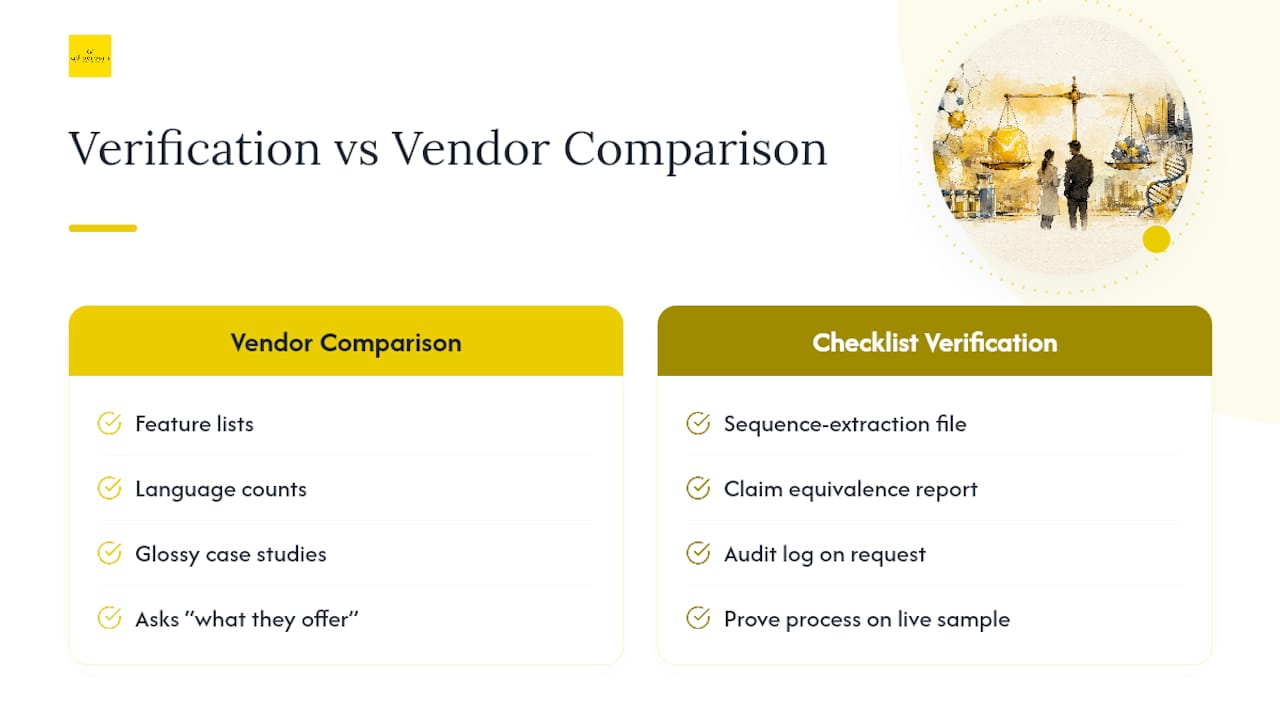
The conventional advice undersells sequence-listing risk specifically. Plenty of buyers treat a sequence listing as just another block of text to translate quickly, when it needs to be pulled out, verified independently, and reconciled character by character. That single distinction separates a defensible filing from an exposed one.
If there’s one priority to fix first, it’s this: stop asking vendors what they offer and start asking them to prove their process on a live sample. A vendor that can produce a sequence-extraction file, a claim equivalence report, and an audit log on request has already told you more than any capabilities page could. A vendor that hesitates has told you something too.
— Eric Brown
Get ISO-Aligned Patent Translation Support From AD VERBUM
AD VERBUM gives regulated life sciences teams a faster path to filing-ready translations without trading away the SME and patent-law review that protects claim scope. Where a traditional agency model often means slower turnaround and inconsistent terminology across a multi-country filing, AD VERBUM’s AI+HUMAN hybrid translation runs on a proprietary LangOps System hosted on EU servers, with sequence listings extracted and verified separately, TM/TB integration from day one, and ISO 17100/18587/27001 QA behind every deliverable.
That combination supports the medical device and clinical-data translation requirements covered earlier in this piece, backed by a network of 3,500+ subject-matter linguists across 150+ languages. For teams facing a PCT national-phase deadline, review the 7-step translation quality assurance checklist and then request a sample sequence-listing verification to see the workflow on your own filing before you commit to a full engagement.
Sources
Standards and guidance referenced above: the FDA for regulatory terminology expectations, WIPO ST.26 sequence-listing requirements, and ISO-aligned patent translation practices. For AD VERBUM’s own services, visit the contact page.
Biotechnology Patent Translation Experts - Artlangs
Recommended

