ISO 13485 Translation: Compliance Rules and Validated Workflows

Under ISO 13485, translated quality documents are controlled records, not casual language swaps. They must come from a validated, auditable workflow that a Notified Body or FDA auditor can trace step by step. Skip that discipline and a mistranslated label instruction becomes a nonconformity, or worse, a field safety issue.
Before reading further, check these five things against your current process:
Document control assigned to every translated language version, not just the source.
A qualified, monitored translation supplier with records on file.
Documented evidence that the translation process itself was validated.
Active governance of translation memories ™ and term bases (TB).
Subject-matter expert (SME) review for any safety-critical text.
Key Takeaways
Compliant ISO 13485 translation depends on a validated, documented workflow with supplier qualification and SME review, not simply linguistic fluency.
Point | Details |
Translation is a controlled document | ISO 13485 governs translation through document control (4.2.4/4.2.5), supplier management (7.4), and process validation (7.5.6). |
Risk determines review depth | IFUs, labels, and warnings need SME and back-translation review; administrative content needs lighter review. |
Supplier files must survive audits | Retain translator qualifications, SLAs, and review records; the manufacturer stays responsible even when outsourcing. |
Change control spans every language | A source update must propagate to all validated versions, with logged approvals for each. |
AD VERBUM aligns to the framework | Its AI+HUMAN hybrid workflow pairs LLM generation with certified SME review and QA aligned to ISO 17100 and ISO 18587. |
Table of Contents
What Does ISO 13485 Translation Actually Cover?
ISO 13485:2016 has no clause titled “translation requirements.” Instead, translation obligations flow from document control (clauses 4.2.4 and 4.2.5), supplier management (clause 7.4), and process validation (clause 7.5.6), because a mistranslated instruction for use carries the same safety weight as a mistranslated original. Translation is a controlled document activity, and each language version needs the same rigor as the source file, per the ISO 13485:2016 standard entry.
The scope varies by document type and audience:
Instructions for use (IFUs) and labels: written for lay users and clinicians, both requiring exact terminology.
Quality manuals and SOPs: internal, but still subject to version control across languages.
Risk management records and training materials: read by auditors and staff, requiring traceable accuracy.
Which Documents Need the Tightest Translation Controls?
Not every document carries equal risk, so controls should scale with what a mistake could cost.
IFUs and product labels. These reach patients and clinicians directly. A translation error here can cause misuse, injury, or a regulatory recall. Regulators scrutinize these files first during a review.
Risk management records (ISO 14971 files). Translated risk analyses must preserve exact hazard descriptions. A softened or ambiguous phrase can undermine the entire risk file’s defensibility.
SOPs and manufacturing protocols. Multi-site manufacturers running production in several languages need process steps that read identically in intent across every version, or line workers interpret instructions differently.
CAPA records and training materials. These need traceability more than polish. Auditors want to see that a corrective action, once translated, was understood and applied the same way at every site.
What Is the Validated Translation Workflow for ISO 13485 Documents?
A compliant workflow is repeatable, documented, and produces evidence at every step, not just a finished translated file.
Asset integration. Pull the client’s existing TM and TB into the project before any drafting starts, so approved terminology carries forward automatically.
Terminology governance. Lock in device-specific vocabulary (dosage terms, warning language, anatomical references) before translation begins, avoiding drift between document versions.
AI+HUMAN hybrid or human translation. Generate the draft using a constrained, terminology-aware process, never an unconstrained public engine for regulated text.
Linguistic review. A second qualified linguist checks grammar, register, and terminology consistency against the TB.
SME and regulatory review. A subject-matter expert, ideally with clinical or engineering background, confirms technical and regulatory accuracy.
Approval and release under change control. The final version gets signed off and entered into the document control system with a version number and audit trail.
This sequence maps directly onto document control (4.2.4/4.2.5), supplier control (7.4), and process validation (7.5.6). A documented translation procedure such as SYS-052 illustrates the structure auditors expect: defined roles, forms, and records for every language output.
Pro Tip: Treat your TM and TB as regulated assets, not convenience tools. If a translator can bypass the term base, you have no terminology control at all.
Apply a risk-based approach to depth of review. Warnings, contraindications, and dosage instructions warrant back-translation and SME clinical review, while lower-risk administrative content can move through standard linguistic review alone.
When AI-assisted tools enter the process, data governance matters as much as linguistic accuracy. Confirm where the tool hosts data, who can access project files, and whether the platform generates audit logs. A validated process integrating TM/TB before generation is a baseline expectation, not an advanced feature.
How Do You Qualify and Monitor Translation Suppliers?
Outsourcing translation does not transfer responsibility. Under ISO 13485, the manufacturer remains accountable for the accuracy of every translated document, which means supplier qualification records need to survive an audit on their own.
Qualification criteria to document:
Relevant certifications: ISO 17100 for translation services and ISO 18587 for machine-translation post-editing.
Individual translator credentials, including subject-matter background in medical or engineering fields.
Evidence of a validated internal process, not just a completed job history.
Data security certifications (ISO 27001 or equivalent) when sensitive design or clinical data changes hands.
Contracts should specify SLAs, change-control procedures, and a right-to-audit clause. Keep translator qualification files and review records on hand, because a common audit finding is missing evidence that an SME actually reviewed safety-critical text. Monitor suppliers ongoing with defined KPIs, periodic sampling of delivered translations, and scheduled audits rather than a one-time approval.
How Do You Manage Version Control Across Multilingual Documents?
A source-document change has to propagate into every validated language version, with each update logged and re-approved before release.
Trigger a formal change request the moment the source document changes, listing every affected language.
Use a translation management system (TMS) to reuse approved segments, flag outdated ones, and notify reviewers automatically.
Log distribution of the updated document to every site or market that uses it.
Retain approval signatures and dates for each language version, not just the source.
A TMS earns its place here because it prevents the most common gap: a source update that reaches English readers but never gets pushed to the Japanese or German version.
What Translation Errors Cause ISO 13485 Nonconformities?
Translation failures tend to repeat across a small set of patterns, and most trace back to a missing control rather than a one-off mistake.
Mistranslated warnings or dosage instructions. A softened or reversed negation (“do not exceed” rendered ambiguously) turns a safety instruction into a hazard.
Missing propagation of a source update. One language version gets revised; three others quietly stay outdated.
Unqualified ad hoc translation. A staff member with no documented qualification translates a label change to save time, leaving no review trail.
Mislabeling and translation gaps are cited among recurring contributors to labeling-related recalls in medical devices, which is why regulators treat translated labeling as high-risk content, not paperwork.
Pro Tip: When a translation error surfaces, document the CAPA the same way you would for a manufacturing defect: root cause, containment, corrective action, and verification that the fix propagated to every affected language.
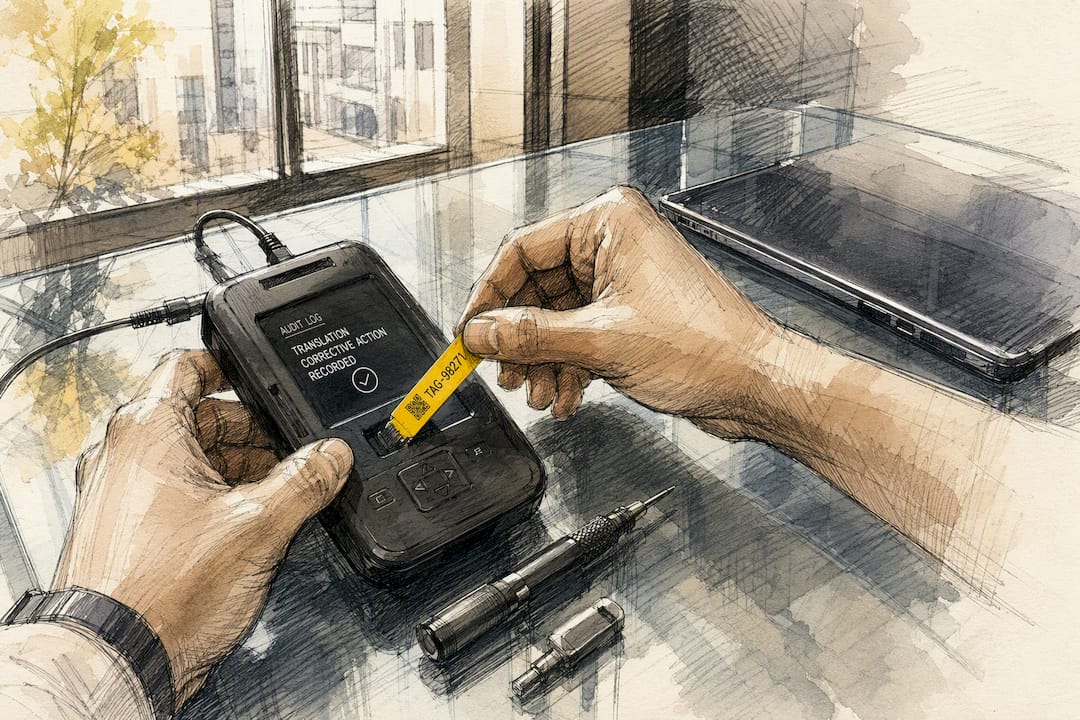
Mitigate with a risk-based review tier, back-translation for warnings and contraindications, and periodic sampling audits of lower-risk content.
What Do Validated Translation Workflows Look Like in Practice?
Two scenarios show how risk level changes the workflow without changing the underlying controls.
High-risk IFU revision: A dosage instruction changes. The update triggers SME review, full translation of all active language versions, linguistic and regulatory sign-off, and TMS propagation to every market file, with each approval logged and dated.
Low-risk administrative update: A company address change on a label. The workflow simplifies to a single linguistic review, but version numbering, distribution logs, and approval records still apply, because even minor changes are controlled documents.
Where Does AD VERBUM Fit Into This Compliance Framework?
AD VERBUM’s AI+HUMAN hybrid translation workflow maps directly onto the controls this article describes. The sequence starts with asset integration, pulling in the client’s existing TM and TB, followed by generation through AD VERBUM’s proprietary LLM-based LangOps System constrained by that terminology. A certified subject-matter expert then reviews the output for technical and regulatory accuracy, and quality assurance runs aligned to ISO 17100 and ISO 18587.
Audit-readiness in medical device translation comes down to one question: can you produce documented evidence, for every language version, that a qualified person reviewed the safety-critical text before release? That is the standard AD VERBUM’s workflow is built to satisfy.
Choose this workflow when you need:
Audit evidence generated automatically at each review stage.
EU-hosted data sovereignty for sensitive device and clinical files.
SME depth across 3,500+ subject-matter linguists, including medical professionals and engineers.
ISO-aligned QA under certifications including ISO 13485, ISO 27001, and ISO 42001.
Regulatory and quality teams evaluating a vendor can review the professional translation workflow or the technical file translation compliance guide for deeper process detail before initiating a supplier qualification review.
The Compliance Gap Most Teams Miss
Most guidance on ISO 13485 translation focuses on finding a linguist who “knows medical terminology.” That is necessary but nowhere near sufficient. The standard does not care how fluent your translator is. It cares whether you can produce a document trail showing a validated process, a qualified supplier, and an SME sign-off on the specific text that could hurt someone if it is wrong.
The gap I see most often is treating translation as a procurement decision instead of a QMS process. Companies negotiate rate per word and turnaround time, then discover during an audit that nobody can produce translator qualification records or evidence that a clinical reviewer actually looked at the dosage language. That is not a translation failure. It is a supplier control failure, and clause 7.4 makes it the manufacturer’s problem regardless of who did the actual translating.
The fix is not more scrutiny on linguistic quality. It is treating every translated document the way you already treat a validated manufacturing process: defined steps, assigned roles, retained records, and a change-control trigger that nobody can skip. Get that architecture right, and quality follows.
— Eric Brown
Get Audit-Ready Translation for Your Quality Management System
Regulatory teams choosing between a general-purpose translation vendor and a compliance-built process usually find the difference shows up during the audit, not before it. AD VERBUM’s AI+HUMAN hybrid translation runs asset integration, terminology-constrained generation, certified SME review, and ISO-aligned QA as one documented sequence, producing the exact records a Notified Body review or FDA audit asks for.
For medical device manufacturers managing IFUs, labeling, SOPs, or risk management files across multiple markets, that structure means version control and translator qualification evidence exist before an auditor requests them, not after. AD VERBUM supports 150+ languages and regional variants, with EU-hosted infrastructure aligned to GDPR, HIPAA, and MDR expectations for sensitive device data. If your current vendor cannot produce a validated process document or SME review trail on request, that is the gap worth closing first. Start a conversation about your localization requirements and request a scoped proposal for your next translation project.
Recommended