Regulated Work: Interpreting vs Translation, Audit Trails Matter
- 8 hours ago
- 7 min read

Interpreting converts spoken or signed language live, in real time. Translation converts written text into a durable, reviewable document. If you need someone in the room or on the call right now, hire an interpreter. If you need a document you can review, revise, and certify, hire a translator. Interpreters typically charge based on time, such as by the hour or day; translators typically charge based on text volume, such as by word or page.
TL;DR:
Interpreters provide live, bidirectional spoken or sign language communication, requiring real-time judgment and ephemeral delivery, often billed hourly.
Translators produce reviewable, fixed-text documents using research, drafting, and revision processes, typically billed per word or page.
Ensuring quality involves verifying certifications like ATA or ISO 17100, especially when handling regulated, high-stakes content in life sciences, legal, or defense sectors.
Using AI in regulated translation involves a hybrid workflow with subject-matter expert review, quality assurance, and compliance with standards like ISO 18587.
Mismatching service types or neglecting QA can lead to significant risks, especially in legal or medical scenarios where errors are hard to correct after delivery.
Table of Contents
Interpreting vs Translation: Definitions and Where They Overlap
Interpreting vs Translation: The Differences That Actually Matter
Interpreting Skills vs Translation Skills, and How to Vet Them
How to Decide Between Interpreting and Translation for Your Project
Get a Quote for Regulated Translation and Interpretation Work
Interpreting vs Translation: Definitions and Where They Overlap
The Bureau of Labor Statistics draws the line at medium: interpreters work with spoken or signed language, translators work with written text. That distinction sounds simple until you hit the edge cases that trip up procurement teams every day.
An interpreter converts meaning as someone speaks, with no chance to pause and consult a dictionary. A translator works from a fixed source document, with time to research terminology, draft, and revise before delivery. Both require fluency in two languages, but the working conditions could not be more different.
One hybrid case confuses almost everyone: sight translation. This is when a person reads a written document aloud in another language on the spot, without a prepared written translation. It happens constantly in courtrooms and medical intake, and it borrows skills from both professions.
Public confusion between the two terms is common enough that the National Council on Interpreting in Health Care has published guidance specifically to correct it, noting that the mix-up obscures how specialized each skill set actually is. A few corrections worth keeping straight:
“Translator” does not cover live spoken conversion, no matter how casually the word gets used at the front desk.
A bilingual staff member is not automatically a qualified interpreter or translator.
Sign language interpreting is interpreting, not translation, even though it involves no speech.
Interpreting vs Translation: The Differences That Actually Matter
Six factors separate these services in ways that affect cost, risk, and timeline.
Deliverable. Interpreting produces a live, ephemeral exchange with no fixed record unless separately recorded. Translation produces a written document you can archive, audit, and revise.
Timing. Interpreters work in the moment, with no reference materials beyond memory and prep notes. Translators work through drafting, research, and revision cycles that can span days or weeks.
Directionality. Interpreters typically work bidirectionally within a single session, moving between two languages as the conversation shifts. Translators usually work one direction per assignment, converting into their strongest target language.
Tools. Interpreters rely on booths, headsets, or phone and video platforms. Translators use CAT tools, translation memory, and term bases, plus a formal post-editing pass when AI-generated drafts are involved.
Accuracy and QA. A translated document can be checked word-for-word against the source before delivery. Spoken interpretation, once delivered, cannot be revised after the fact, which raises the stakes for live regulated encounters like court hearings or medical consults.
Billing and turnaround. Interpreters charge by the hour or half day, often with minimums. Translators charge by the word or page, with turnaround set by document length and revision passes.
Interpretation Modes and Delivery Formats Explained
Interpreting splits into five working modes, each suited to a different setting.
Simultaneous: real-time rendering as the speaker talks, used at conferences and multilingual broadcasts, almost always requiring booth equipment.
Consecutive: the speaker pauses, the interpreter renders the segment, then the conversation resumes, common in depositions and small meetings.
Whispered (chuchotage): a quiet, real-time rendering delivered directly to one or two listeners without equipment.
Liaison: informal back-and-forth interpreting for small group or one-on-one settings, such as a factory tour or business negotiation.
Sight translation: oral rendering of a written document on the spot, bridging the two disciplines.
Delivery format adds another layer: on-site, over-the-phone (OPI), video remote (VRI), and remote simultaneous interpretation (RSI) each trade off audio quality, scheduling flexibility, and cost. AI-driven live interpretation tools are emerging but remain far less mature than AI text translation, carrying distinct risk patterns around latency and misrecognition that make human oversight non-negotiable for regulated settings.
Pro Tip: For any session running longer than an hour, book two simultaneous interpreters, not one. Cognitive load in simultaneous work is severe enough that professionals commonly rotate every 20 to 30 minutes, according to the American Translators Association, and a solo interpreter past that mark starts dropping accuracy.

Interpreting Skills vs Translation Skills, and How to Vet Them
Interpreters need exceptional working memory, split-second decision-making, and polished verbal delivery. They work without dictionaries or reference material mid session. Translators need deep research skills, target-language writing craft, and the patience to revise a draft multiple times before it ships.
Tool sets diverge just as sharply:
Translators use CAT tools, translation memory, and term bases to enforce consistent terminology across long documents.
Interpreters use booths, headsets, and remote platforms, but nothing that substitutes for real-time judgment.
Both professions typically require at least a bachelor’s degree or specialized training, and the Bureau of Labor Statistics notes that many pursue formal certification on top of that.
When vetting a provider, ask what certifications they hold. ATA certification, ISO 17100 alignment, and sector-specific credentials (medical, legal, defense) signal that a provider has processes in place, not just language ability. A resume listing “fluent in Spanish” tells you nothing about QA discipline.
How to Decide Between Interpreting and Translation for Your Project
Run through this checklist before requesting a quote:
Is the need live or written? Live conversation, meeting, or hearing points to interpreting. A contract, manual, or regulatory filing points to translation.
Does the output need to be reviewable or certified? If a third party (a court, regulator, or auditor) must inspect the final text, you need a translated document, not a transcript of an interpreted exchange.
What are the regulatory stakes? Life sciences, legal, and defense content demands documented QA, not just linguistic fluency.
How complex is the dialect or terminology? Specialized domains need subject-matter expertise on top of language skill.
What’s the turnaround and budget? Interpreting is priced per hour or day; translation per word or page, with rush fees for compressed timelines.
Red flags to walk away from: a provider who can’t name the interpreting mode they’ll use, who has no domain experience in your sector, or who can’t describe a QA step beyond “a second person reads it.”
Two Real Scenarios: Where Each Service Gets Used
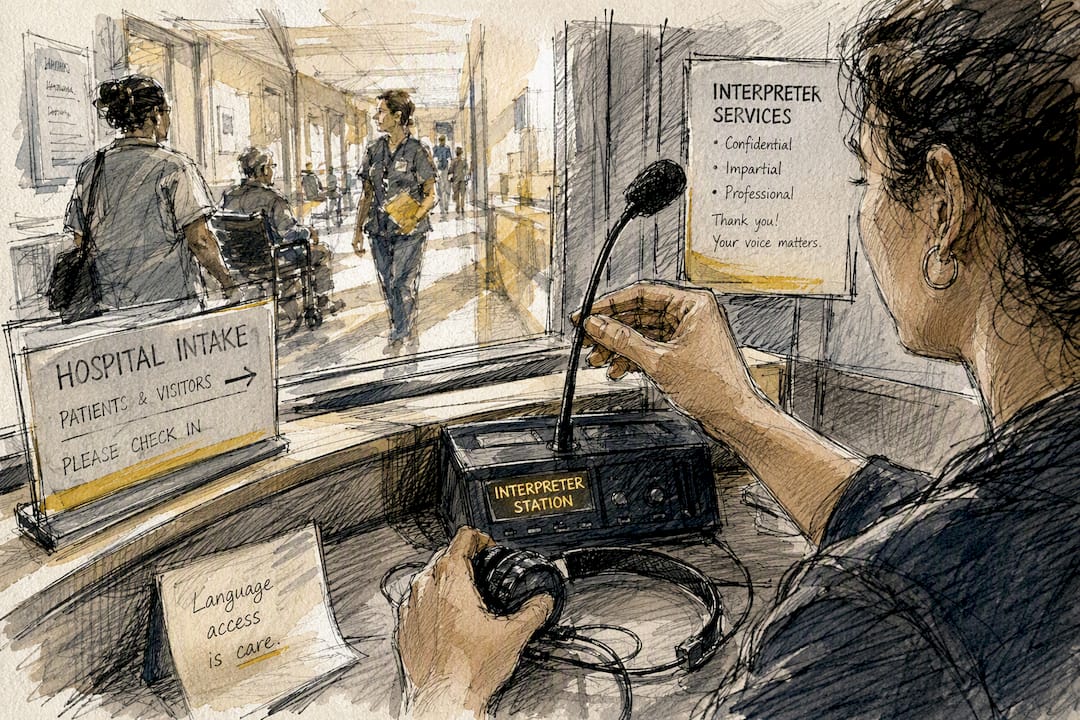
A hospital intake desk needs a patient’s history in a language the on-call physician doesn’t speak. A certified medical interpreter, briefed beforehand on the visit type, working over VRI or on-site, is the right call. A machine app on a nurse’s phone is not, given the clinical stakes.
A pharmaceutical company needs its clinical trial protocol translated for a regulatory submission in a new market. That calls for terminology governance, ISO-aligned QA, and subject-matter expert review, not a fast machine draft.
Common failure modes and fixes:
Poor audio quality in remote interpreting. Mitigate with tested equipment and a pre-call check.
Mistranslation of negation or qualifiers in regulated text. Mitigate with SME review before final sign-off.
Missing or inconsistent terminology. Mitigate with term base enforcement from the first draft.
Where AD VERBUM Fits for Regulated Translation Work
AD VERBUM’s AI+HUMAN hybrid translation workflow runs a fixed sequence: asset integration of the client’s translation memory and term base, generation through a proprietary LLM-based system constrained by that terminology, review by a certified subject-matter expert, then QA aligned to ISO 17100 and ISO 18587.
That sequence matters most when the document carries regulatory weight:
Life sciences, legal, finance, defense, and manufacturing content where a mistranslated qualifier has real consequences.
Projects requiring audit trails, terminology consistency, and data sovereignty (AD VERBUM’s infrastructure is EU-hosted, aligned to GDPR, HIPAA, and MDR).
Work needing certifications beyond translation quality alone: ISO 9001, ISO 13485, ISO 27001, ISO 42001, and AQAP 2110 for defense-sector clients.
AD VERBUM supports 150+ languages, including regional variants, with a network of 3,500+ subject-matter expert linguists reviewing AI-generated output before it ships.
An Editorial Take on Matching Risk to the Right Service
The mistake I see most often isn’t confusing the two terms. It’s treating both as commodity language work priced by speed alone. A live interpreting error at a court hearing and a mistranslated dosage instruction in a drug insert carry the same category of risk: no undo button once the words are out. The fix isn’t more caution across the board, it’s matching QA investment to the actual stakes of the document or conversation in front of you. Regulated content earns terminology governance and SME review every time; a casual internal memo does not. See the author bio for credentials.
— Eric Brown
Get a Quote for Regulated Translation and Interpretation Work
If your documents touch life sciences, legal, finance, defense, or manufacturing, generic bilingual staff or unreviewed AI output is not a defensible workflow. AD VERBUM pairs a proprietary LLM-based system with certified subject-matter expert review and QA aligned to ISO 17100 and ISO 18587, so regulated content gets both speed and an audit trail.

Beyond document translation, AD VERBUM also handles interpretation staffing, multilingual SEO, and localization for teams expanding into new markets. Explore the full range of services or, if your priority right now is multilingual content and search visibility, check the multilingual SEO and LLMO page. Request a quote to get a turnaround estimate and a certification checklist matched to your sector.
Sources
Interpreters and translators : Occupational Outlook Handbook : U.S. Bureau of Labor Statistics
Translator vs. Interpreter: What’s the difference? - American Translators Association (ATA)
What’s in a Word? Overview — National Council on Interpreting in Health Care (NCIHC)
Interpretation vs translation: what’s the difference — Blog | InterMIND
Recommended