


AI+Human Compliance Processes for Regulated-Document Localization
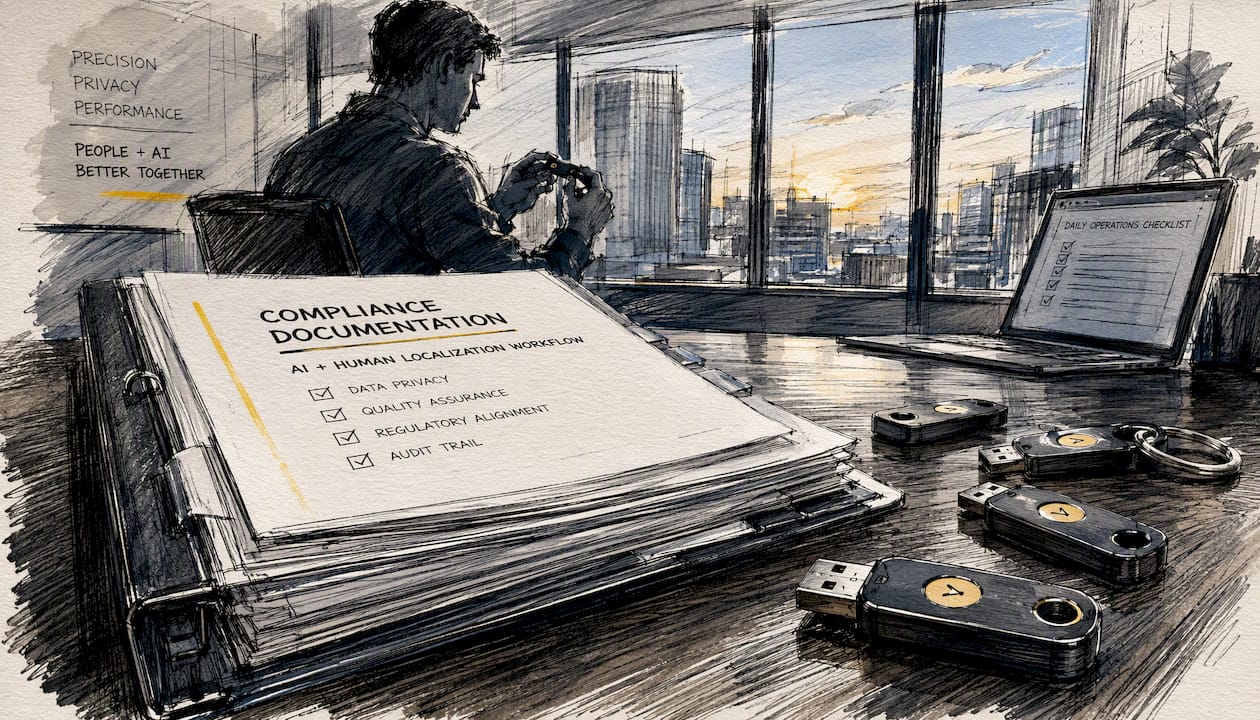
The compliant AI+HUMAN hybrid translation workflow for regulated documents runs in four locked steps: ingest client Translation Memories ™ and Term Bases (TB), generate target-language output through a proprietary LLM constrained by that terminology, route every segment to a certified subject-matter expert (SME) post-editor, then close with QA aligned to ISO 17100 and ISO 18587 before releasing any deliverable. Every step must produce a traceable artifact.
Quick controls summary:
Data residency: source documents and TM/TB assets must remain on controlled, auditable infrastructure; EU-hosted private servers satisfy GDPR and many HIPAA-aligned data processing agreements.
Post-editor competences: reviewers must meet the competency profile defined in ISO 18587, including domain knowledge and the ability to judge when full retranslation is safer than editing.
Audit artifacts: versioned TM/TB snapshots, pre/post-edit diffs, reviewer IDs, QA reports, and access logs must be retained and producible on demand.
Use AI+HUMAN hybrid translation when volume, speed, or cost pressure is real and the content risk level permits certified SME oversight to close the gap. Retain a pure human translate-revise workflow under ISO 17100 for the highest-risk document classes — safety-critical device labeling, primary regulatory submissions — where a single mistranslation carries direct patient or legal consequence.
Key Takeaways
A compliant AI+HUMAN hybrid translation workflow requires locked TM/TB assets, a proprietary LLM with terminology enforcement, certified SME full post-editing, and a complete artifact set delivered with every project.
Point | Details |
Lock assets before generation | Version-stamp and write-lock TM/TB at intake; hash the snapshot to prove constraints were in place before the LLM ran. |
Full PE is the default for regulated content | ISO 18587 defines full and light post-editing levels; safety-critical and legal documents require full PE with documented SME credentials. |
Audit artifacts are non-negotiable | Require pre/post-edit diffs, reviewer IDs, QA reports, and access logs in every contract; missing artifacts are the most common audit finding. |
Data residency must be contractual | Specify EU-hosted or jurisdiction-specific infrastructure in writing; a BAA or DPA must cover every storage environment touching protected data. |
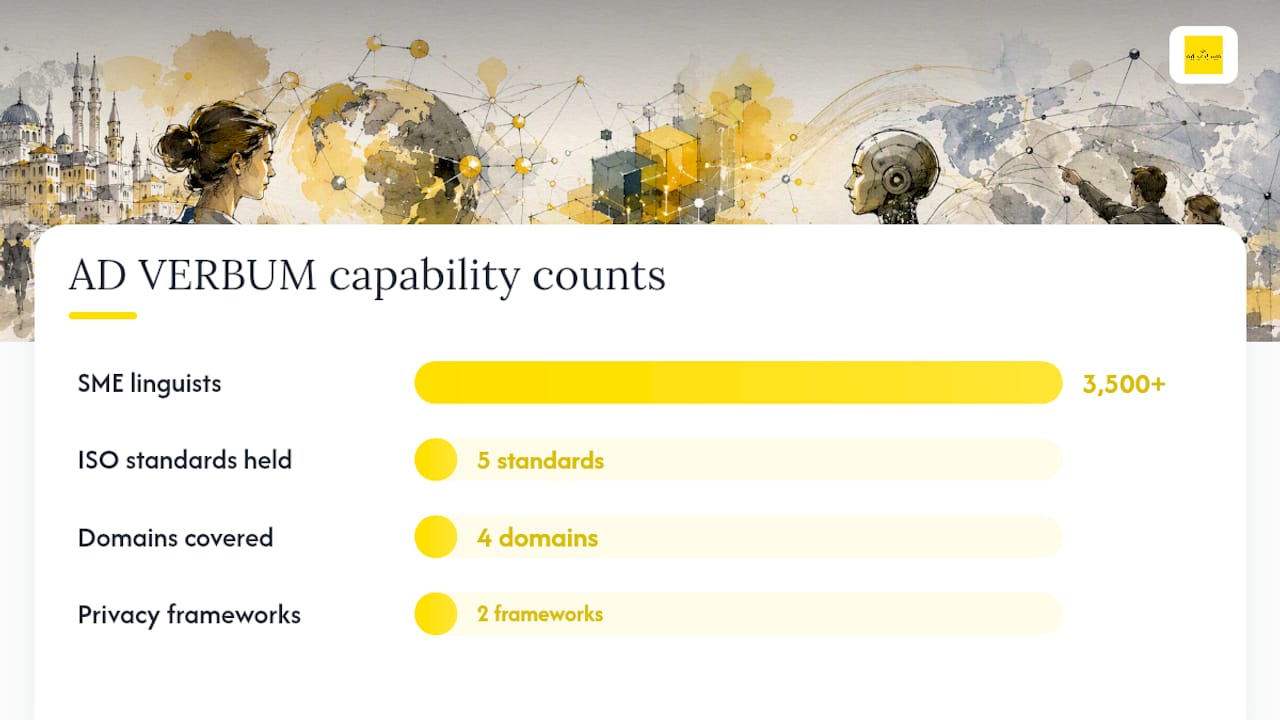
AD VERBUM for regulated engagements | AD VERBUM holds ISO 17100, ISO 18587, ISO 13485, ISO 27001, and ISO 42001, audited by Bureau Veritas, with EU-hosted LLMs and 3,500+ SME linguists. |
Table of Contents
What “AI+HUMAN hybrid translation” actually means for regulated documents
How to run a compliant AI+HUMAN translation workflow step by step
What decision criteria and controls compliance leads must require
Common failure modes in regulated AI+HUMAN workflows and how to prevent them
Authoritative standards and guidance for procurement and audit teams
What “AI+HUMAN hybrid translation” actually means for regulated documents
AI+HUMAN hybrid translation is a production workflow in which a proprietary LLM generates a draft translation constrained by client-supplied terminology assets, and a certified human post-editor reviews every segment before the output is accepted. It is not raw machine translation (MT), which produces literal output with weak context handling and a higher rate of critical-meaning errors in safety-critical text. It is also not standard neural machine translation (NMT) run through a public SaaS engine, where terminology control is inconsistent and governance documentation is typically absent.
The scope of this guide is narrow by design: it covers translation and localization workflows only — TM/TB ingestion, proprietary LLM generation, SME review, and ISO-aligned QA. Organizational AI governance (model risk management, algorithmic auditing, ethics frameworks) is a separate discipline with a different audience and is not addressed here.
The standards that set the compliance floor for these workflows are:
ISO 17100: defines core human translation processes, translator and revisor roles, and resource requirements. Raw MT output plus post-editing falls outside its scope, which is why ISO 18587 exists alongside it.
ISO 18587: sets requirements for post-editing processes, post-editor competences, MT engine management, and quality evaluation. It applies specifically to content processed by MT or LLM systems.
ISO 27001: information security management. Required for any workflow handling protected health information or confidential regulatory data.
ISO 13485: quality management for medical devices. Triggers when the document type is an IFU, labeling, or MDR submission.
GDPR / HIPAA: data processing obligations that govern where source content is stored, who can access it, how breaches are reported, and how long data is retained.
ISO 17100 and ISO 18587 are complementary; many of their requirements overlap, and agencies that hold both certifications can demonstrate capability across human and MTPE workflows in a single audit conversation.
How to run a compliant AI+HUMAN translation workflow step by step
Pre-flight: asset intake and locking. Receive client TM and TB files. Version-stamp and write-lock both assets before any processing begins. Confirm the LLM suitability assessment for the document type — safety-critical content may require a full human workflow instead.
LLM generation. Run the proprietary LLM with client TM/TB as hard constraints. The system must enforce terminology at the segment level and log every generation parameter. No public cloud routing of source content.
SME post-editing. A certified subject-matter expert reviews every segment against the source. Per ISO 18587, the post-editor must have documented domain competence and must assess whether editing or full retranslation is appropriate for each segment. Full post-editing (not light PE) is the default for regulated content.
QA and revision. Run automated QA checks (terminology consistency, tag integrity, number fidelity) followed by a human QA pass. Document all changes with timestamps and reviewer IDs.
Delivery and artifact packaging. Release the target file alongside the complete artifact set: versioned TM/TB snapshots, pre/post-edit diffs, QA report, access log, and reviewer credentials.
Pro Tip: Lock TM/TB assets with an immutable snapshot at intake, not after generation. If a terminology dispute arises during audit, you need to prove the constraints were in place before the LLM ran, not after. Store snapshots in a write-once location with a cryptographic hash.
For a detailed walkthrough of this sequence applied to a live compliance project, see AD VERBUM’s AI+HUMAN translation process tutorial.
What decision criteria and controls compliance leads must require
Not every document type warrants the same workflow. The table below maps content risk to workflow choice and required controls.
Document risk category | Recommended workflow | Required controls |
Safety-critical device labeling, primary regulatory submissions | Full human (ISO 17100) or AI+HUMAN with mandatory full PE | ISO 13485, dual-reviewer sign-off, immutable audit trail |
Clinical study reports, legal contracts, compliance policies | AI+HUMAN full post-editing | ISO 18587 full PE, SME domain credential, QA report |
Regulatory correspondence, SDS sheets, technical manuals | AI+HUMAN full post-editing | ISO 18587, terminology lock, change log |
Marketing, training materials, internal communications | AI+HUMAN light PE acceptable | Terminology check, single-reviewer sign-off |
Mandatory contractual and data processing clauses to require from any vendor:
Data residency: specify the jurisdiction and physical hosting location for all source content and TM/TB assets.
Encryption: at-rest and in-transit encryption standards, with key management documentation.
Subprocessor disclosure: full list of any third-party services that touch source content.
Breach notification: timeline (typically 72 hours for GDPR, prompt notification for HIPAA) and escalation contacts.
Right to audit: contractual right to inspect QA records, access logs, and reviewer credentials on request.
Retention and deletion: document retention periods tied to regulatory requirements, with confirmed deletion procedures.
For vendor selection criteria and RFP language, this procurement guide covers the pass/fail items audit teams most commonly request.
Two regulatory scenarios that show the workflow in practice
Scenario A: Medical device IFU for MDR submission
A pharma-device manufacturer needs Instructions for Use translated into 12 EU languages for a CE marking submission. ISO 13485 applies. The workflow triggers full post-editing by a linguist with documented medical device domain credentials. Every segment change is logged with a timestamp and reviewer ID. The artifact package delivered to the notified body includes: versioned TM/TB snapshots, pre/post-edit diffs per language, a QA report with error categorization, and access logs showing no unauthorized data egress. Retention period: minimum 10 years per MDR Article 10(8).
Scenario B: Financial compliance policy localization across five jurisdictions
A global bank needs its AML policy localized into five languages for local regulatory filing. Light PE is not acceptable here — policy language carries legal weight. Full post-editing by a certified legal-financial linguist is required. Terminology governance is the central control: the TB locks terms like “beneficial owner,” “suspicious activity,” and jurisdiction-specific regulatory body names. QA metrics tracked: zero critical errors, terminology consistency rate verified against the locked TB. The deliverable package includes the QA report, reviewer credentials, and a change log for each locale. For cross-border data transfer considerations in multi-jurisdiction workflows, see AD VERBUM’s foreign entity legal document translation guide.
Common failure modes in regulated AI+HUMAN workflows and how to prevent them
Failure mode | Cause | Detection signal | Mitigation | Verification step |
Terminology drift | TB not locked before LLM run | Inconsistent term usage across segments | Write-lock TB at intake; enforce at segment level | Post-QA terminology consistency report |
Critical-meaning error | Light PE applied to high-risk content | Auditor flags semantic deviation | Require full PE for all regulated content; retranslate flagged segments | Dual-reviewer sign-off on safety-critical segments |
Data leak | Source content routed through public cloud | Unauthorized access log entry | Require private, EU-hosted infrastructure; contractual subprocessor ban | Access log audit at project close |
Audit gap | Missing or incomplete artifact set | Auditor cannot reconstruct review chain | Define artifact checklist in contract; automate artifact packaging at delivery | Pre-delivery artifact completeness check |
Post-editor qualification gap | Reviewer lacks domain credential | QA errors cluster in domain-specific terminology | Require ISO 18587-aligned competency documentation per reviewer | Credential verification at project kickoff |
Acceptance criteria — when a deliverable is unacceptable:
Any critical-meaning error in a safety-critical segment.
Terminology consistency rate below the contracted threshold.
Missing reviewer ID or timestamp on any segment change.
Artifact set incomplete at delivery.
Corrective action: quarantine the deliverable, issue a non-conformance record, retranslate affected segments under full human review, and update the QA report before re-release. For translation compliance for technical documents, TM/TB governance is the single most common audit finding.
When to choose AD VERBUM for AI+HUMAN compliant translation
Decision conditions where AD VERBUM is the appropriate choice:
Regulated content requiring ISO 17100, ISO 18587, ISO 13485, or ISO 27001 certification from the vendor.
Projects where EU-hosted data processing is a contractual or regulatory requirement.
Engagements requiring SME post-editors with documented domain credentials (medical, legal, financial, defense).
High-volume projects where significantly faster turnaround compared to traditional workflows is operationally necessary.
Defense or NATO-adjacent work requiring AQAP2110 quality assurance.
Decision criterion | AD VERBUM proof |
Held; independently audited by Bureau Veritas | |
ISO 13485 (medical devices / MDR) | Held |
ISO 27001 information security | Held |
ISO 42001 (AI use and safety) | Held |
EU-hosted private LLM infrastructure | Proprietary LangOps System on EU servers; no public cloud routing |
SME post-editor network | 3,500+ subject-matter expert linguists across medical, legal, financial, and defense domains |
GDPR and HIPAA alignment | Documented; see AD VERBUM’s regulated-industries compliance guide |
Caveat: For primary regulatory submissions where a notified body or regulator requires a fully human translate-revise workflow with no AI involvement, or where your legal counsel requires independent legal review of translated contracts, AD VERBUM can provide ISO 17100-aligned human workflows. Confirm the workflow type in writing before project kickoff.
What artifacts a vendor must deliver for a compliance audit
Audit artifact checklist:
Versioned TM/TB snapshots (write-locked, with cryptographic hash and intake timestamp).
Pre/post-edit diffs per segment, with reviewer ID and timestamp.
QA report (see structure below).
Access log showing who accessed source content, when, and from which system.
Encryption log confirming at-rest and in-transit encryption for all data transfers.
Reviewer credential documentation (ISO 18587 competency profile or equivalent).
Sample QA report mandatory fields:
Field | Content |
Source document ID | Unique identifier and version |
Target language and variant | e.g., French (Canada) |
Post-editing level | Full or light, with justification |
Reviewer ID and credential | Name, certification, domain |
Error log | Category, segment reference, severity, resolution |
Terminology consistency rate | Percentage of segments matching locked TB |
Final acceptance sign-off | Reviewer ID, date, timestamp |
Storage and retention: Store all artifacts in a write-once, access-controlled repository. For GDPR-covered projects, the repository must be EU-hosted. For HIPAA-covered projects, a signed Business Associate Agreement (BAA) must cover the storage environment. Retention periods follow the most stringent applicable requirement — MDR mandates 10 years for device documentation; HIPAA requires 6 years for covered records. For AI-related data protection controls relevant to cross-border workflows, this resource on AI legal services and data protection illustrates the kind of access-control and residency documentation regulators increasingly expect.
The compliance case for getting this right from the start
Compliance leads who have sat through a translation-related audit finding know the pattern: the translation itself was fine, but the artifact trail was not. No reviewer ID on a segment change, a TB that was updated mid-project without a version record, a QA report that listed categories but not resolutions. Auditors do not fail workflows because AI was involved. They fail workflows because the evidence of human oversight is missing.
The AI+HUMAN hybrid translation model, when implemented with the controls in this guide, produces a more complete audit trail than many traditional workflows do. Every LLM generation is logged. Every post-editor action is timestamped. Every terminology decision is traceable to a locked TB snapshot. The compliance argument for this model is not that AI makes it faster — it does — but that the structured handoff between system and human creates documentation that a pure human workflow often skips.
The risk is in the shortcuts: light PE on high-risk content, unlocked TBs, post-editors without documented domain credentials. Those are the failure modes auditors find. The workflow in this guide is designed to close each one before the project starts.
AD VERBUM’s compliance-ready localization service
Regulated-document localization demands more than speed. It demands a vendor whose certifications, infrastructure, and reviewer network are auditable on day one.
AD VERBUM’s AI+HUMAN hybrid translation service covers 150+ languages through a proprietary LangOps System hosted on EU servers, with zero reliance on public cloud tooling for core processing. Every project runs through a network of 3,500+ certified SME linguists and closes with QA aligned to ISO 17100, ISO 18587, and sector requirements including MDR. Certifications — ISO 9001, ISO 13485, ISO 17100, ISO 18587, ISO 27001, ISO 42001, and AQAP2110 — are independently audited by Bureau Veritas.
To start a compliance-ready engagement, request a quote or pilot through AD VERBUM’s localization services page, or contact the team directly for a custom enterprise scope.
Authoritative standards and guidance for procurement and audit teams
ISO 18587:2017 — Requirements for post-editing of machine translation output, including post-editor competences and PE level definitions. Retain as the primary standard for any MTPE or AI+HUMAN workflow.
ISO 17100:2015 — Requirements for human translation services. Use to specify translate-revise workflows for the highest-risk document classes.
ISO 17100 vs. ISO 18587 comparison — Practitioner analysis of overlapping requirements; useful for drafting RFP pass/fail criteria and understanding dual-certification value.
AD VERBUM AI+HUMAN workflow tutorial — Step-by-step process documentation with compliance controls; share with procurement teams as a vendor proof reference.
AD VERBUM regulated-industries compliance guide — Data residency, EU hosting posture, and GDPR/HIPAA alignment documentation for AI translation workflows.
AD VERBUM compliance best practices — Checklist-style guidance for audit and procurement teams; suitable for inclusion in RFP appendices.
Regulated document translation workflow guide — Procedural reference for step-by-step regulated-document workflows; useful as a downloadable checklist for project managers.
This article is general information, not a substitute for advice from a qualified lawyer. Consult a qualified legal professional about your own circumstances before acting on anything here.
Sources
Recommended
