


What Glossary Sign Off Means in Translation Governance

Glossary sign off is the formal, recorded approval of a termbase entry, complete with version number and named signatory, before that term becomes binding across a translation project. The terminology owner and the relevant domain SME must approve it, with compliance or legal review added for regulated content. If no sign-off record exists yet for a critical term in your active glossary, the next action is to create one today: assign an owner, document the approved target term, and log the approval with a date and version number.
TL;DR:
Manual sign-off is required for legal, safety-critical, regulatory, brand, and high-frequency terms to ensure compliance and auditability.
Sign-off records must include detailed metadata such as term ID, source, approved target, context, status, version, signatory, date, and rationale to be audit-ready.
Automated approval can only be used for low-risk, infrequent terms, while high-risk or frequently appearing terms need explicit manual review and approval.
Enforcing glossary compliance requires integrated TMS controls that reject deviations and mandate rationale documentation for approvals.
Establishing clear ownership, SLAs, and routine audit procedures prevents sign-off gaps and maintains a verifiable, regulatory-compliant terminology governance process.
Table of Contents
What Does Glossary Sign Off Cover in a Translation Project?
Glossary sign off applies to a specific termbase (TB) entry once it carries a recorded, dated approval tied to a version number. It is not the same as a translator’s informal preference or a style guide suggestion. It is a governance event, and it needs to be reconstructable months later if an auditor asks who approved a term and why.
A complete entry needs a defined set of metadata fields. Skipping any of them is what turns a routine terminology update into an audit finding.
Term ID: a unique, stable identifier for the entry
Source string: the exact source-language term as it appears in the content
Approved target: the sanctioned translation, per language or locale variant
Part of speech and context note: disambiguates homonyms and industry-specific usage
Status: draft, proposed, approved, deprecated, or rejected
Version: increments with every substantive change
Signatory and date: the named approver and the approval timestamp
Rationale: a short note on why this term was chosen over alternatives
Certain term categories almost always require sign-off rather than automated acceptance: regulatory claims language, legal terms of art, product and brand names, and clinical or dosage terminology. A glossary management guide covering terminology consistency in localization recommends documenting this metadata as standard practice, not an exception for difficult projects.
How Does the Glossary Approval Process Actually Work?
The workflow starts before a single term gets proposed. Ingesting the client’s existing Translation Memory ™ and Term Base (TB) comes first, so new proposals get checked against what the organization has already approved rather than duplicating or contradicting it.
Proposal. Translators, SMEs, or the terminology owner submit a candidate term with the minimum required metadata: source string, suggested target, context, and rationale. Incomplete proposals get bounced back before they enter review.
Risk-based branching. Low-risk terms (a UI button label, a generic marketing phrase) can route to automated approval if they don’t touch regulated content and don’t repeat more than a handful of times. High-risk terms (dosage instructions, contractual language, safety warnings) get routed to mandatory manual review regardless of frequency.
Review and adjudication. The domain SME and, where relevant, legal or compliance reviewers examine the term, log comments, and either approve, request changes, or reject it. Every comment and revision gets timestamped and retained.
Formal approval. The signatory records approval through a digital signature or a system-generated record, the version number increments, and the entry publishes to the live TB and TM.
Notification. Translators and reviewers working on the project get notified that the term is now active and enforced.
Audit logging. The full history, proposal, comments, approval, and publication, stays retained and exportable for later review.
Enforcement is what makes the workflow stick rather than just look good on paper. Pre-submit QA checks should flag any translated segment that deviates from an approved, enforced glossary entry, and the translation interface should highlight glossary terms inline so linguists see the approved rendering before they finalize a segment. Post-translation compliance reports then confirm the delivered file matches the approved termbase, term by term. Platforms that support this kind of inline enforcement and pre-submit blocking catch violations before delivery instead of after a client complaint.
Pro Tip: Set your risk threshold by occurrence count, not just term type. A term that appears twice in a 50,000-word manual carries different exposure than one that appears 200 times across every regional variant. Frequency changes the blast radius of a wrong sign-off.
Which Terms Require Manual Sign Off Instead of Automated Approval?
Automated approval works for genuinely low-risk terms. It fails, sometimes badly, when applied to anything a regulator, auditor, or plaintiff’s attorney might read later.
Manual sign-off should be mandatory whenever a term touches any of the following:
Legal claims or contractual language where a mistranslation shifts liability
Safety-critical instructions, including warnings, dosages, and operational limits
Regulatory or compliance terminology tied to a specific filing or submission
Product and brand names that must stay consistent across every market
Any term appearing frequently across the project, since one error compounds
A workable governance policy names at least four approver roles: the terminology owner (accountability for the entry’s lifecycle), the domain SME (technical or clinical accuracy), a compliance or legal reviewer (regulatory exposure), and the project manager (records the approval and manages the version release).
For an audit-ready record, store the signed approval with a timestamp, the version number, and a short written rationale, ideally in a system that exports the full history rather than a spreadsheet someone can quietly edit. This directly mirrors the expectations in ISO 17100:2015, which requires translation service providers to follow client terminology and complete a final verification step before delivery. AD VERBUM’s own breakdown of ISO 17100 translation standards covers how that final verification step maps onto terminology governance in practice.
What Does an Approval-Ready Glossary Entry Look Like?
A finished entry and its sign-off record are two separate documents that reference each other by version number.
Sample glossary entry:
ID: TB-0472 | Source: “adverse event” | Approved target: locale-specific clinical term | Context: pharmacovigilance reporting | Status: approved | Version: 3
Sample sign-off record:
Signed by: [Terminology Owner name] | Role: Terminology Owner | Date/time: recorded timestamp | Version: 3 | Rationale: “Aligned to regulatory filing language per legal review; supersedes v2’s colloquial rendering.”
A clinical term like the one above needs the full manual chain, SME plus legal plus terminology owner. A UI label such as “Cancel” in a settings menu can move through automated approval the same day it’s proposed, provided it carries no regulatory weight and doesn’t repeat across safety-critical screens.
Where Sign-Off Processes Break Down (and How to Fix Them)
Most failures trace back to a handful of recurring gaps, and each one has a specific, fixable cause.
Ambiguous ownership. No single person owns final sign-off, so approvals stall or get skipped entirely. Fix it with a documented RACI matrix and firm SLAs for each approval stage.
TMS enforcement gaps. The glossary exists but the translation environment doesn’t block deviations from it. Fix it with enforced glossary flags and pre-submit QA that stops a file from going out with unapproved terms.
Missing audit trail. Approvals happened, but nobody can reconstruct who signed what, when. Fix it with system-backed versioning and exportable logs rather than email threads or shared documents.
Regional variant disputes. Teams disagree on which regional rendering is correct and the disagreement resurfaces every project. Fix it with locale-specific variant entries, a documented prohibited-term list, and a named final adjudicator whose decision closes the argument.
Pro Tip: Run a quarterly spot audit on five random approved terms, not just the ones flagged in a client complaint. If you can’t reconstruct the sign-off chain for a term nobody complained about, your process has a gap you haven’t found yet.
How Does AD VERBUM’s Hybrid Workflow Support Glossary Sign Off?
AD VERBUM’s AI+HUMAN hybrid translation workflow maps directly onto the sign-off stages described above. Asset integration ingests the client’s existing TM and TB first, so the proprietary LLM-based system generates output constrained by already-approved terminology rather than guessing. A certified subject-matter expert then reviews for technical accuracy and regulatory compliance, and QA aligned to ISO 17100 and ISO 18587 closes the loop before delivery. Notably, ISO 17100 excludes raw machine translation plus post-editing from its scope, which is exactly why unmanaged MT/NMT output creates governance risk that hybrid, SME-reviewed workflows are built to avoid.

Life sciences, medical device, legal, and defense programs benefit most, given the audit trail and terminology governance requirements each sector carries. AD VERBUM’s EU-hosted LangOps System, ISO 27001 and ISO 42001 alignment, and GDPR and HIPAA posture make it a reasonable fit when a regulated program needs documented terminology governance alongside SME validation, not just fast throughput.
Five Steps to Put a Sign-Off Workflow in Place This Quarter
Glossary sign off is the recorded, versioned approval that turns a proposed term into a binding standard across every translator and every file touching your project.
Assign a single terminology owner with clear authority to approve or reject
Define the required metadata fields for every entry before proposals start
Set SLAs for proposal, review, and approval turnaround
Configure TB enforcement so unapproved terms get flagged before submission
Export and archive the audit trail on a fixed schedule, not only when requested
For enterprise implementation support, AD VERBUM’s team can walk through configuring these controls against an existing TMS.
Why Auditability Is the Part Most Teams Get Wrong
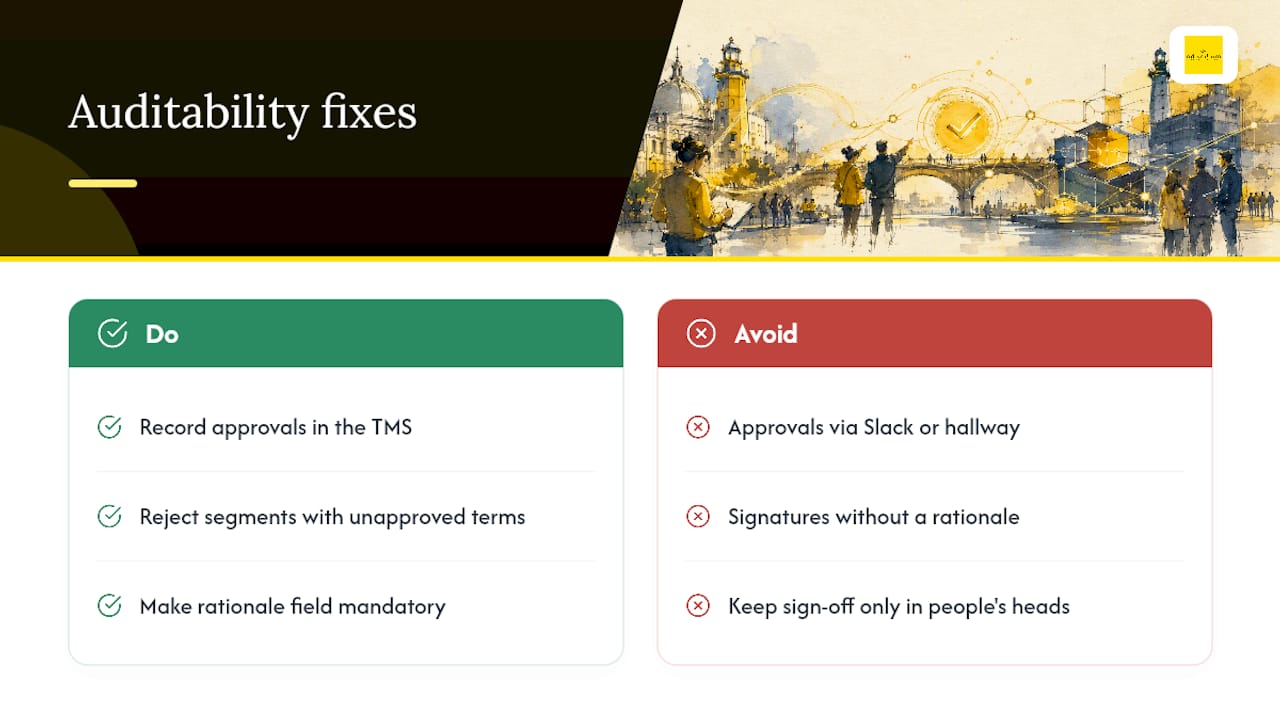
Eric Brown, writing on behalf of AD VERBUM, has watched regulated localization programs treat glossary sign-off as a documentation afterthought rather than a control. The pattern repeats: a term gets “approved” in a Slack thread or a hallway conversation, and six months later nobody can produce a record when a regulator or client audit asks for one. The lesson isn’t that teams lack diligence. It’s that they build sign-off into their heads instead of their systems.
Two adjustments fix most of it. First, make your TMS reject any segment using an unapproved variant of an enforced term, rather than relying on a linguist to remember the rule. Second, treat the rationale field as mandatory, not optional. A signature without a reason is a record you can’t defend three years later.
— Eric Brown
Get Audit-Ready Glossary Governance With AD VERBUM
AD VERBUM gives regulated teams a translation workflow where terminology governance is a built-in control, not a spreadsheet someone maintains on the side. The AI+HUMAN hybrid translation approach runs your approved TM and TB through a proprietary LLM-based LangOps System first, then routes every output through certified subject-matter expert review and QA aligned to ISO 17100 and ISO 18587, so glossary sign-off decisions actually hold up when a client or regulator asks to see the record.
If your organization is managing terminology governance across life sciences, legal, finance, defense, or manufacturing content and needs a documented, audit-capable approval trail behind every term, AD VERBUM’s localization team can walk through how the sign-off workflow integrates with your existing TMS. Request a quote to see how the process maps to your current glossary and approval requirements.
Sources
ISO 17100:2015 sets the baseline requirements for translation service processes, including terminology compliance and final verification, and is the standard most compliance teams cite when justifying sign-off policy internally. You can preview and search the standard’s contents through the ISO Online Browsing Platform before purchasing the full document for procurement or audit files.
For workflow patterns you can adapt directly, the glossary management guide on terminology consistency covers governance and approval structures in more operational detail. Teams building out legal or regulatory glossaries may also find the legislative glossary reference from OneGov useful for structuring policy-specific term definitions. AD VERBUM’s own guides on terminology enforcement workflows and QA steps for technical translation compliance go deeper into the technical controls that keep an approved glossary enforced in production.
Recommended

