


6 Step Audit Ready Playbook for Defense Teams Translating Acronyms

Consult JP 1-02 or the relevant NATO STANAG and AAP-15 glossary before translating any defense acronym. Preserve standardized, interoperability-critical abbreviations as-is, and translate only when a target-language expansion is authoritative or a publication rule requires it. Controlled documents must be sanitized under DoDM 5200.01 before translation begins, following best practices for document control and redaction detailed by AML Guard, and every decision needs a recorded citation.
Table of Contents
How Do You Translate Defense Acronyms Step by Step?
A defense acronym never gets translated on instinct. It moves through a fixed sequence, and skipping a step is how “ISR” ends up meaning three different things in the same document.
Step 1: Identify the acronym and capture context. Note the exact string, the sentence it appears in, the document type (operational order, acquisition contract, intelligence brief), and the issuing service or command. This metadata determines which glossary applies before you open a single reference.
Step 2: Check authoritative sources for the expansion. Start with JP 1-02 for U.S. joint terminology. For allied or multinational documents, cross-check NATO AAP-15 and any STANAG referenced in the document’s front matter. Service-specific glossaries fill the gap when a term is branch-specific rather than joint.
Step 3: Apply the preserve-or-translate criteria. Ask three questions: Does this acronym affect interoperability between forces? Is it a formal designation (a program name, a platform code, a NATO-standardized term)? Who is the end reader? A standardized abbreviation used across allied forces almost always stays untouched. A term aimed at a domestic, non-specialist audience with no formal designation is a translation candidate.
Step 4: Record the decision and lock the term. Enter the ruling into the Translation Memory ™ and Term Base (TB) with the source citation, the context it applies to, and the date. Locking the term prevents a different linguist from reversing the call three pages later.
Step 5: Route to subject-matter expert review. A linguist fluent in the language pair is not automatically fluent in acquisition terminology or tactical doctrine. A subject-matter expert (SME) with domain background checks whether the ruling holds up against the document’s actual technical content, not just its dictionary definition.
Step 6: Sanitize before external release. If the document contains controlled or classified information, sanitization under DoDM 5200.01 happens before the file leaves a controlled environment for translation, not after.
Identify the acronym and capture its document context.
Check JP 1-02, AAP-15, STANAGs, and service glossaries.
Apply preserve-or-translate criteria (interoperability, designation, audience).
Record the ruling in TM/TB and lock the term.
Route to SME review for domain nuance.
Sanitize controlled content before external translation or release.
Pro Tip: Build a running TB entry for every acronym the moment you resolve it, even if it only appears once. The second time it shows up, in a different document, six months later, you will not remember why you made the call, but the citation will.
When Should You Preserve an Acronym Instead of Translating It?
The default assumption in defense translation should run opposite to general technical translation: preserve first, translate only with justification. Standardized NATO and DoD designations exist specifically so that a pilot, a logistics officer, or an intelligence analyst reading the term in any allied language recognizes the same operational meaning instantly. Translating “IFF” (Identification, Friend or Foe) into a local-language equivalent in a tactical document risks a reader failing to cross-reference it against equipment manuals, radio protocols, or NATO standardization agreements that use the English form.
Four situations call for preserving the acronym exactly as written:
The acronym is a NATO-standardized designation or appears in a STANAG that specifies fixed terminology across languages.
Translating it would create an interoperability or safety risk, particularly in tactical, targeting, or emergency-procedure contexts.
It names specific equipment, a weapon system, or a formal program title (JSTARS, HIMARS) where the acronym functions as a proper noun.
The source document explicitly instructs translators to retain original-language abbreviations.
Translation becomes appropriate under narrower conditions:
The target audience is a domestic, non-specialist reader (a public affairs release, a general contracting notice) with no operational need for the original acronym.
An authoritative local-language expansion already exists in an official glossary or a prior government publication.
The publication’s own style guide or the client’s terminology governance requires localized expansion for accessibility.
When neither preservation nor a clean translation fully serves the reader, dual labeling resolves the tension: present the acronym followed by a parenthetical expansion in the target language on first use, then use the acronym alone thereafter. This is standard practice in bilingual NATO publications and works equally well in contractor-facing localization projects. Equipment names, program titles, and other proper nouns generally stay untranslated regardless of audience, the same way a company name would not be translated in a business contract.
How Do You Resolve an Acronym With Multiple Meanings?
Polysemy, the same acronym string carrying different meanings across domains, is the single biggest source of critical translation errors in defense documents. “ISR” means Intelligence, Surveillance, and Reconnaissance in an operations order and something entirely different in a logistics context if used loosely. “SOF” can mean Special Operations Forces or, in a contracting document, refer to a Statement of Facts. The string alone tells you nothing; the surrounding domain does.
A reproducible disambiguation method removes the guesswork:
Read the document metadata first. The issuing command, the document type, and the classification banner narrow the likely domain before you read a single sentence of body text.
Scan nearby terminology. An acronym surrounded by logistics vocabulary (sustainment, throughput, requisition) points toward a supply-chain meaning; one surrounded by targeting language points toward an intelligence or fires meaning.
Cross-check the authoritative source for that domain. JP 1-02 frequently lists multiple entries for the same abbreviation, each tagged to its governing context; find the entry that matches the document’s domain, not the first one that appears.
Escalate to SME sign-off when ambiguity persists. If two plausible expansions both fit the surrounding text, a subject-matter expert with operational or acquisition background makes the final call, not the linguist alone.
Document the ruling. Record the citation, the context that justified it, the date, and the reviewer’s initials in the TM/TB entry.
That last step is not paperwork for its own sake. In a regulated defense translation project, an auditor may ask why a specific acronym was expanded one way in a 2024 contract annex and a different way in a 2025 revision of the same program’s documentation. Without a dated citation trail, there is no defensible answer, and the inconsistency itself becomes the finding.
What Sanitization Steps Come Before Translation?
Sanitization, declassification, and purging are not interchangeable terms, and confusing them creates real exposure. Sanitization removes sensitive content from a document while leaving it usable for its intended (often lower-classification) purpose. Declassification changes a document’s formal classification status through an administrative review process. Purging typically refers to destroying data on media so it cannot be recovered at all. DoDM 5200.01 governs the first two; sanitization manuals covering storage-device handling govern the third, specifying methods like degaussing and physical destruction by media type.
Translators and localization teams typically only need sanitization, but they need to execute it correctly at the file level, not just the text level:
Office documents require removal of tracked changes, comments, author metadata, and hidden revision history before the file ever reaches a translation environment.
PDFs need a check for embedded layers, bookmarks, and metadata fields that survive a casual “flatten” operation.
CAD and BIM files carry the highest residual-risk profile: layered drawings can retain facility details, coordinates, or annotations invisible in the default view but present in the underlying file structure. Guidance on sanitization recommends flattening or converting these files to raster images when the underlying layers cannot be verified clean.
A secure copy of the unsanitized original should be retained under access control, separate from the sanitized version sent for translation, to support later audit or reclassification review.
Chain-of-custody controls matter as much as the technical steps. Every person who touches a controlled document, from the program office to the linguist to the QA reviewer, should be logged, and processing should occur within an environment consistent with the document’s classification and export-control status. Readers handling export-controlled material should review the specific rules around U.S.-person processing requirements before routing a document to any translation team.
The most common failure mode is not malicious. It is a well-meaning redaction that blacks out visible text in a PDF while leaving the original text selectable and extractable underneath, or a CAD layer nobody remembered to check. Guidance on document sanitization repeatedly flags residual metadata and embedded layers as the leading cause of accidental disclosure in technical files.

Pro Tip: Never sanitize and translate in the same pass. Sanitize first, verify the sanitized file independently (open it in a different tool than the one that created it), and only then hand it to the translation team. Combining the steps is how a layer or metadata field slips through unnoticed.
Worked Examples: How Are Ambiguous Acronyms Resolved?
Five short cases show the lookup process in action, from candidate expansions through the final documented ruling.
“C2” in a joint operations order. Candidate expansions: Command and Control, or in a rare civil-engineering annex, a project phase code. Domain cues: the surrounding text discusses force employment and decision authority. Source: JP 1-02 confirms Command and Control as the joint-doctrine meaning. Decision: preserve “C2” untranslated even in a non-English version, since it is a standardized designation used across allied C2 systems. TM/TB entry: acronym, JP 1-02 citation, “preserve” ruling, context tag “operational/joint.”
“MOU” in a bilateral cooperation annex. Candidate expansions: Memorandum of Understanding, or Ministry of Urban (in a foreign-government context). Domain cues: the document is a diplomatic cooperation agreement between two defense ministries. Source: standard government usage plus the document’s own defined-terms section. Decision: translate to the local-language equivalent of “Memorandum of Understanding,” since the audience includes non-English-speaking ministry staff and no interoperability risk exists.
“ISR” in a targeting annex versus a budget justification. Candidate expansions: Intelligence, Surveillance, and Reconnaissance in both cases, but the budget document uses it as a program line-item name tied to a specific capability. Domain cues: acquisition vocabulary (funding line, procurement quantity) versus operational vocabulary (sensor coverage, collection tasking). Source: JP 1-02 for the doctrinal meaning, program glossary for the line-item usage. Decision: preserve in both contexts, but tag the TM entries differently so future occurrences route to the correct domain note.
“NCO” in a personnel policy document. Candidate expansions: Non-Commissioned Officer, or in a finance annex, Net Capital Outlay. Domain cues: the document discusses promotion boards and enlisted career progression. Source: service personnel glossary confirms Non-Commissioned Officer. Decision: translate for a general-audience personnel handbook aimed at new recruits, since no interoperability concern applies and the readership benefits from a localized term.
“JSTARS” as a platform name. Candidate expansions: none, it is a proper noun (Joint Surveillance Target Attack Radar System) functioning as a program title. Domain cues: irrelevant, since program names are preserved regardless of context. Source: DoD acquisition documentation confirms it as a formal system designation. Decision: preserve untranslated in every language version, consistent with equipment-name handling.
Each of these rulings gets stored the same way: acronym, candidate expansions considered, the authoritative source consulted, the domain tag, and the final decision with a reviewer’s initials. That five-field record is what turns a one-off translation choice into a reusable, defensible asset across future projects.
Where AD VERBUM’s AI+HUMAN Hybrid Workflow Fits
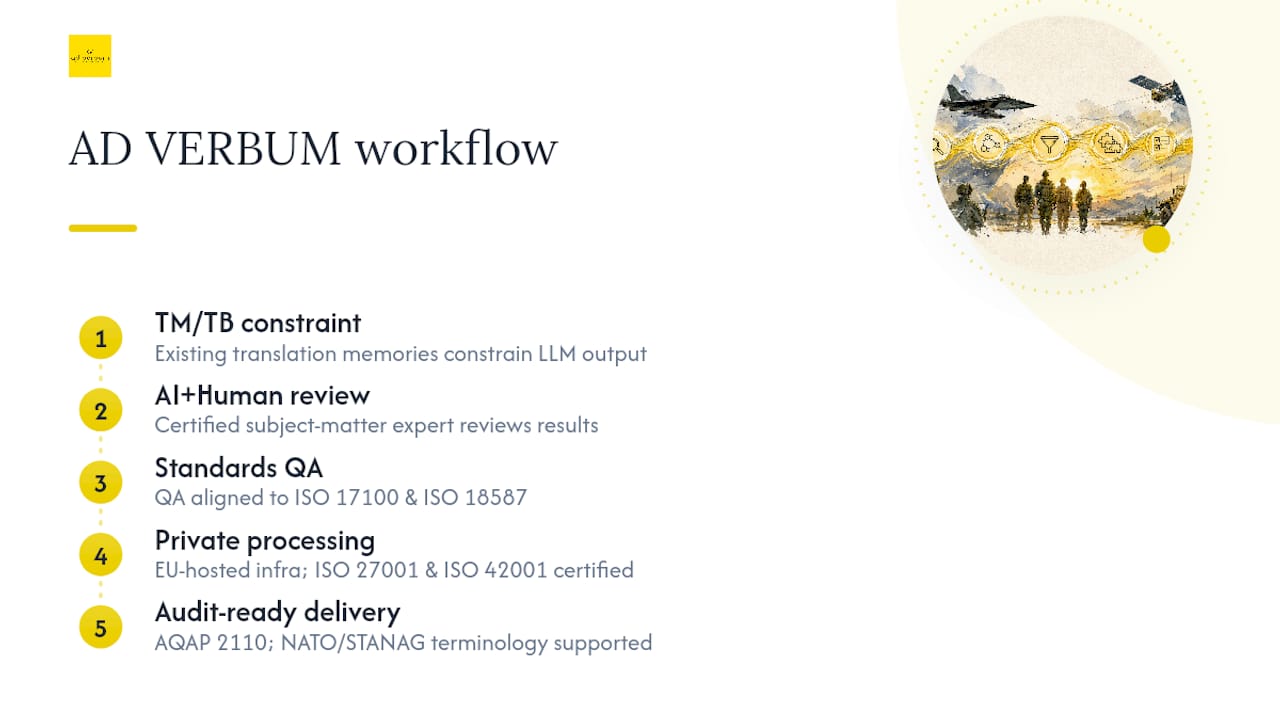
Acronym translation at scale, across a defense contractor’s full document portfolio, needs a workflow that locks decisions once and reuses them consistently. AD VERBUM’s AI+HUMAN hybrid translation process follows a fixed four-stage sequence built for exactly this kind of terminology governance.
Asset integration. Client Translation Memories and Term Bases are ingested first, so prior acronym rulings (JP 1-02 citations, NATO preservation decisions, program-specific expansions) constrain every subsequent translation rather than getting re-litigated document by document.
LLM generation. AD VERBUM’s proprietary LLM-based system produces target-language output governed by that locked terminology, rather than defaulting to a generic or literal expansion the way a public machine translation engine typically would.
Subject-matter expert review. A certified SME checks technical accuracy, regulatory compliance, and domain-specific nuance, catching the polysemy cases a terminology database alone cannot resolve.
Quality assurance. QA aligned to ISO 17100 and ISO 18587 closes the loop, with sector-specific requirements applied where relevant.
Control | What it does | Why it matters for defense translation |
TM/TB integration | Locks acronym decisions and reuses them across projects | Prevents inconsistent expansions of the same term across a document set |
Private EU-hosted infrastructure | Keeps processing off outsourced public cloud tooling | Supports data sovereignty for sensitive and controlled content |
ISO 27001 / ISO 42001 | Certifies information security and AI governance practices | Gives auditors a verifiable security posture, not a vendor claim |
AQAP 2110 | NATO quality assurance standard for defense suppliers | Signals alignment with NATO-recognized quality requirements |
SME review | Certified subject-matter expert checks technical and regulatory accuracy | Resolves domain-specific ambiguity an algorithm alone cannot catch |
The decision to engage a specialist language service provider rather than handle acronym translation in-house usually comes down to three conditions: the content is regulated (defense, export-controlled, or classified-adjacent), an audit trail is a contractual or compliance requirement, and translation memory integration needs to persist across multiple contracts or programs over time. Contractors weighing which providers can handle NATO STANAG and AQAP documentation should treat certification alignment and TM governance as the deciding factors, not turnaround speed alone.
Where to Find Authoritative Glossaries Fast
Speed matters when a deadline is close, but speed without a citation is worthless in an audited deliverable.
JP 1-02 is publicly hosted through military and academic repositories; cite it by full title, edition date, and the specific entry when quoting an expansion.
NATO AAP-15 and the NATO acronym repository cover allied abbreviations; search by exact string first, since near-matches often belong to a different standardization family entirely.
Service-specific glossaries and defense library resources fill gaps for branch-specific or newly coined terms not yet in JP 1-02.
Once a ruling is confirmed, store it in your TM/TB with the source citation attached, so the next translator who encounters the same acronym inherits the decision instead of researching it from scratch.
Treat every glossary lookup as a one-time cost that pays for every future occurrence of that acronym, provided the ruling gets recorded properly the first time.
Common Pitfalls in Defense Acronym Translation
The mistake I see most often is a translator assuming an acronym has one fixed meaning because it did in the last document they worked on. That assumption breaks the moment the domain shifts from tactical to acquisition to personnel policy. The second most common failure is skipping the metadata check entirely and translating from the sentence alone, without asking which command issued the document or under what classification.
Before any deliverable goes out, run this checklist:
Every acronym has a documented source citation, not a guess.
Standardized NATO or joint designations are preserved, not localized.
Controlled documents were sanitized under DoDM 5200.01 before translation, with a verified check for residual metadata.
A subject-matter expert reviewed domain-specific and ambiguous terms.
Every ruling is stored in the TM/TB with reviewer initials and a date.
Accountability for controlled material does not end at delivery. Whoever handled the document, translator, reviewer, or project manager, needs to be traceable in the audit trail, because a defense customer will eventually ask who touched the file and when.
— Eric Brown
Secure, Auditable Acronym Translation With AD VERBUM
Getting an acronym wrong in a defense document is not a stylistic error. It is a compliance and interoperability risk that AD VERBUM’s approach is built to close through terminology governance, not guesswork.
AD VERBUM runs every defense translation project through the AI+HUMAN hybrid workflow described above: your existing TM/TB assets constrain the LLM output, a certified subject-matter expert reviews the result, and QA is aligned to ISO 17100 and ISO 18587. Processing runs on private, EU-hosted infrastructure certified to ISO 27001 and ISO 42001, with no dependence on outsourced public cloud tooling for core processing, a posture built for exactly the data sovereignty and audit requirements defense contractors face. AD VERBUM holds AQAP 2110 certification, NATO’s own quality assurance standard for defense suppliers.
Choose AD VERBUM when the content is regulated, an audit trail is required, translation memory needs to persist across contracts, or the deliverable involves NATO or STANAG terminology that cannot tolerate inconsistent handling. Review the defense translation services or the broader translation and localization offerings to request a quote for your next regulated deliverable.
Sources
The primary DoD terminology source is JP 1-02, the Department of Defense Dictionary of Military and Associated Terms. It standardizes terminology across DoD components for policy, doctrine, strategy, and planning documents, and its appendices list approved abbreviations and acronyms alongside full terms. When a translator needs to justify an expansion in a compliance review, a JP 1-02 citation is the strongest available answer.
Allied and multinational documents answer to a different authority. NATO AAP-15 catalogs thousands of standardized abbreviations and flags which ones are preferred versus accepted variants. STANAGs, the standardization agreements that sit underneath NATO doctrine, often specify that certain abbreviations must appear identically in every member nation’s version of a document, precisely to prevent the kind of drift that breaks interoperability. NATO’s own acronym repository is searchable and worth bookmarking for quick lookups during a live project.
Below JP 1-02 and AAP-15 sit service-specific glossaries: Army, Navy, Air Force, and Marine Corps terminology guides that cover acronyms too narrow or too new for the joint dictionary. Program-specific glossaries published alongside acquisition contracts often define terms that exist nowhere else, because they were coined for that program.
A translator working across these tiers needs a clear precedence rule:
Every citation used to justify a translation decision should be captured with enough detail to survive an audit: the source document, the edition or publication date, and the section or entry number. A ruling that says “per JP 1-02” without a page or entry reference is not verifiable six months later when a compliance reviewer asks how the call was made.
FAQ
How Do You Say “I Love You” in Military Code?
There is no official military code for this phrase. It circulates informally in phonetic-alphabet renderings or personal shorthand between service members and families, but no DoD or NATO glossary defines it, since JP 1-02 and allied dictionaries cover operational and administrative terminology, not personal expressions.
What Is the Abbreviation for Defense?
“DoD” is the standard abbreviation for the Department of Defense in U.S. military and government documents. In NATO contexts, “DEF” or the full national defense ministry designation may appear instead, depending on the NATO glossary entry for a given member nation.
What Are Some Famous Military Acronyms?
Widely recognized examples include NATO, ISR (Intelligence, Surveillance, and Reconnaissance), C2 (Command and Control), and SOF (Special Operations Forces). Each carries a fixed meaning in JP 1-02 or NATO glossaries, and most are preserved rather than translated in allied documents to protect interoperability.
Does AD VERBUM Translate Defense Acronyms?
AD VERBUM handles defense terminology translation through its AI+HUMAN hybrid workflow, integrating client Translation Memories and Term Bases with subject-matter expert review for regulated content. Pricing is quoted per project on the services page, since defense engagements vary by document volume and classification requirements.
Should I Ever Translate a NATO-Standardized Acronym?
Generally no. NATO-standardized abbreviations listed in AAP-15 are preserved across languages specifically to maintain interoperability between allied forces. Translate only when the document’s own style guide requires localization for a non-specialist domestic audience and no operational risk applies.
Recommended

