


Data Security Checklist for Language Services: 2026 Guide

A complete data security checklist for language services covers eight controls in priority order: data inventory and classification, data minimization, encryption (TLS in transit, AES-256 at rest), access controls with MFA, signed NDAs and Data Processing Agreements, defined retention and deletion schedules, an incident response plan with breach notification procedures, and documented audit trails. Apply this checklist to any project handling protected health information (PHI), personally identifiable information (PII), regulated device documentation, legal contracts, or financial records.
Quick actions for the next 24–72 hours:
Pause file transfers to any vendor that cannot produce a signed DPA and proof of ISO 27001 certification.
Require TLS 1.2 or higher for all file transfers effective immediately; reject email attachments for sensitive source files.
Confirm that your vendor’s translation management system (TMS) does not feed client data into public machine translation (MT) engines by default.
Collect signed NDAs and confidentiality agreements from every linguist assigned to the project.
Mandatory compliance references for U.S. projects: HIPAA Security Rule (PHI), NIST Cybersecurity Framework (general controls), ISO 27001 (vendor information security), ISO 17100 and ISO 18587 (translation and post-editing quality and process).
Pro Tip: Request a vendor’s ISO 27001 certificate number and verify its current validity directly with the issuing certification body before signing any statement of work.
Key Takeaways
A complete data security program for language services requires eight controls applied in sequence, with documented evidence for each one collected before project start.
Point | Details |
Inventory and classify first | Document every data type (PHI, PII, IP) and sensitivity tier before assigning linguists or transferring files. |
DPA and NDA are non-negotiable | A signed DPA covering sub-processors and a linguist-level NDA must be in place before any source file is shared. |
Encrypt at both points | Require TLS 1.2+ for all transfers and AES-256 for files at rest; collect written confirmation, not verbal assurance. |
Disable MT training on client data | Confirm in writing that the vendor’s MT or AI system does not use client content for model training. |
Match framework to project type | HIPAA applies when PHI is present; add ISO 13485 and FDA/MDR controls for device documentation; layer GDPR for EU data subjects. |
AD VERBUM for regulated projects | AD VERBUM holds ISO 27001, ISO 17100, ISO 18587, ISO 13485, ISO 42001, and AQAP 2110, with DPA and BAA support available on request. |
Red flags that should stop a project until resolved: no signed DPA, public MT engine active by default, no MFA on TMS accounts, no sub-processor list available, linguist NDAs not on file.
Store all evidence (DPA, ISO certificates, access logs, encryption attestations, NDA records) in a single project security folder accessible to your compliance team and available for audit on demand.
Table of Contents
What does “data security for language services” actually cover?
Which technical controls should you enforce on translation projects?
How should you handle incidents and U.S. compliance touchpoints?
Which regulatory frameworks apply to your U.S. language project?
When does an ISO-certified language service provider make sense?
What project managers should check before every translation assignment
AD VERBUM handles the security documentation so you don’t have to
What does “data security for language services” actually cover?
The phrase covers the full set of technical, contractual, and organizational controls that protect sensitive content from the moment a source file leaves a client’s system to the moment translated deliverables are archived or deleted. It is not limited to IT infrastructure. It includes how linguists handle files, how translation memories (TMs) are stored and shared, how machine translation tools process content, and how sub-processors are governed.
Apply this checklist when a project involves any of the following:
PHI or PII — patient records, clinical trial data, insurance documents, employee records.
Regulated device or drug documentation — instructions for use, labeling, clinical evaluation reports subject to FDA or MDR requirements.
Legal and financial content — contracts, litigation materials, merger documents, audit reports.
Controlled technical data — defense specifications, export-controlled engineering drawings.
Vendor-hosted TMs or AI-assisted workflows — any scenario where client terminology or prior translations are stored on third-party infrastructure or processed by a public NMT engine.
Common sensitivity levels in language projects range from public marketing copy (low risk, minimal controls) to clinical trial protocols with patient identifiers (high risk, HIPAA-grade controls required). The checklist scales accordingly: not every project needs every control, but every regulated project needs the full set.
Step-by-step data security checklist for language services
The FTC’s five practical principles — take stock, scale down, lock it, pitch it, plan ahead — translate directly into an operational sequence for translation projects.
Take stock: know what data you handle
MUST — Inventory every data type in the source files before project kick-off: identify PHI, PII, IP, and regulated content.
MUST — Classify files by sensitivity tier (public, internal, confidential, restricted) and document the classification in the project record.
DO — Map all systems that will touch the data: TMS, CAT tools, cloud storage, email, MT engines, and sub-processor platforms.
Scale down: minimize what you share
MUST — Redact or pseudonymize identifiers in source files before sending to linguists when the translation task does not require them.
DO — Limit TM scope: share only the segments relevant to the current project, not the full TM corpus.
OPTIONAL — Use tokenization for highly sensitive fields (patient IDs, account numbers) that can be re-inserted post-translation.
Lock it: encrypt and control access
MUST — Enforce TLS 1.2+ for all file transfers; require AES-256 encryption for files at rest on vendor systems.
MUST — Implement role-based access control (RBAC): linguists access only their assigned segments; project managers cannot export full TMs without approval.
MUST — Require MFA for all TMS and CAT tool logins.
DO — Set session timeouts on shared workspaces; disable copy/paste and local export where the TMS supports it.
Pitch it: define retention and deletion
MUST — Agree on a retention period in the DPA before project start; document the deletion method (secure overwrite, certificate of destruction).
DO — Schedule TM review cycles: flag and delete segments containing residual PII on a defined cadence.
OPTIONAL — Anonymize TM entries after the contractual retention period rather than deleting them, preserving linguistic value without retaining personal data.
Plan ahead: incident response and audits
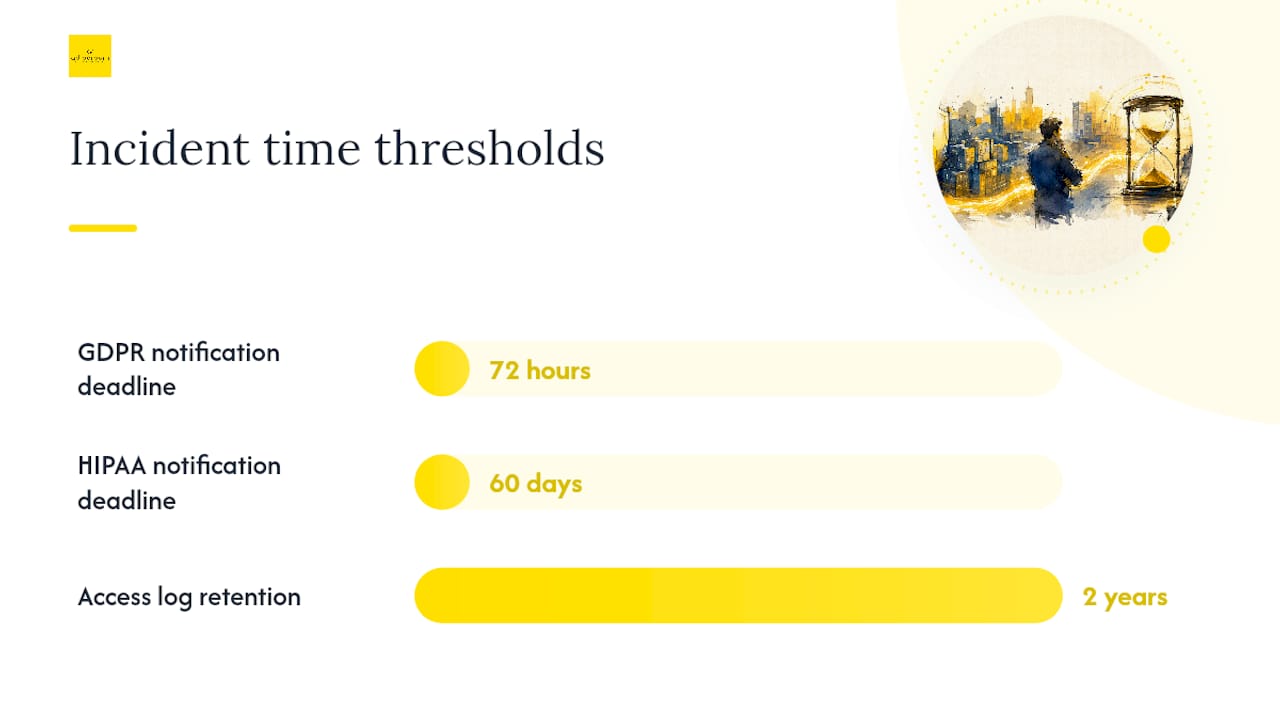
MUST — Confirm the vendor has a written incident response plan that includes breach notification timelines (72 hours to controller under GDPR; HIPAA requires notification to covered entities without unreasonable delay).
MUST — Require audit logs: access logs, file transfer receipts, and TMS activity logs retained for a minimum period agreed in the DPA.
DO — Schedule an annual vendor security review; request updated ISO certificates and a summary of any security incidents in the prior year.
Verification table:
Control | Who signs off | Evidence to collect |
DPA executed | Legal / Procurement | Signed DPA document |
Encryption confirmed | IT / Vendor security | TLS config proof, AES-256 attestation |
Access controls active | Vendor PM | RBAC policy, MFA enrollment records |
Retention schedule set | Legal / DPO | Retention clause in DPA |
Incident plan in place | Vendor security lead | Written IRP with notification timelines |
Audit logs available | Vendor IT | Sample log extract or audit statement |
Which technical controls should you enforce on translation projects?
Encryption
Data security best practices consistently require encryption at two points: in transit and at rest. For language projects, that means TLS 1.2 or 1.3 for every file transfer, portal upload, and API call between client and vendor systems. Files stored in TMS repositories, cloud drives, or backup systems require AES-256 encryption. Key management matters too: encryption keys should be rotated on a defined schedule and never stored alongside the data they protect.
Identity and access controls
Zero-trust principles require identity, credential, and access management (ICAM) across the data lifecycle. In practice for translation workflows:
MFA on every TMS, CAT tool, and project portal login.
Least-privilege access: a medical translator sees only their assigned segments, not the full project file.
Role-based access control separating linguist, reviewer, PM, and admin permissions.
Automatic session timeouts after inactivity (15–30 minutes is a defensible standard).
Centralized access logs that record who accessed what and when.
Secure tooling and workspace isolation
Restrict copy/paste and local file export in TMS configurations where possible. High-risk projects (clinical trials, defense contracts) warrant isolated project workspaces with no cross-project TM sharing. Terminology stores and TMs should be hosted on private infrastructure, not shared SaaS environments with other clients’ data.

AI and MT safeguards
Consumer NMT engines and public MT APIs present a specific risk: many default to using submitted content for model training unless explicitly disabled. Before routing any client content through an MT or AI translation system:
Confirm in writing that training on client data is disabled.
Verify the opt-out or data-processing setting in the vendor’s terms of service.
Minimize data before submission: remove identifiers not needed for translation.
Include an explicit contractual prohibition on data retention by the MT provider.
AD VERBUM’s proprietary LangOps System processes content on private EU-hosted infrastructure with no reliance on public cloud MT APIs, which eliminates the training-data risk by design.
Pro Tip: During vendor onboarding, ask for a screenshot or configuration export showing that MT training is disabled for your workspace. A verbal assurance is not audit evidence.
What contracts and vendor governance do you actually need?
Must-have contract clauses
GDPR Article 28 obligations set the baseline for DPA content even when the primary regulatory framework is HIPAA or a U.S. state privacy law. A compliant DPA for language services should include:
Defined scope of processing (languages, file types, systems used).
Data retention period and deletion method with a deadline.
Sub-processor list with prior written approval required for changes.
Breach notification obligation: vendor notifies client within a defined window (72 hours is the GDPR standard; align HIPAA projects to the covered entity’s BAA timeline).
Audit and inspection rights: client may audit vendor controls on reasonable notice.
Prohibition on processing data for any purpose beyond the translation scope.
NDAs should be signed by every individual linguist, not just at the company level. Background checks for linguists handling restricted content (defense, legal, clinical) are a reasonable additional control.
Vendor vetting checklist
Language vendor GDPR compliance guidance identifies certifications and operational controls as the primary evidence of compliant handling. Request and verify:
ISO 27001 certificate (current, with issuing body and expiry date).
ISO 17100 certification for translation process quality.
ISO 18587 certification if the vendor uses MT post-editing workflows.
Evidence of linguist NDAs and confidentiality agreements.
Hosting location and data residency documentation.
Sub-processor list with DPAs in place for each.
Sub-processors and cross-border transfers
The TEW GDPR Project Report recommends that LSPs document all sub-processors, apply Standard Contractual Clauses (SCCs) for transfers outside the EEA, and maintain records of processing activities. For U.S.-based projects that involve EU data subjects (common in pharma, legal, and financial services), the same SCC requirement applies. Require a documented sub-processor approval workflow: any new sub-processor requires written client consent before data is shared. For cross-border transfer risks involving unvetted translators, the EU technical data risks analysis provides a useful case-level breakdown.
How should you handle incidents and U.S. compliance touchpoints?
When a security event touches a language project, the response sequence maps to the systems involved: TMS access logs, shared drives, email threads, and MT API call records.
Incident response steps:
Contain — Revoke access credentials for the affected account or system immediately; suspend the relevant TMS workspace if compromise is suspected.
Preserve evidence — Capture access logs, file transfer receipts, and TMS activity records before any remediation that could overwrite them. CISA guidance recommends maintaining forensic readiness as a baseline operational posture.
Notify the controller — Under GDPR, the processor (vendor) must notify the controller (client) without undue delay and within 72 hours of becoming aware of a breach. HIPAA requires covered entities and business associates to notify without unreasonable delay and within 60 days of discovery.
Remediate — Patch the vulnerability, rotate credentials, and update access controls before resuming the project.
Document — Record the incident timeline, evidence collected, notifications sent, and remediation steps in a permanent incident log.
Evidence to retain for audits:
Access logs with timestamps (minimum retention: align to the DPA; two years is a common baseline for regulated projects).
File transfer receipts showing encryption status.
DPA and any amendments executed during the project.
Breach notification records with timestamps.
U.S.-specific considerations: HIPAA’s Security Rule applies whenever PHI appears in source or translated content, regardless of the language. A Business Associate Agreement (BAA) is required between the covered entity and the language service provider. For forensic readiness and incident planning, NIST SP 800-61 (Computer Security Incident Handling Guide) provides the standard framework U.S. organizations reference. For data breach legal escalation, consulting a data breach attorney early in the incident timeline can clarify notification obligations and limit liability exposure.
Which regulatory frameworks apply to your U.S. language project?
The framework that governs a project depends on what data it contains and what the output will be used for.
Framework | Trigger for language projects | Key expectations |
HIPAA Security Rule | PHI in source or translated content | BAA required; encryption, access controls, audit logs, breach notification |
NIST CSF / NIST SP guidance | Federal contracts, general U.S. best practice | Identify, Protect, Detect, Respond, Recover functions; ICAM; inventory |
ISO 27001 | Vendor information security baseline | Risk assessment, ISMS, access control, incident management, audit |
ISO 17100 | Translation process quality | Qualified translators, revision process, project management controls |
ISO 18587 | MT post-editing workflows | Post-editor competence, QA process, output review |
GDPR (EU data) | EU data subjects in source content | DPA, SCCs for transfers, retention limits, controller/processor roles |
FDA / MDR | Device labeling, IFU, clinical evaluation | Translation accuracy, traceability, QMS alignment (ISO 13485) |
How to pick your baseline: Start with HIPAA if PHI is present. Add FDA/MDR requirements if the content is device or drug documentation. Use ISO 27001 as the vendor security baseline for any regulated project. Layer GDPR controls when EU data subjects are involved. NIST CSF applies as a general control framework for any U.S. organization regardless of sector.
For a deeper look at how these frameworks interact in regulated industry translation, the data security in regulated industries guide covers sector-specific control stacking in detail.
Two implementation examples and the failure modes to avoid
Example 1: Clinical trial translation
A U.S. pharma company needs informed consent forms translated into 12 languages. The forms contain patient identifiers and protocol details. Controls to apply end-to-end:
Execute a BAA (HIPAA) and a DPA (GDPR, because EU trial sites are involved) before any file transfer.
Pseudonymize patient identifiers before sending source files to linguists; re-insert post-translation under controlled conditions.
Require ISO 27001 and ISO 13485 certifications from the LSP.
Restrict TM scope to this trial only; prohibit TM sharing across other client projects.
Retain translated files and audit logs for the trial’s regulatory retention period (typically 15 years for clinical data).
Assign only medically qualified linguists; collect signed NDAs from each.
Example 2: Legal contract localization with cross-border sub-processors
A U.S. law firm localizes merger agreements into German and Japanese using an LSP that sub-contracts to in-country reviewers. Controls required:
DPA with the LSP must list all sub-processors and require prior written approval for any additions.
SCCs must cover the transfer to the Japanese sub-processor (outside the EEA).
TM entries containing contract-specific terms must be isolated in a client-dedicated TM, not a shared pool.
Audit rights clause allows the firm to request sub-processor DPAs on demand.
For practical guidance on legal workflow controls, the best practices for legal document translation article covers the specific proof points procurement teams should request.
Common failure modes
Failure mode | Risk | Mitigation |
Unvetted freelance sub-contractors | No DPA, no NDA, unknown security posture | Require sub-processor list and DPAs before project start |
Uncontrolled TM growth with residual PII | PII persists beyond retention period | Schedule quarterly TM audits; delete or anonymize flagged segments |
PHI sent via unencrypted email | HIPAA breach exposure | Enforce TLS-secured portals; prohibit email for sensitive source files |
Public MT engine used by default | Client data used for model training | Contractual prohibition; verify opt-out settings in writing |
No MFA on TMS | Credential theft exposes full project corpus | Enforce MFA enrollment before granting any project access |
When does an ISO-certified language service provider make sense?
The vendor-fit threshold is straightforward: if the project triggers HIPAA, FDA/MDR, export controls, or GDPR, you need an LSP that can demonstrate compliance through certifications, not just contractual promises.
AD VERBUM’s proof points against the checklist:
ISO 27001 (information security management, audited by Bureau Veritas) — covers access control, incident management, and ISMS requirements.
ISO 17100 and ISO 18587 — translation process quality and MT post-editing QA.
ISO 13485 — medical device QMS alignment for FDA/MDR projects.
ISO 42001 — AI use and safety governance for the LangOps System.
AQAP 2110 — NATO quality assurance for defense translation.
GDPR and HIPAA alignment — DPA templates available; BAA execution supported for U.S. healthcare clients.
EU-hosted private infrastructure — LangOps System runs on private EU servers with no public cloud MT processing, satisfying data residency requirements for EU data subjects.
3,500+ subject-matter expert linguists — medical professionals, engineers, and legal scholars available for regulated content.
25+ years of industry experience across life sciences, legal, finance, defense, and manufacturing.
The AI+HUMAN hybrid translation workflow follows a fixed sequence: client TMs and Term Bases are ingested first, the proprietary LLM generates output constrained by that terminology, a certified subject-matter expert reviews for accuracy and regulatory compliance, and QA is aligned to ISO 17100 and ISO 18587. That sequence produces an audit trail at each stage.
Suggested starter asks for procurement:
Request the ISO 27001 certificate number and Bureau Veritas audit date.
Ask for a sample DPA and confirm it covers sub-processor controls and breach notification timelines.
Request a sample audit log extract to verify logging is active and structured.
Define a pilot scope (one document type, one language pair) to validate the secure onboarding workflow before full project launch.
For a structured vendor evaluation framework, the guide to choosing a translation provider for legal and compliance content covers the procurement questions in detail.
What project managers should check before every translation assignment
Most security failures in language projects are not technical. They are procedural: a PM approves a TM export without checking who has access to the destination folder, or a linguist is assigned to a clinical project without a current NDA on file. The controls exist; the gap is in the daily workflow.
Before assigning linguists, verify three things: the NDA is current and covers the specific project scope, the linguist’s access is limited to their assigned segments, and MFA is active on their TMS account. None of those checks takes more than five minutes, and any one of them can prevent a reportable incident.
Before approving a TM import or export, confirm the destination system is covered by the DPA and that the TM does not contain residual PII from prior projects. TM hygiene is chronically underestimated as a security control. A TM that has accumulated three years of segments from multiple clients is a liability, not just an asset.
Before accepting a vendor’s security report or audit summary, ask one specific question: when was the last access control review, and what changed? A vendor that cannot answer that question with a date and a documented outcome has not operationalized their ISMS. For operational tips that translate directly into daily PM practice, the secure translation management guide is worth keeping in your project toolkit.
Training is the control that holds everything else together. Linguists who understand why they cannot forward source files to personal email, why MFA is non-negotiable, and what to do if they suspect a breach are more reliable than any technical control applied without explanation. Annual security awareness training, documented and signed off, belongs in every vendor’s evidence package.
AD VERBUM handles the security documentation so you don’t have to
Regulated translation projects require a vendor that arrives with the paperwork already in order. AD VERBUM holds ISO 27001, ISO 17100, ISO 18587, ISO 13485, ISO 42001, and AQAP 2110 certifications, all independently audited by Bureau Veritas. DPA templates, BAA execution for HIPAA-covered projects, and audit log access are available on request before a project starts, not after a compliance review flags a gap.
The LangOps System runs on private EU-hosted infrastructure with no public cloud MT processing, which satisfies data residency requirements for EU data subjects and eliminates the training-data risk that comes with consumer NMT engines. Every project follows the AI+HUMAN hybrid translation workflow with certified subject-matter expert review and QA aligned to ISO 17100 and ISO 18587.
To start a security-focused pilot or request AD VERBUM’s security documentation package, contact the team with your project scope, data classification, and compliance framework. The team will confirm DPA terms, provide ISO certificate details, and define a pilot scope before any data changes hands.
Primary sources and references
FTC: Protecting Personal Information — Five-principle framework (take stock, scale down, lock it, pitch it, plan ahead) that maps directly to language project controls.
CIO.gov: Zero-Trust Data Security Guide (revised May 2025) — ICAM, data inventory, and lifecycle controls; basis for access control and TM classification guidance.
CISA: Security Tip ST04-015 — TLS requirements, network configuration, and human-factor defenses applicable to TMS and remote access.
European Commission: GDPR Overview — Controller/processor obligations, DPA requirements, and cross-border transfer safeguards.
TEW GDPR Project Report (April 2022) — Sector-specific guidance for LSPs: DPAs, SCCs, retention policies, and TM anonymization.
ATC: GDPR and Personal Data in Translation (June 2021) — Readiness checklist for translation providers; controller/processor role definitions and sub-processor verification.
Palo Alto Networks: Data Security Best Practices — Classification, least privilege, encryption, retention, and audit controls applicable to language workflows.
ILT Group: Vendor GDPR Compliance Checklist — Operational controls (encryption, RBAC, DPAs, ISO certifications) as evidence of compliant language vendor handling.
This article is general information, not a substitute for advice from a qualified lawyer. Consult a qualified legal professional about your own circumstances before acting on anything here.
Sources
Recommended
