


Audit Ready CMS Translation Playbook for Medicare Advantage & Part D
- 9 hours ago
- 7 min read

Plans must translate CMS-required materials into any non-English language that meets the 5% service-area threshold, and submit English translations to HPMS whenever a material was created only in a non-English language. This applies to Medicare Advantage organizations and Part D sponsors under the 2024 Final Rule. The immediate action item: run a limited-English-proficiency (LEP) language audit for every Plan Benefit Package (PBP) service area before your next marketing cycle.
TL;DR:
Non-English translation is required for materials in languages spoken by at least 5% of the plan’s service area, based on current ACS data; exemptions include very minimal content items like ID cards.
All member-facing documents, especially high-risk ones like denial notices and evidences, must be accurately translated and submitted with clear metadata and consistent filenames to HPMS; missteps often cause rejections.
Plans should inventory and classify all regulated materials by regulatory criticality, map them to required languages, and assign a dedicated owner to ensure timely, compliant translations.
Using a hybrid AI and human review process that enforces terminology consistency and audit trails helps plans meet CMS regulation and audit demands, especially for high-risk documents.
The biggest compliance pitfalls include concatenated string errors, incorrect threshold calculations, and incomplete or inconsistent HPMS submissions, which can be mitigated with standardized workflows and governance checks.
Table of Contents
What the CMS Final Rule Changed for Translation Requirements
Translation Thresholds, Exemptions, and Material-Specific Rules
How to Implement CMS Translation Compliance: A Step-by-Step Checklist
HPMS Submission Rules: Packaging, Metadata, and Common Pitfalls
Which Documents Actually Trigger CMS Translation Requirements
A Compliant Localization Workflow for Regulated CMS Materials
Get Audit-Ready Translation Support for CMS-Regulated Materials
What the CMS Final Rule Changed for Translation Requirements
The 2024 Medicare Advantage and Part D Final Rule (CMS-4201-F) tightened obligations for MA organizations and Part D sponsors around translated materials and accessible formats. It applies across enrollment materials, plan benefit documents, and member communications rather than a narrow subset of forms.
Key changes compliance teams need to track:
Clarified how the 5% threshold applies per PBP service area, not per plan or per state.
Reinforced accessibility expectations, including alternate formats for people with disabilities.
Tightened packaging and submission expectations for materials filed through HPMS.
The Federal Register notice carries the full regulatory text, and the CMS fact sheet is the fastest way to brief a compliance committee on what actually moved.
Translation Thresholds, Exemptions, and Material-Specific Rules
The core rule lives in 42 CFR §422.2267 and its Part D counterpart, §423.2267. Translation is required into any non-English language spoken by 5% or more of the population in a plan’s PBP service area, based on the most current American Community Survey language tables.
A few carve-outs matter operationally:
ID cards and similarly minimal-content items are generally exempt from full translation, though they typically still need a multi-language insert (MLI) or tagline pointing members to language assistance.
Special Needs Plans (SNPs) and dual-eligible integrated plans face added scrutiny given the LEP concentration common in their enrollee populations.
Members can request alternate formats (large print, audio, Braille) regardless of the language threshold, and plans must have a documented process to fulfill that request within CMS timeframes.
Taglines translated into the top languages for a service area must appear on specified materials even when full-document translation isn’t triggered.
Treat the ACS refresh cycle as a recurring compliance event, not a one-time lookup.
How to Implement CMS Translation Compliance: A Step-by-Step Checklist
Inventory every member-facing material by PBP, from Evidence of Coverage (EOC) documents to appeals notices to onboarding kits.
Classify each item by regulatory criticality. A denial notice carries different risk than a wellness newsletter.
Map materials to required languages using current ACS data for each service area, and log the source dataset and date for audit purposes.
Assign translation tiers. High-risk regulated content gets full human review; low-risk marketing copy may tolerate a lighter QA pass.
Name an HPMS submission owner. One accountable person, not a rotating committee, prevents missed filing windows.
Set SLAs for high-risk materials. Appeals and coverage denials often carry short turnaround windows that translation vendors must meet.
Pilot a hybrid workflow on one high-volume document type before rolling it out plan-wide.
Document everything. Retain audit evidence: source files, translation dates, reviewer names, and version history for CMS oversight.
Pro Tip: Store your LEP threshold calculations alongside the translated materials themselves, not in a separate compliance folder. When CMS or an auditor asks why a language was or wasn’t included, you want the ACS data and the translated document in the same file, not in two systems that need to be reconciled under deadline pressure.
HPMS Submission Rules: Packaging, Metadata, and Common Pitfalls
Per the Medicare Communications and Marketing Guidelines, plans don’t need to resubmit non-English translations of materials already approved in English. But when a material is created only in a non-English language first, the plan must submit an English translation to HPMS alongside it.
Submission packages typically need:
The original non-English file and its English translation, packaged together, not as separate uploads.
Correct SMID (Standard Marketing Identifier) tagging where applicable, since non-standardized materials follow a different review path.
Clear, consistent filenames that match the material identifier used elsewhere in the submission.
The most common rejection triggers: missing metadata fields, mismatched filenames between the English and translated versions, and translated files submitted without enough contextual English source material for CMS reviewers to evaluate accuracy.
Which Documents Actually Trigger CMS Translation Requirements
Not every plan document carries the same translation obligation. Summary of Benefits and Coverage (SBC) documents require a 15-language tagline addendum regardless of the local threshold, alerting members to available language assistance. Evidence of Denial Notices (EDNs) and appeals correspondence almost always fall into the high-risk tier, since a mistranslated denial notice can affect a member’s ability to exercise appeal rights within statutory deadlines.
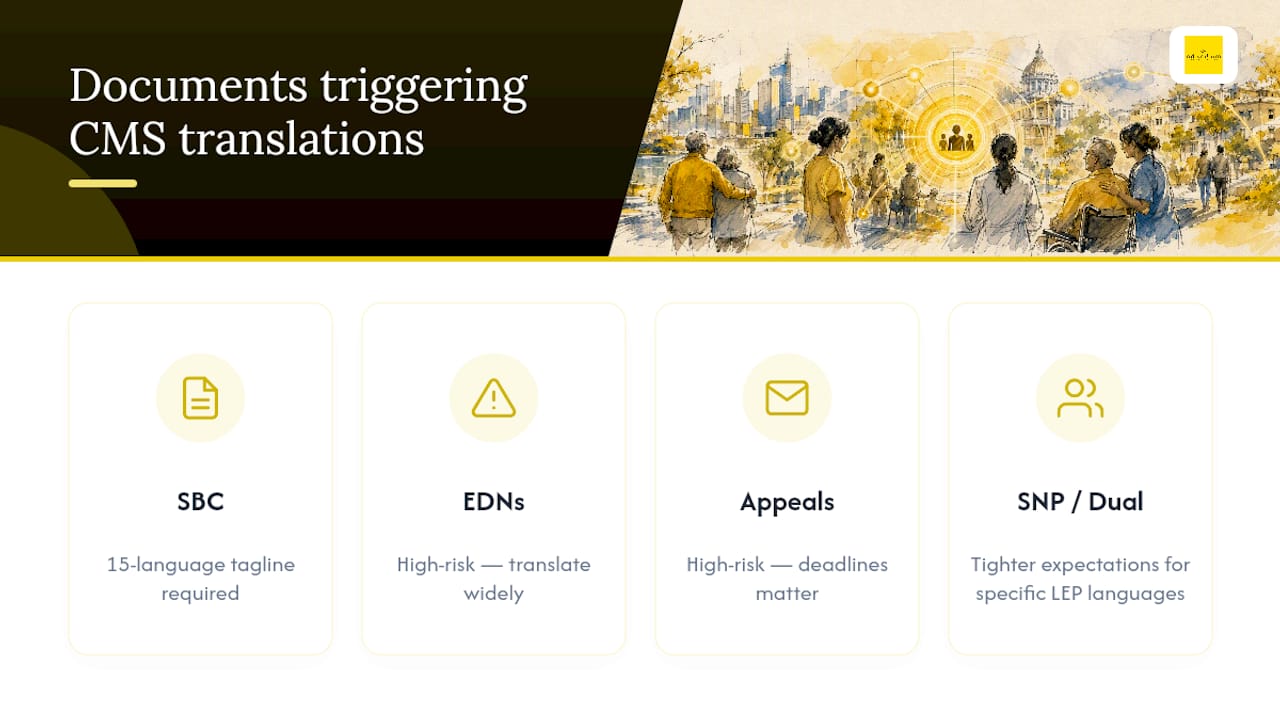
SNPs and dual-eligible plans face tighter expectations here, since their enrollee populations often cluster around specific LEP languages that a general-population ACS threshold might understate.
A Compliant Localization Workflow for Regulated CMS Materials
Compliant translation workflows for CMS materials look nothing like general-purpose machine translation. AD VERBUM’s process for regulated healthcare documentation follows a fixed sequence: asset integration of the plan’s existing Translation Memories ™ and Term Bases (TB), generation through a proprietary LLM-based system constrained by that terminology, review by a certified subject-matter expert linguist, then QA aligned to ISO 17100 and ISO 18587.
Governance controls that matter for CMS audit readiness:
Enforced terminology so “grievance,” “appeal,” and “reconsideration” translate consistently across every document type.
Access controls and audit logs tracking who touched a file and when.
Defined retention schedules matching CMS recordkeeping expectations.
A documented rule for which assets require full SME validation (denial notices, EOCs) versus lighter machine-translation-plus-QA review (internal FAQs, low-risk newsletters).
Pro Tip: Tag content by intent at the CMS level, not after translation begins. A document flagged “regulatory” at creation should route automatically to the highest-assurance workflow, removing the judgment call from whoever happens to be managing the queue that week.
Common Translation Compliance Failures and How to Fix Them
Three failure patterns show up repeatedly in regulated healthcare translation:
Concatenated-string errors. Assembling sentences from code fragments breaks grammar and pluralization in most target languages. Fix: give translators complete, context-rich sentences, never string fragments stitched together downstream.
Incorrect threshold mapping. Teams often apply the wrong geography (county instead of PBP service area) when calculating the 5% figure. Fix: automate LEP reporting from current ACS data and add a governance check before any tagline or translation decision ships.
HPMS submission errors. Missing English translations for non-English-only materials, or inconsistent metadata, cause rejections and rework. Fix: a standardized submission checklist with one centralized regulatory filing owner.
When AD VERBUM Fits Your CMS Translation Program
AD VERBUM’s AI+HUMAN hybrid translation model fits Medicare Advantage and Part D compliance work specifically where the material is regulated, an audit trail is required, and terminology has to stay locked across hundreds of documents and revision cycles.
Decision conditions worth checking before you engage a vendor:
Does the material touch PHI or member health data? AD VERBUM aligns to HIPAA and GDPR and holds ISO 27001 and ISO 42001 certification for information security and AI governance.
Does the workflow need documented SME review, not just a machine pass? AD VERBUM’s network includes 3,500+ subject-matter linguists, including medical professionals.
Does your team need EU-hosted infrastructure with no dependence on public cloud tooling for core processing?
A practical entry point is a pilot on one high-risk material type, such as EOC documents or appeals notices, followed by an SLA covering the full regulated document set once quality and turnaround are proven.
A Compliance Officer’s Honest Take on What Actually Matters
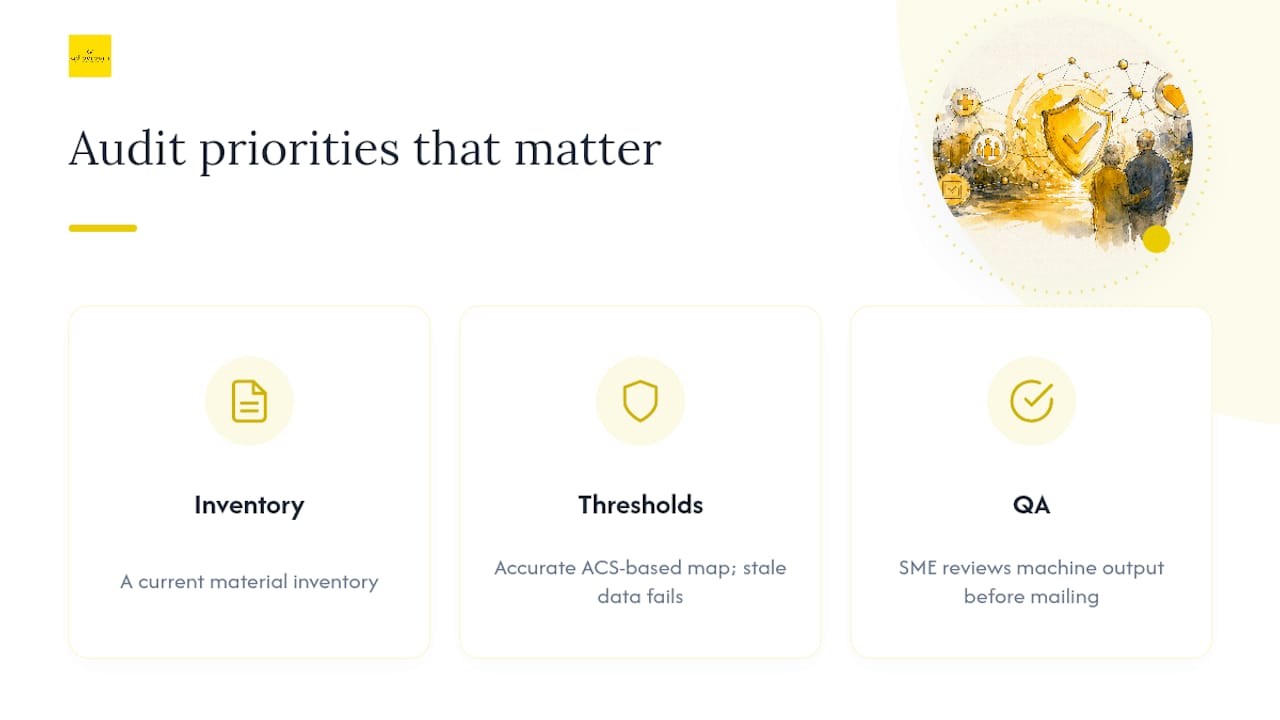
Three priorities separate plans that pass CMS scrutiny from those that scramble during audit season: a current material inventory, an accurate ACS-based threshold map, and a QA process that puts a real subject-matter expert between the machine output and the member’s mailbox. Most compliance failures I’ve seen analyzed in this space trace back to stale threshold data, not bad translation vendors.
Start with a 30-day audit of your highest-risk document type, then pilot a hybrid translation workflow on that single item before scaling. Fix the inventory and threshold map first; the vendor decision gets easier once you know exactly what you’re translating and why.
— Eric Brown
Get Audit-Ready Translation Support for CMS-Regulated Materials
Unlike general translation agencies juggling CMS work alongside unrelated industries, AD VERBUM builds its workflow around regulated documentation specifically, pairing certified medical and legal linguists with a proprietary AI system that enforces terminology instead of guessing at it.
That matters most on the documents where a translation error carries real consequences: appeals notices, EOCs, denial letters. AD VERBUM’s AI+HUMAN hybrid translation process routes every regulated file through subject-matter expert review and QA aligned to ISO 17100 and ISO 18587, with EU-hosted infrastructure and HIPAA-aligned data handling built in rather than bolted on. If your plan is heading into a service-area expansion or an ACS threshold update, a pilot on one high-risk document type is the fastest way to see the workflow in action. Request a quote for your next regulated translation project.
Sources
Recommended

