


Can mistranslated DPAs lead to GDPR Article 83 fines?

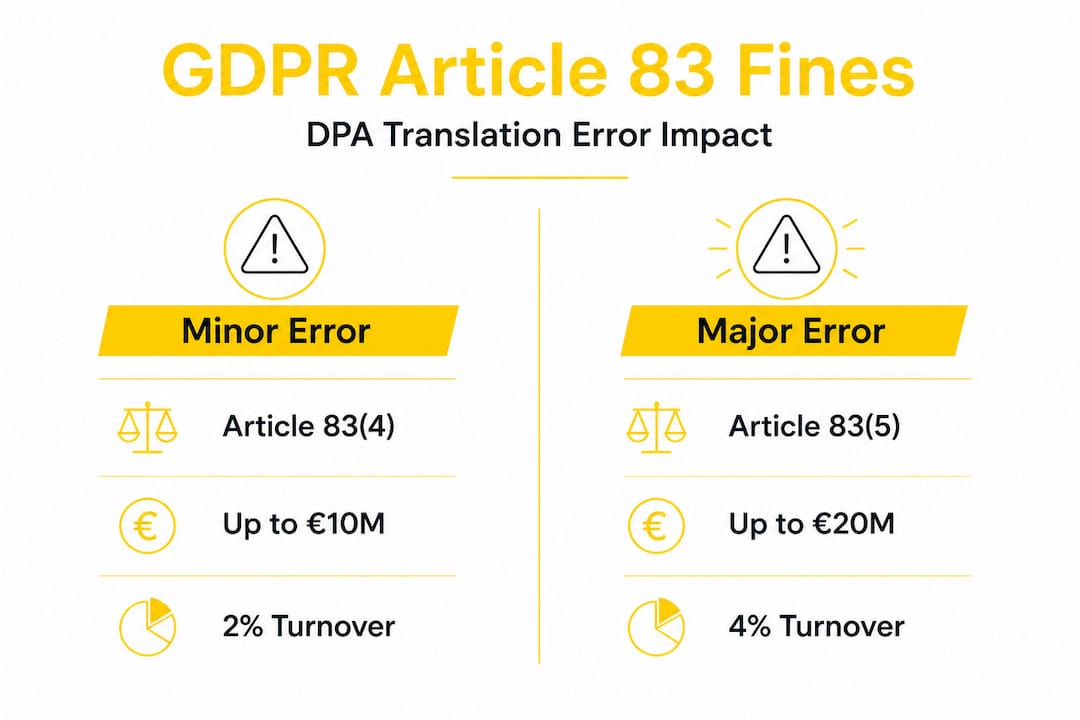
A single mistranslated clause in a Data Processing Agreement is not a clerical oversight. It is a potential enforcement event. Under GDPR, a DPA is a mandatory legal instrument governed by Article 28, and any defect that causes a processor to act outside the controller’s documented instructions can constitute a violation actionable under Article 83(4), carrying fines up to €10 million or 2% of global annual turnover. For DPOs and legal counsel operating across jurisdictions with multiple working languages, the language-of-execution problem is not theoretical. It is already appearing in enforcement decisions across the EU.
Table of Contents
Key Takeaways
Point | Details |
Translation errors are risky | A mistranslation in a DPA can trigger significant GDPR enforcement and fines. |
Both lower and higher tier fines | Simple DPA translation failures may lead to lower Article 83(4) fines, but substantive errors can trigger higher penalties. |
Controller remains liable | Even if the processor misinterprets the DPA, liability stays with the data controller. |
Machine translation isn’t enough | Automated translation raises your enforcement risk and requires expert human review for legal reliability. |
Best practices reduce exposure | Structured review and linguistic diligence significantly reduce the risk of costly fines. |
Why DPA translation matters under GDPR
A Data Processing Agreement is the contractual backbone of every controller-processor relationship under GDPR. Article 28 mandates specific content: the subject matter and duration of processing, the nature and purpose of processing, the type of personal data involved, categories of data subjects, and the controller’s specific instructions. If any of those elements are rendered inaccurately in translation, the processor may operate on a materially different understanding than the controller intended.
This is not a hypothetical concern. Article 28 violations have resulted in enforcement actions across the EU, with German supervisory authorities fining companies €5,000 per missing DPA, and Spain’s AEPD issuing over 40 sanctions in 2024 partly for insufficient DPAs. These enforcement patterns reveal that regulators are no longer treating DPA gaps as administrative technicalities. They are treating them as substantive compliance failures.
The table below summarizes the fine structure and common DPA defects regulators have acted on:
Violation type | GDPR article | Fine tier | Max penalty |
Missing or incomplete DPA | Article 28 | Lower (83(4)) | €10M / 2% turnover |
Processor acting outside instructions | Articles 28, 29 | Lower (83(4)) | €10M / 2% turnover |
Translation error causing unlawful processing | Article 5 / 12 | Upper (83(5)) | €20M / 4% turnover |
Invalid consent from mistranslated notice | Article 7 / 12 | Upper (83(5)) | €20M / 4% turnover |
Regulated sectors face heightened exposure. Life Sciences organizations translating clinical trial processing instructions, legal firms handling cross-border litigation data, and financial institutions operating under national DPA implementations each carry sector-specific terminology risks that standard translation tools are not built to handle. Understanding technical data risks with unvetted translators is foundational to building an effective DPA compliance strategy. Similarly, legal translation data security has become a critical factor in how regulators assess the seriousness of DPA defects.
“Regulators across Germany, Spain, and the Netherlands are no longer waiting for a breach to investigate DPA quality. The document itself is the audit target.”
How mistranslation triggers GDPR Article 83 enforcement
The path from translation error to administrative fine is more direct than most DPOs anticipate. It runs through specific clause categories where semantic drift, the gradual shift in meaning when legal terms are rendered in a second language without domain expertise, produces operational divergence between controller intent and processor behavior.
Consider four clause categories that are particularly enforcement-actionable:
Sub-processor lists. If the approved sub-processor list is mistranslated and a jurisdiction-specific restriction is omitted or generalized, the processor may engage a sub-processor the controller never authorized. This directly breaches Article 28(2) and is auditable.
Breach notification timeframes. Article 33 requires notification to supervisory authorities within 72 hours. A DPA clause specifying a 72-hour window can be mistranslated as a business-day calculation in some languages, creating a material operational gap.
Data categories and processing scope. Mistranslating “special category data” (Article 9) as a generic data type can cause a processor to apply standard rather than elevated safeguards. That creates a direct Article 5(1)(f) exposure.
Liability allocation clauses. Indemnity and limitation language that shifts liability between controller and processor is highly sensitive to precise legal phrasing. Ambiguity created by translation can void the intended allocation entirely.
The distinction between Article 83(4) and 83(5) exposure depends on what the translation error actually caused. Translation errors in GDPR documents including privacy notices and consent forms can violate Article 5 (lawfulness, fairness, transparency) or Article 12 (transparent communication), both of which fall under the upper fine tier. The DPA translation itself triggers the lower tier, but the downstream processing it enables can escalate to the upper tier quickly.
Fine tier | Articles covered | Trigger conditions | Maximum penalty |
Lower (83(4)) | 28, 29, 30, 31, 32, 33 | DPA defect, processor acting outside instructions | €10M / 2% turnover |
Upper (83(5)) | 5, 6, 7, 9 | Core principles, lawful basis, consent failures | €20M / 4% turnover |
Mistranslation causing inaccurate information or invalid consent can escalate to €20M or 4% of global turnover under Article 83(5). That escalation is not automatic, but it is foreseeable, and regulators have shown they will pursue it when processing harm is identified.

Pro Tip: For every DPA executed across more than one working language, require a concurrent legal review in the language of each party’s jurisdiction, not just the governing law language. Translating Standard Contractual Clauses follows the same principle: the operative version must be legally precise in every language where it functions as an instruction. For financial sector DPOs, avoiding PSD2 and PCI DSS translation errors in compliance documentation is equally critical, since those instruments interact directly with DPA obligations. Regulators increasingly treat privacy policy language failures as indicative of systemic translation governance gaps across all compliance documentation.
Critical risk scenarios: When a mistranslated DPA becomes a liability
Abstract enforcement risk becomes very concrete when you examine the scenarios regulators have already investigated. The Netherlands AP, France’s CNIL, Germany’s BfDI, and Spain’s AEPD have all taken positions on DPA quality that go beyond the existence of the document and examine its operative content.
The most significant edge case is processor action outside documented instructions. Under Article 29 enforcement logic, if a mistranslation causes a processor to process data categories not actually authorized by the controller, the processor is acting outside the controller’s instructions. That breaches Article 29 directly. Critically, the controller remains jointly liable under the ECJ’s reasoning in Case C-683/21, even if the error originated in translation rather than intent.
Here is how this plays out across real-world scenarios:
Wrong data category processed. A controller instructs a processor to handle “contact data” only. Mistranslation in the German-language version includes “behavioral data” within scope. The processor collects browsing data. The controller is liable.
Sub-processor in a restricted jurisdiction. The approved sub-processor list is mistranslated in the Italian version, omitting a geographic restriction. The processor engages a sub-processor in a non-adequate third country. This triggers Article 44 exposure on top of the Article 28 failure.
Breach notification window miscommunicated. A Spanish-language DPA translates the notification obligation as 72 business hours rather than 72 calendar hours. The processor delays notification. The supervisory authority investigates both the breach and the DPA defect.
“The controller’s liability for processor actions is not absolved by a translation error. Regulators treat inadequate translation as a failure of due diligence in Article 28 governance.”
The audit implications extend beyond fines. A DPA with translation inconsistencies across language versions creates evidentiary problems during investigation. Supervisory authorities examining cross-border data flows will request the operative DPA in the jurisdiction’s language. If that version diverges materially from the governing law version, the investigation scope expands. Understanding data security in translation and applying jurisdiction-specific translation compliance practices are not optional for multinationals. They are part of demonstrating that the DPA was executed in good faith. For further context on how employee privacy rights intersect with DPA obligations, particularly in HR data processing contexts, the operational implications compound across every jurisdiction the controller operates in.
Avoiding enforcement: Best practices for DPA translation and review
Given that mistranslation can escalate to fines of €20M or 4% of global turnover when it affects core processing principles, a reactive posture is simply not defensible. DPOs and legal counsel need a structured, repeatable process for DPA translation governance.
Here is a practical framework:
Establish translation governance at DPA inception. Do not treat translation as a post-negotiation task. Designate the governing law language version and require simultaneous translation review during drafting, not after.
Require certified legal translators with domain expertise. ISO 17100 certification establishes a minimum standard for translation process quality. For DPAs in regulated sectors, this means translators with actual legal training in GDPR, not generalist language professionals.
Apply back-translation for high-risk clauses. For sub-processor lists, data category definitions, breach notification timeframes, and liability allocation clauses, commission a back-translation into the source language and compare for semantic drift. This is the single most effective quality check for enforcement-sensitive content.
Maintain version control across all operative language versions. Each language version should carry a version identifier, the date of legal sign-off, and the identity of the qualified reviewer. This documentation becomes your audit trail.
Audit existing DPAs in all operational languages. A DPA signed three years ago in English may have been translated informally into German, French, or Polish for operational use. Those translations may not have received legal review. Audit them before regulators do.
Integrate translation review into your DPIA process. Where a Data Protection Impact Assessment identifies high-risk processing, the DPA governing that processing should be reviewed in all operative languages as part of the DPIA output.
Pro Tip: For Life Sciences organizations operating under MDR or HIPAA, apply the same linguistic rigor to your DPA as you would to a clinical trial protocol. The data security checklist for translations provides a structured starting point for building translation governance into your compliance infrastructure. For procurement and legal teams handling vendor agreements across jurisdictions, merchant agreement localization insights offer directly applicable guidance on managing meaning across language boundaries in high-stakes commercial documents.
The hidden cost: Why most DPOs underestimate translation risks
Here is the uncomfortable reality most compliance programs have not yet confronted: translation is being treated as a procurement function when it is actually a compliance function. DPOs who oversee sophisticated data flow mapping, lawful basis assessments, and incident response programs routinely sign off on DPAs that have been translated by a vendor’s internal bilingual staff or a consumer-grade neural machine translation tool. That gap is not invisible to regulators anymore.
The deeper problem is a lag between regulatory practice and corporate compliance culture. Supervisory authorities like the BfDI and the AEPD have developed internal expertise in identifying DPA defects. Their investigators are not just checking whether a DPA exists. They are reading it, in the operative language, and comparing it against the controller’s stated processing purposes. Corporate compliance teams, on the other hand, have often not updated their translation governance frameworks since GDPR came into force in 2018.
The contrarian view worth stating plainly: overreliance on Neural Machine Translation (NMT) tools for GDPR documentation is being quietly exposed in enforcement. NMT tools produce fluent-sounding output. They do not enforce terminology consistency. They do not flag when a negation is dropped or when a legal term of art in one jurisdiction has no clean equivalent in another. The fluency masks the risk, which is exactly why it is more dangerous than the clearly broken output of legacy machine translation.
The call to action for DPOs is structural. Translation review for DPAs should sit within the compliance and CISO function, not procurement. It should be subject to the same documentation and audit standards as any other Article 28 governance activity. The risk of product liability from machine translation errors in technical documentation is well-documented. The same logic applies to DPAs: when the document that governs data processing is itself inaccurately rendered, every processing activity it authorizes carries elevated risk.
How to safeguard your multilingual DPAs and compliance posture
DPA translation is not a translation problem. It is a compliance architecture problem. The organizations that will weather GDPR enforcement scrutiny are those that treat every operative language version of a DPA as equally binding and equally subject to legal review.

AD VERBUM’s ISO 17100 and ISO 18587 certified AI+HUMAN hybrid workflow is specifically designed for this use case. The process begins with ingesting your existing Translation Memories and Term Bases to enforce your organization’s established legal terminology. The proprietary LLM-based LangOps System, hosted on private EU infrastructure with ISO 27001 certification, generates target-language output constrained by your terminology governance. Every output is then reviewed by a certified legal subject-matter expert before ISO 17100 and ISO 18587 aligned QA sign-off. No data touches public cloud infrastructure. The result is a DPA and legal localization process that can withstand supervisory authority scrutiny. If your organization operates in multiple EU jurisdictions and needs to assess your current DPA translation exposure, explore AD VERBUM’s multilingual GDPR solutions and request a compliance translation review.
Frequently asked questions
Can a mistranslated DPA alone trigger a GDPR fine?
Yes. A mistranslated DPA can result in fines under Article 83(4) for insufficient Article 28 compliance, typically at the lower fine tier of up to €10M or 2% of global annual turnover.
Is there precedent for fines specifically due to DPA mistranslation?
While no public cases focus solely on DPA mistranslation, fines for translation failures in GDPR documentation including privacy notices and consent forms are established across multiple EU jurisdictions.
What is the difference between an Article 83(4) and 83(5) fine?
Article 83(4) covers DPA and Article 28 failures with a maximum of €10M or 2% of turnover, while Article 83(5) covers core principle violations including lawfulness and transparency, with a maximum of €20M or 4% of turnover.
Are machine translations sufficient for GDPR-compliant DPAs?
No. Machine translation tools lack the terminology governance and legal domain expertise required to reliably render GDPR documentation. Only expert human review by legally qualified translators ensures the fidelity required for regulatory compliance.
Do all EU countries enforce DPA translation quality?
Yes. Enforcement is consistent across the EU, with Germany, Spain, and the Netherlands among the most active jurisdictions issuing fines for non-compliant or insufficient DPAs, including cases where documentation quality was found to be deficient.
Recommended

